
Winter Tire Temperature Threshold & DuPage County Pre-Freeze Maintenance Guide

October 19th, 2026 by

Why 45°F (7°C) Is the Universal Temperature Threshold for Switching to Winter Tires

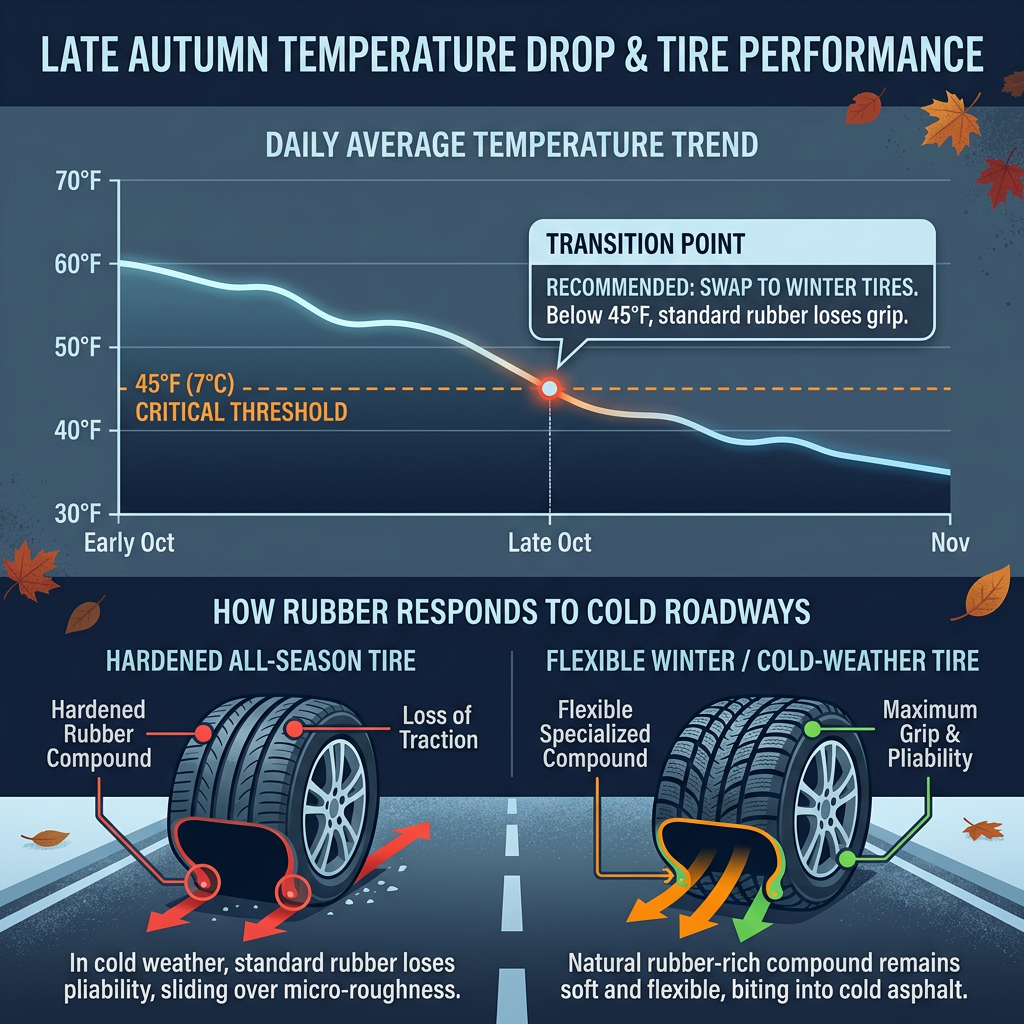
For suburban Chicago drivers navigating the shoulder months between late autumn and early winter, knowing when to change out tires can feel like predicting unpredictable DuPage County weather. However, automotive tire engineers and safety specialists do not rely on calendar dates or the first snowfall to define tire safety—they rely on ambient temperature. The universal threshold recognized across the tire industry is 45°F (7°C). When daily average ambient temperatures consistently hover around or drop below 45°F, it is time to switch from all-season tires to dedicated winter tires.

Many vehicle owners across Carol Stream, Glendale Heights, and Bloomingdale assume winter tires are only necessary once heavy snow accumulates on North Avenue or Army Trail Road. In reality, modern tire performance is dictated primarily by rubber compound chemistry rather than tread depth alone. Standard all-season tires are engineered with flexible synthetic polymer compounds optimized for warm to moderate temperatures. When ambient air cools down to 45°F, those exact compounds begin a molecular hardening process. On dry asphalt at 40°F, an all-season tire has significantly less grip than it did at 70°F, leading to expanded stopping distances, reduced lateral control, and delayed steering response.

At Hawk Ford of Carol Stream, our certified technicians emphasize that winter safety begins long before icy roads arrive. Equipping your vehicle with dedicated cold-weather rubber before local temperatures lock below 45°F ensures maximum road contract, responsive emergency braking, and total driving stability across dry, damp, wet, or frost-covered Chicagoland thoroughfares.
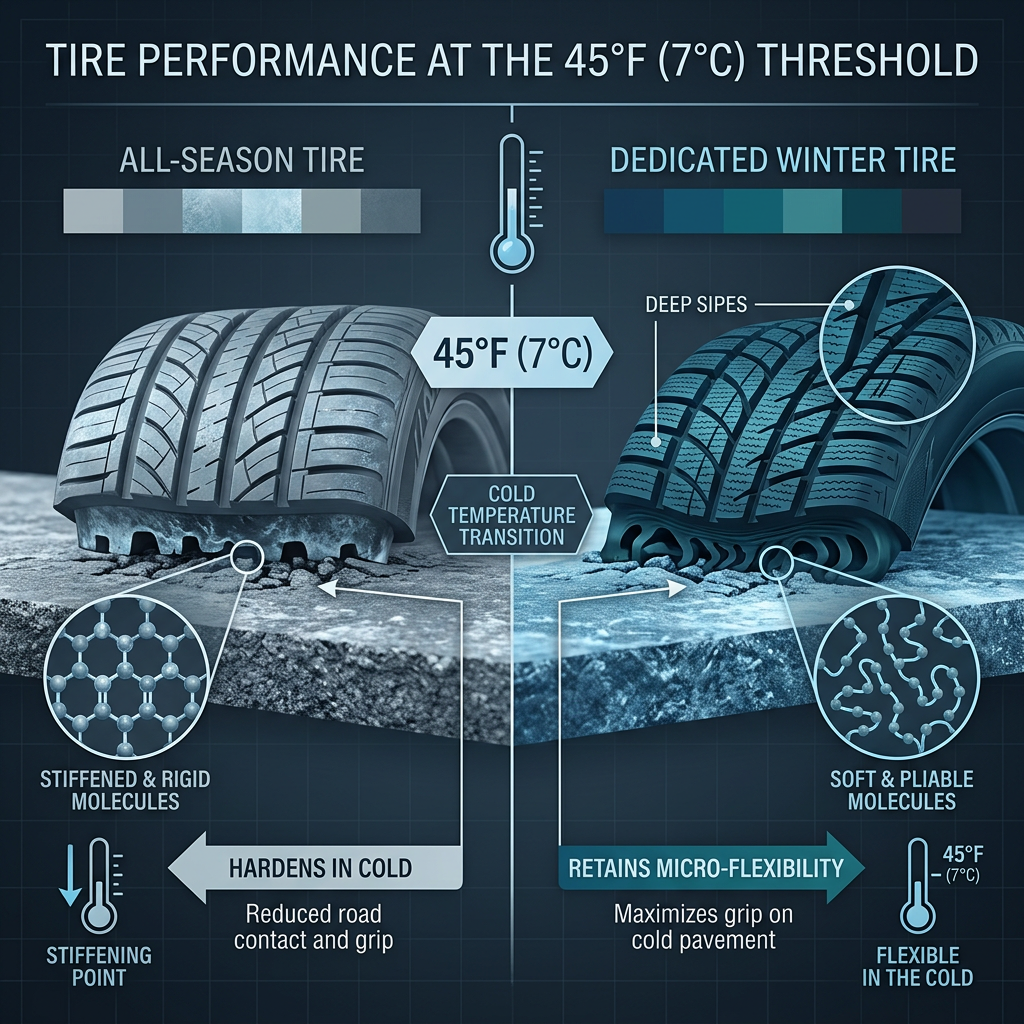
Infographic comparing all-season and dedicated winter tire molecular flexibility and grip at 45 degrees Fahrenheit. (Representative image for illustration purposes only. Actual vehicle may vary based on trim and configuration.)

How All-Season Tread Rubber Hardens and Loses Grip Below 45 Degrees
To understand why low ambient temperatures degrade all-season tire performance, it helps to examine tire chemistry. Tread rubber compounds rely on elastomeric polymers, silica formulations, and natural rubber matrixes. In warm weather, these compounds remain pliable, conforming to small micro-irregularities in the road surface to generate friction and grip.

As temperatures decline toward the freezing mark, all-season compounds reach what materials scientists call their glass transition temperature. Below 45°F, the rubber loses elasticity and becomes increasingly rigid—often described informally in the automotive industry as turning into ‘hockey puck rubber.’ A stiffened tire cannot deform into microscopic road textures. Instead of gripping the pavement, the rigid rubber skips across dry or damp road micro-features, resulting in a dramatic reduction in friction even when no snow or ice is present.

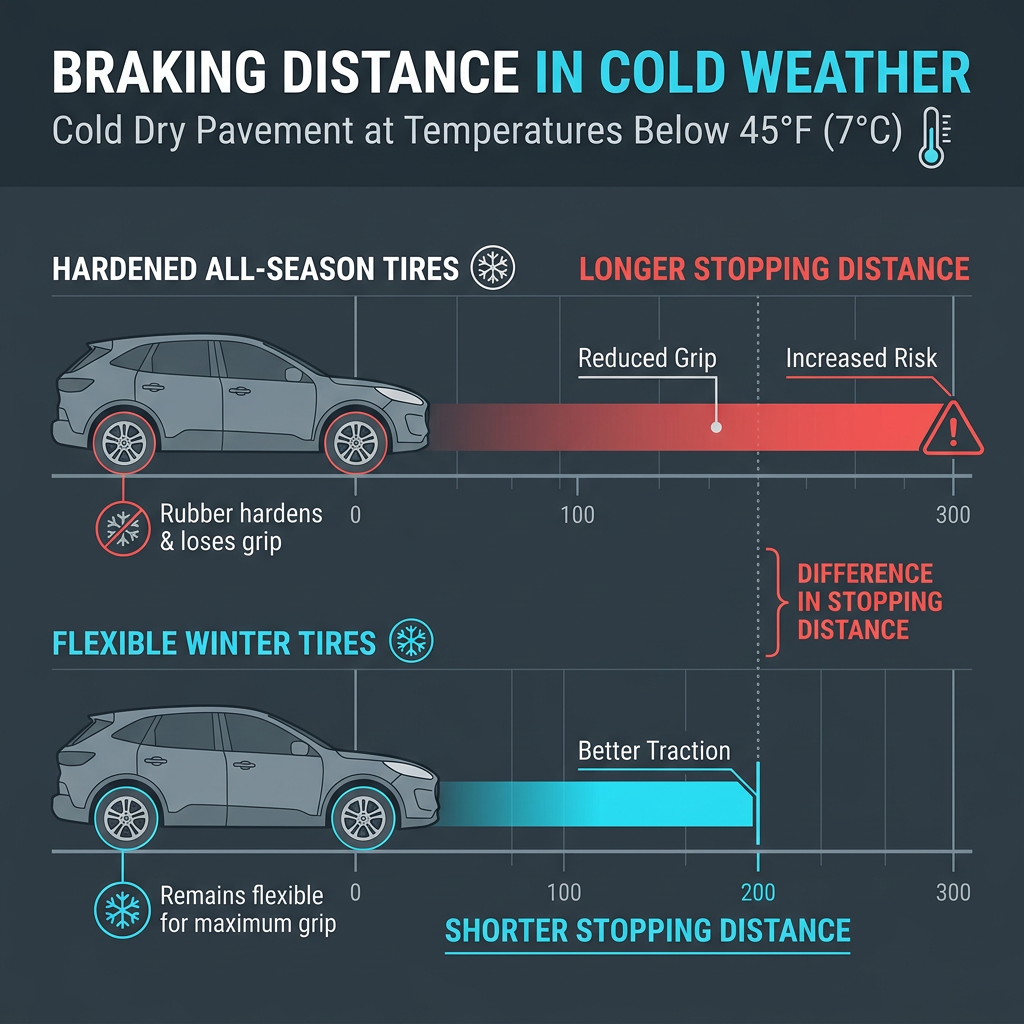
Stopping distance tests reveal that at 35°F on dry asphalt, a vehicle equipped with all-season tires can require up to 20% to 30% more distance to come to a complete stop from 60 MPH compared to the same vehicle fitted with cold-weather winter tires. In emergency stopping situations on Route 64 or County Farm Road, that additional distance represents multiple car lengths.

Infographic comparing braking distances of hardened all-season tires versus flexible winter tires in cold weather. (Representative image for illustration purposes only. Actual vehicle may vary based on trim and configuration.)
Dedicated winter tires, by contrast, utilize specialized high-silica rubber compounds engineered to maintain flexibility in sub-zero climates. Even when Chicagoland wind chills push ambient temperatures well below zero, winter tire rubber remains supple, ensuring optimal footprint contact, predictable cornering stability, and short stopping distances.

Key Differences Between All-Season, All-Weather, and Dedicated Winter Tires

Selecting the right seasonal tire requires understanding the functional distinctions between all-season, all-weather, and dedicated winter tire options. Drivers in northern Illinois encounter a full spectrum of winter conditions, making proper tire selection vital for safety and peace of mind.

All-Season Tires

Designed for mild climates with spring, summer, and fall performance focus. Operates best above 45°F. Tread pattern features smooth circumferential grooves for water evacuation, but minimal high-density siping. Compound hardens in cold weather, severely compromising snow and ice traction.

All-Weather Tires

A hybrid solution featuring rubber compounds flexible down to freezing temperatures. Earns the 3PMSF rating while staying mounted year-round. Ideal for suburban drivers who want strong winter performance without twice-yearly tire changeover routines.

Dedicated Winter Tires

Engineered exclusively for temperatures below 45°F, deep snow, slush, and black ice. Feature extreme siping density, hydrophilic compounds, and deep tread voids. Displays the Three-Peak Mountain Snowflake (3PMSF) symbol certifying rigorous winter testing performance.


Tire Type Feature Standard All-Season All-Weather (3PMSF) Dedicated Winter Tire
Optimal Temp Range Above 45°F (7°C) -10°F to 90°F Below 45°F (7°C)
Rubber Flexibility in Freeze Stiff / Rigid Moderate Flexibility High Flexibility (Soft Matrix)
3PMSF Severe Snow Rating No Yes Yes
Siping Density (Biting Edges) Low to Moderate Moderate to High Maximum High-Density Sipes
Black Ice Grip Rating Fair / Limited Good Exceptional
Year-Round Usage Yes (Warm Climates) Yes No (Swap in Spring)


When to Switch Tires in Carol Stream, Glendale Heights, and Bloomingdale

Analyzing multi-year meteorology data for western DuPage County reveals that average daily high temperatures in Carol Stream and surrounding communities consistently drop below the 45°F benchmark starting between late October and early November. Nighttime temperatures frequently drop into the upper 20s and low 30s as early as mid-October.

Waiting until the first heavy snowstorm causes major service delays across the region. Tire centers quickly become backlogged, and driving on hardened all-season tires during that initial freeze poses unnecessary safety hazards on I-355, Route 59, and local school zones.

The optimal window to schedule your seasonal tire swap at Hawk Ford of Carol Stream is during late October. Switching early ensures your vehicle is safe before frost, freezing rain, or black ice impacts morning commutes across Glendale Heights and Bloomingdale.

Infographic detailing tire performance drops below 45°F and comparing hardened all-season tires to flexible winter tires. (Representative image for illustration purposes only. Actual vehicle may vary based on trim and configuration.)

Preparing Your Ford for First Freeze: DuPage County Fall & Winter Maintenance Checklist

Tire changeover is only one critical part of comprehensive cold-weather vehicle preparation. A sudden drop below freezing taxes automotive electrical, cooling, braking, and wiper systems simultaneously. Use this practical step-by-step checklist to ensure your Ford vehicle is completely prepared for Northern Illinois winter conditions.

1. Electrical & Fluids

• Battery Load Test: Cold weather reduces battery cranking power by up to 50%. Have your 12V battery conductance tested. • Winter Washer Fluid: Flush summer bugs fluid and fill with sub-zero rated fluid (-20°F or lower) to prevent reservoir freezing. • Engine Oil Check: Transition to full synthetic motor oil matching Ford OEM specifications for optimal cold-start lubrication.

2. Tires & Brakes

• Tread Depth Inspection: Ensure at least 6/32″ tread depth for winter tires to effectively clear snow slush. • Cold Pressure Set: Adjust tire pressure in ambient morning cold; set 1-2 PSI above baseline if recommended by technician. • Brake Rotor & Pad Inspection: Check pad thickness and ensure brake calipers are free of surface rust before road salt season.

3. Visibility & Emergency Prep

• Beam Wiper Blades: Replace worn wiper blades with durable rubber-clad winter beam blades to prevent ice build-up. • Defroster Verification: Confirm front windshield and rear glass heating elements function properly. • Roadside Kit Assembly: Pack heavy blankets, jumper cables, flashlight, portable tire inflator, and traction sand.

What Ratio of Antifreeze Coolant Is Recommended for Freezing Winters in Northern Illinois?
Engine coolant (antifreeze) serves a dual purpose: it dissipates intense engine heat during summer driving and prevents liquid freezing inside the engine block, radiator, and heater core during winter freezes. In severe Northern Illinois cold snaps—where winter polar vortex events can push temperatures below -20°F—maintaining the exact coolant concentration is critical.

The Standard 50/50 Mix: Under normal mild winter conditions, a standard 50/50 mixture of concentrated ethylene glycol coolant and distilled water provides protection down to -34°F (-37°C). The Severe Winter 60/40 Mix: For peak Chicagoland winter protection, Ford factory guidelines allow up to a 60% coolant / 40% water mixture. This optimized ratio lowers the freeze point protection down to approximately -62°F (-52°C), offering maximum defense against internal block cracking, pump cavitation, and heater core freeze-up. Caution: Never exceed a 70/30 coolant-to-water ratio. Concentrated antifreeze without adequate water actually freezes at a higher temperature (around 0°F) and reduces thermal transfer efficiency. Visit our Parts Center for OEM Motorcraft pre-diluted anti-freeze formulations specifically mixed for Ford cooling systems.

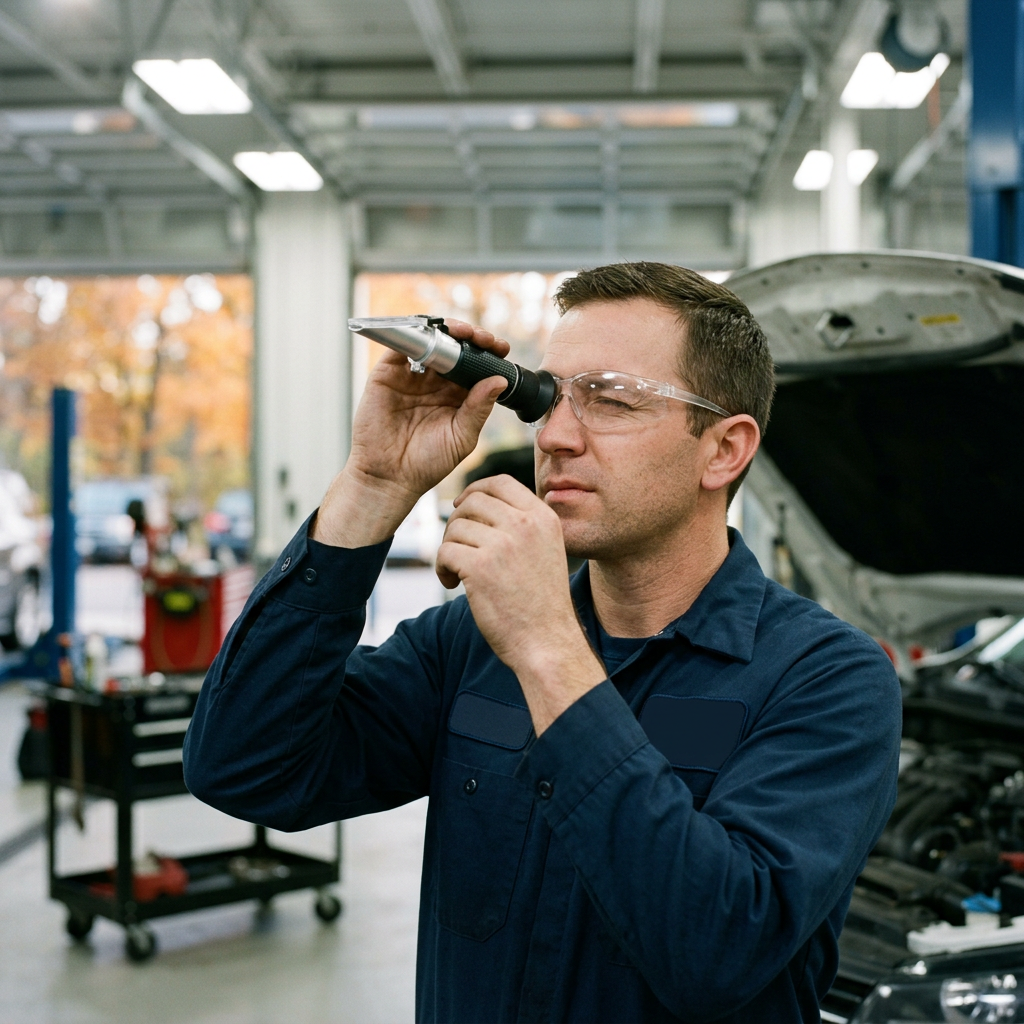
Mechanic looking through a handheld refractometer to check vehicle fluid concentration in an auto shop. (Representative image for illustration purposes only. Actual vehicle may vary based on trim and configuration.)

What Checks Should Be Included in a 2027 Ford’s Pre-Freeze Winter Inspection?

Modern late-model and 2027 Ford vehicles incorporate advanced hybrid architectures, electric powertrains, active driver assistance hardware, and complex digital sensors that require specialized pre-freeze checks beyond traditional mechanical inspections. When servicing cutting-edge Ford vehicles prior to winter at Hawk Ford of Carol Stream, our certified technicians execute multi-point digital diagnostic routines tailored to modern vehicle architecture.

Key diagnostic inspection areas for 2027 Ford models include:

• High-Voltage Thermal Management Circuits: Electric and Plug-In Hybrid Ford models utilize complex liquid thermal loops to warm batteries in sub-freezing weather. Technicians check coolant pump flow, valving, and thermal harness connections. • ADAD Sensor & Radar Heater Elements: Ford Co-Pilot360 systems rely on windshield-mounted cameras and bumper radar modules. Integrated micro-heaters must be tested to ensure they effectively melt frost, ice, and road slush that could blind active safety sensors. • Electronic Brake-by-Wire Moisture Analysis: Modern electronic brake boosters require clean fluid. Moisture contamination lowers brake fluid boiling points and increases freeze susceptibility in small ABS/traction control valves. • Dynamic 12V Auxiliary Power Management: Modern connected Ford vehicles rely heavily on 12V AGM batteries to run telemetry and security when parked. Load testing ensures pre-conditioning functions won’t drain auxiliary voltage.


Inspection Category Traditional Winter Service Advanced 2027 Ford Inspection
Battery & Charging Basic 12V CCA Cranking Test 12V AGM Load + High-Voltage Battery Thermal Loop Scan
Driver Assist Systems Visual Windshield Wiper Check Radar/Camera Sensor Lens Heating Element Verification
Braking System Pad & Rotor Thickness Check Brake-by-Wire Electronic Controller & Moisture Diagnostics
Cabin Comfort System Blower Motor & Heater Operation Heat Pump & FordPass Pre-Conditioning Diagnostic Scan


How Does Ford Intelligent All-Wheel Drive Work During Icy Winter Conditions?
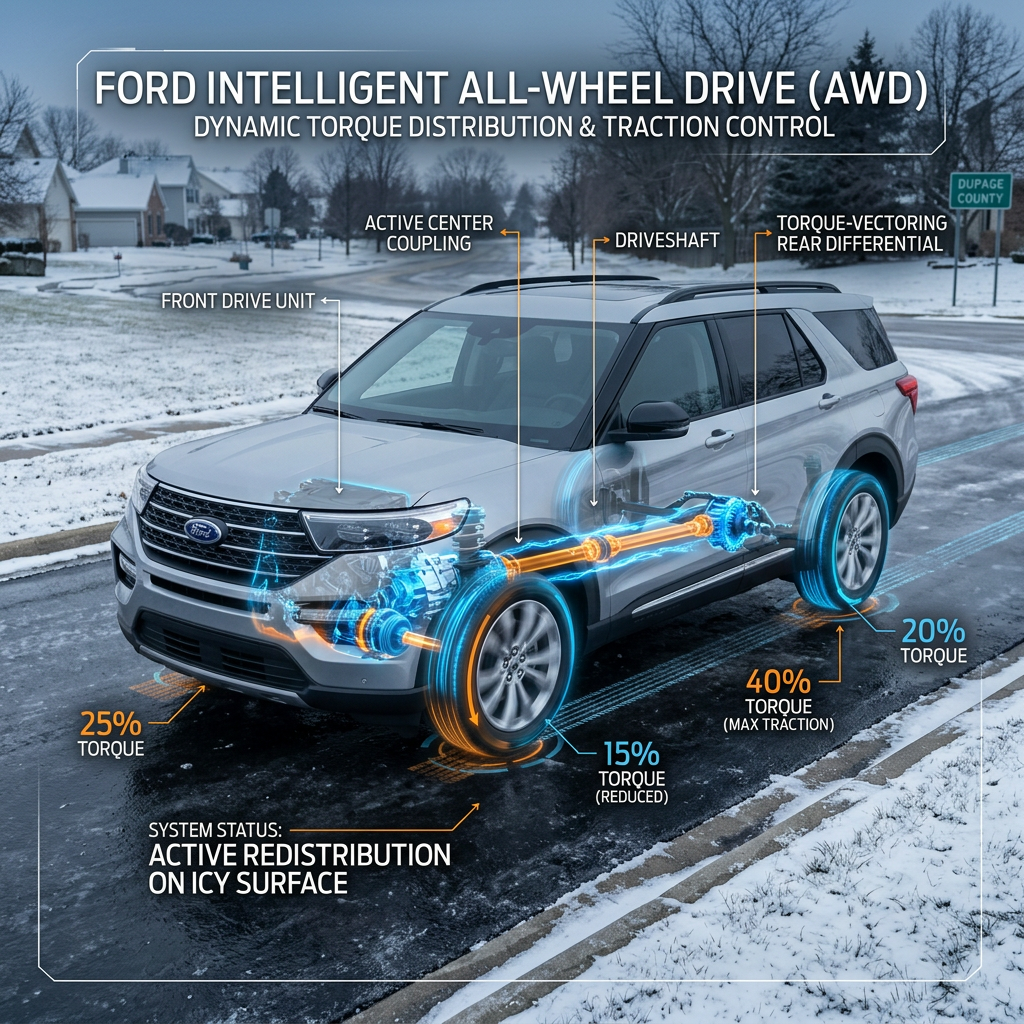
Ford Intelligent All-Wheel Drive (AWD) is an advanced predictive drivetrain system designed to evaluate road conditions hundreds of times per second. Unlike traditional 4WD systems that require manual driver engagement, Ford Intelligent AWD constantly monitors wheel speed, throttle position, steering wheel angle, and ambient temperature sensors to anticipate wheel slip before it happens.

When driving through cold winter conditions in DuPage County, the system continuously distributes torque between the front and rear axles—ranging from 100% front-wheel bias for fuel efficiency on dry highway pavement to a 50/50 torque split when slipping on ice or slush is detected.

Synergy with Winter Tires: A common driver misconception is that All-Wheel Drive replaces the need for winter tires. In reality, AWD only helps accelerate and propel the vehicle forward—it does not assist in stopping or lateral cornering on ice. When Ford Intelligent AWD is paired with flexible cold-weather winter tires, active torque vectoring can effectively transmit engine power to the road surface, ensuring exceptional stability during winter storms. Drivers can also utilize selectable Terrain Management Systems with modes like Slippery or Deep Snow/Sand to recalibrate throttle response, transmission shift points, and traction control parameters for maximum safety on icy suburban streets. Explore our New Vehicle Inventory to test drive Intelligent AWD equipped Ford SUVs and trucks.

Diagram showing Ford's intelligent AWD torque distribution across four wheels on an icy road. (Representative image for illustration purposes only. Actual vehicle may vary based on trim and configuration.)

How Do You Remote Start and Precondition a Ford Vehicle’s Cabin Before Driving in Freezing Temperatures?

Using the FordPass® Smartphone App

1. Open the FordPass App on your mobile device. 2. Press and hold the central Start Vehicle button until the outer ring fills. 3. To schedule automatic departure preconditioning for morning commutes, navigate to Vehicle Settings > Departure Times.
4. Set your desired cabin target temperature (e.g., 72°F). When plugged into a home charger (for EV/PHEV models), grid power warms the cabin without sacrificing battery driving range.

Key Fob Remote Start & Climate Settings

• Press the Lock button once on your Ford key fob, followed by pressing the Remote Start button (2X) twice within 3 seconds. • Configure automatic climate settings via your vehicle’s SYNC® touchscreen under Settings > Vehicle > Remote Start Setup. • Select Auto Mode to allow your Ford to automatically activate max windshield defroster, heated steering wheel, heated seats, and side mirror defrosters based on outdoor ambient temperature.

Managing Cold Weather Inflation Drops and Tire Pressure Sensor Warnings
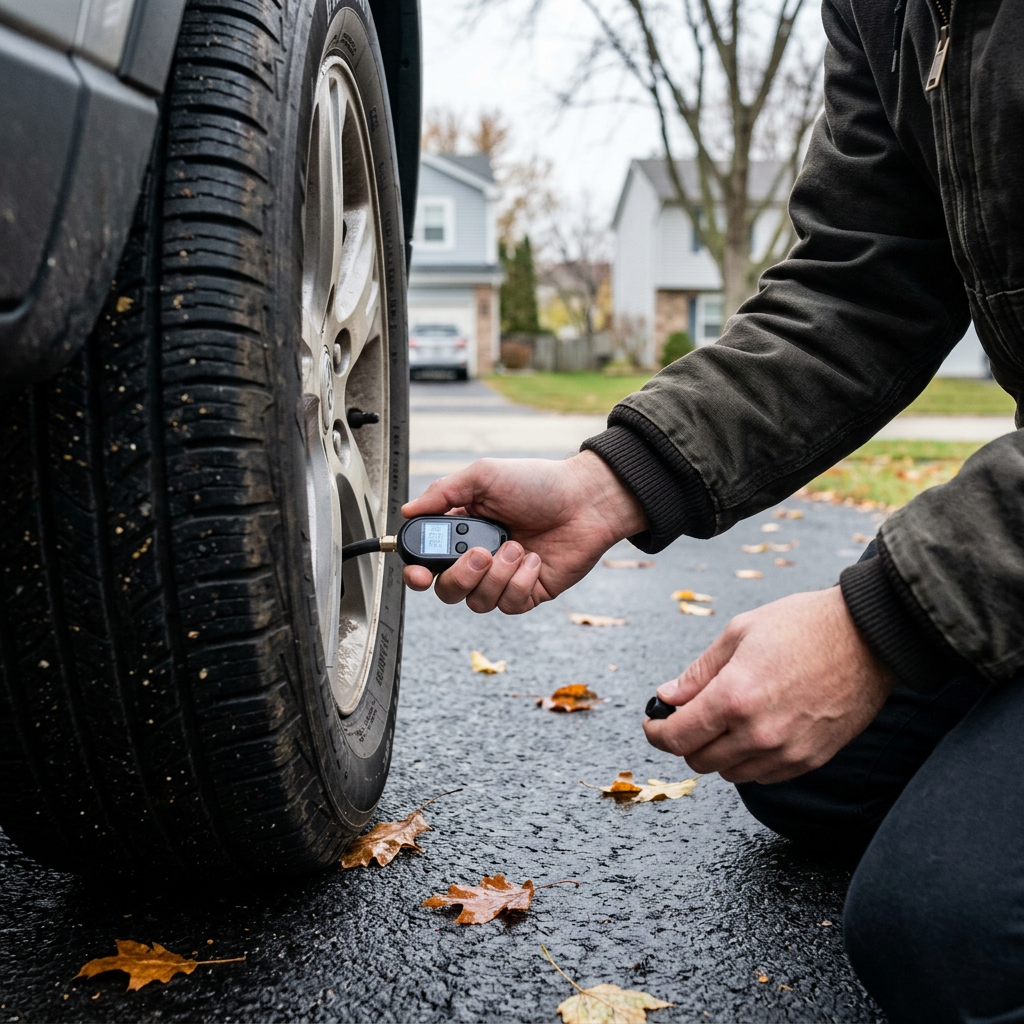
The Physics of Pressure Loss

According to Gay-Lussac’s law of gas dynamics, air contracts when cooled. For every 10°F drop in ambient outdoor temperature, tire pressure decreases by approximately 1 PSI (pound per square inch). A sudden autumn cold drop from 65°F to 25°F results in a 4 PSI loss overnight.

TPMS Morning Warning Lights

Ford Tire Pressure Monitoring System (TPMS) warning lights illuminate when tire pressure drops 25% below the recommended door-jamb placard level. On cold mornings, compressed air triggers false alarms even if no puncture exists. Never ignore a low pressure warning.

Proper Adjustment Protocol

Always check tire pressure when tires are ‘cold’—before driving or after sitting parked for at least three hours. Inflate tires to the precise OEM recommended PSI on the driver’s side door pillar badge, not the maximum PSI stamped on the tire sidewall.
A person kneeling outdoors on a wet driveway to check car tire air pressure with a digital gauge. (Representative image for illustration purposes only. Actual vehicle may vary based on trim and configuration.)

Best Practices for Storing Off-Season Tires Between Seasons

Proper seasonal tire storage is essential for preserving rubber compound integrity, preventing dry rot, and extending tread life across multiple seasons.

1. Thorough Cleaning: Wash off brake dust, road grime, salt residue, and oils with mild soap and water before storage. Allow tires to dry completely. 2. Airtight Plastic Bagging: Place each tire inside an opaque, airtight plastic storage bag or tire tote. Vacuum or press out excess air before sealing. This minimizes oil evaporation from the rubber matrix. 3. Climate-Controlled Environment: Store tires indoors in a cool, dry, dark basement or climate-controlled facility. Avoid outdoor storage under tarps, unheated sheds, or near heat sources like furnaces. 4. Protect from Ozone Sources: Keep stored rubber away from electric motors, generators, welding equipment, or battery chargers, as ozone gas rapidly degrades tire compounds.

Staking vs. Hanging Guidelines:• Mounted Tires (On Wheels/Rims): Best stored inflated to recommended pressure, stacked flat on top of one another, or hung individually from sturdy wall hooks attached through the wheel rim center. • Unmounted Tires (Rubber Only): Store unmounted tires standing upright side-by-side on a heavy-duty tire rack. Never hang unmounted tires by the bead, and avoid stacking unmounted tires in tall vertical piles to prevent tread deformation.

Schedule Your Pre-Freeze Winter Service at Hawk Ford of Carol Stream

Don’t wait until icy roads and sub-zero temperatures arrive in Carol Stream, Glendale Heights, or Bloomingdale. When ambient autumn temperatures drop to 45°F (7°C), visit the factory-certified service center at Hawk Ford of Carol Stream for professional winter tire mounting, balancing, electronic sensor calibration, and comprehensive pre-freeze inspection services.

Our Ford-trained technicians stock a full inventory of top-rated winter and all-weather tires specifically sized for Ford F-150, Explorer, Escape, Edge, Bronco, and Super Duty models. Whether you need winter tire changeover, coolant ratio testing, or battery load testing, our service team ensures your vehicle delivers maximum safety and performance through Northern Illinois winters.

Visit us today at 175 North Ave, Carol Stream, IL 60188. Click below to Get Directions to Hawk Ford of Carol Stream or Call us at (630) 233-9696 to speak with a service advisor. Explore our Used Vehicle Inventory or check your trade value with our Value Your Trade tool before your visit.


}