Navigating winter driving across DuPage County requires predictable vehicle handling and reliable road grip. As temperatures drop along Army Trail Road, North Avenue, and Gary Avenue, suburban Chicago commuters in Carol Stream, Glendale Heights, and Bloomingdale frequently evaluate the exact financial investment involved in changing over seasonal rubber. If you are comparing local service options, understanding the exact cost drivers for seasonal tire changeovers helps you make smarter decisions for your vehicle budget.
| Service Type |
Average Price Range (Set of 4) |
Included Labor & Support Services |
Typical Duration |
| Pre-Mounted Tire Swap |
$30 – $60 |
Wheel unbolting, hub cleanup, re-torque, air pressure adjustment |
20 – 30 Minutes |
| Unmounted Changeover |
$100 – $180 |
Dismounting, bead sealing, mounting, dynamic balancing, new valves |
45 – 75 Minutes |
| TPMS Sensor Recalibration |
$15 – $40 |
Electronic sensor pairing with vehicle computer module |
10 – 15 Minutes |
| Off-Season Tire Storage |
$80 – $150 / season |
Climate-controlled storage, insurance, wash & dry prep |
Seasonal (6 months) |
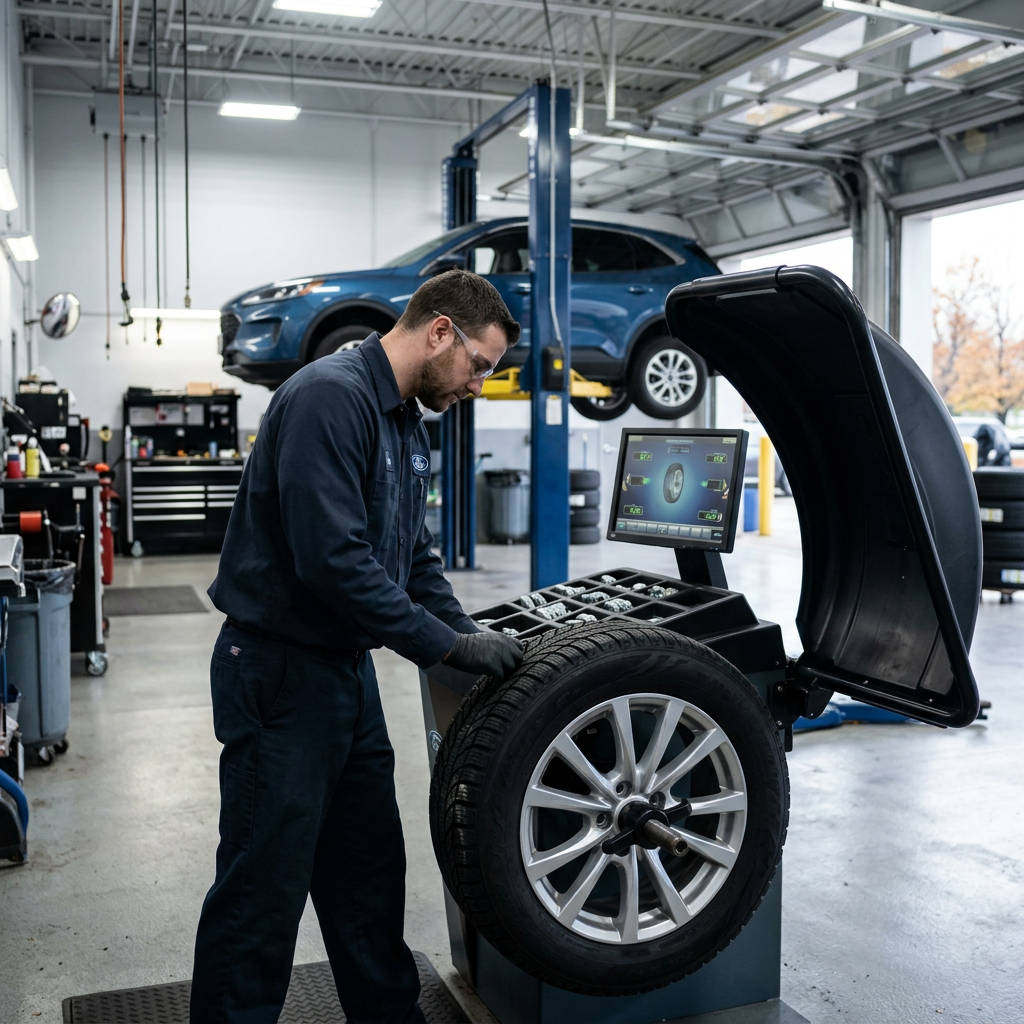
For suburban Chicago motorists, the baseline price of seasonal tire service varies depending on whether your winter tires live on dedicated rims. Pre-mounted setups—where winter tires stay permanently fitted to secondary wheels—require minimal labor, averaging $30 to $60 per set of four. In contrast, unmounted changeovers require dismounting summer or all-season rubber, installing winter tires on your primary rims, and performing full dynamic wheel rebalancing, placing total costs between $100 and $180 per visit. When planning your routine maintenance at
175 North Ave, Carol Stream, IL 60188, accounting for TPMS reset fees and storage needs gives you a clear financial picture.
Mounted Swap vs. Unmounted Changeover: Why Equipment Setup Impacts Your Bill
Understanding the difference between a pre-mounted swap and an unmounted changeover clarifies why labor fees differ so significantly. In a mounted tire swap, two complete sets of wheels and tires exist. The certified technician simply lifts the vehicle, removes the summer or all-season wheel assembly, inspects brake wear and wheel hub surfaces, installs the winter wheel set, and torques lug nuts to exact factory specifications. This procedure requires no heavy tire-changer machinery or recalibration of wheel weights, making it quick and cost-effective.
Conversely, an unmounted tire changeover requires dismounting loose rubber from a single set of wheels. Technicians use specialized tire machines to break tire beads, remove the current tire, replace valve stems, mount cold-weather rubber, inflate tires to specified cold PSI, and spin each assembly on a dynamic computerized balancer to eliminate micro-vibrations at highway speeds. Repeating this labor-intensive process twice a year adds cumulative mechanical wear to tire beads and aluminum alloy rim lips.
Over three to four winter seasons in Northern Illinois, the extra labor costs associated with unmounted changeovers ($200 to $360 annually for spring and fall) quickly match or exceed the upfront price of purchasing dedicated steel or alloy wheels. Furthermore, pre-mounted swaps save you valuable time during peak seasonal rush periods at local service centers.
Is Buying a Dedicated Winter Wheel Package Cost-Effective for a Ford Escape?
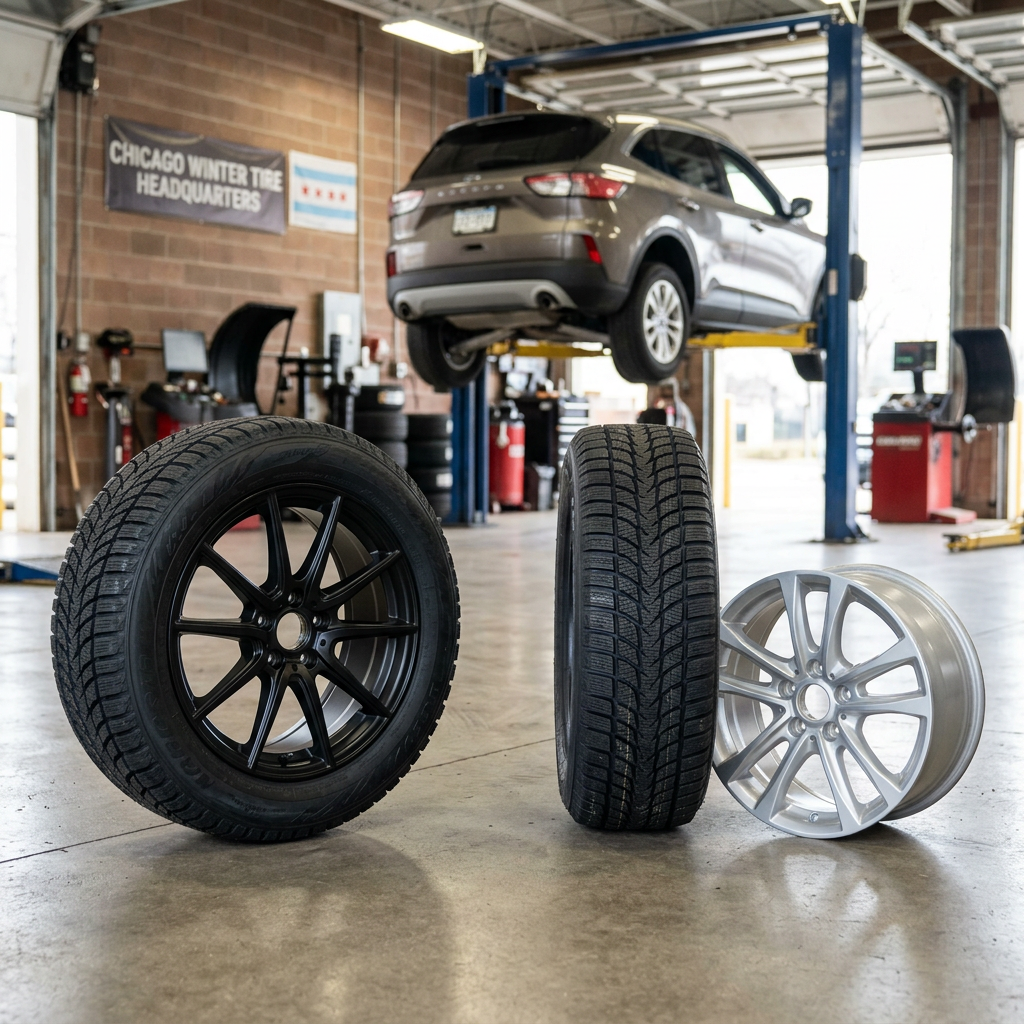
For Ford Escape owners living around Bloomingdale, Carol Stream, and Glendale Heights, investing in a dedicated winter wheel package represents a strategic multi-year financial decision. A complete winter package typically includes four cold-weather dedicated tires, four steel or entry-level aluminum alloy wheels, and a fresh set of Tire Pressure Monitoring System (TPMS) sensors calibrated specifically for your vehicle’s computer module.
While the initial capital outlay for a Ford Escape winter package ranges from $800 to $1,400 depending on wheel diameter and tire compound selection, the long-term savings are substantial. Paying $120 to $160 per changeover twice a year amounts to approximately $240 to $320 annually in mounting and balancing fees. By contrast, swapping pre-mounted wheels costs about $40 per session, saving up to $240 per year in purely redundant labor charges.
Beyond direct labor savings, dedicated winter wheels protect your Escape’s factory alloy wheels from harsh road salt, calcium chloride, and hidden potholes common along Suburban Chicago routes during thawing cycles. Preserving your primary wheels prevents costly finish oxidation, cosmetic curb rash repair, and wheel seal degradation.
By extending overall tread lifespan across both seasonal sets, a dedicated wheel package breaks even within 3 to 4 seasons while offering maximum convenience and vehicle resale value protection. You can explore OEM wheel options directly through our dedicated
Parts Center team.
At What Temperature Do Standard All-Season Tires Lose Flexibility Compared to Winter Tires?
The 45°F Rubber Threshold
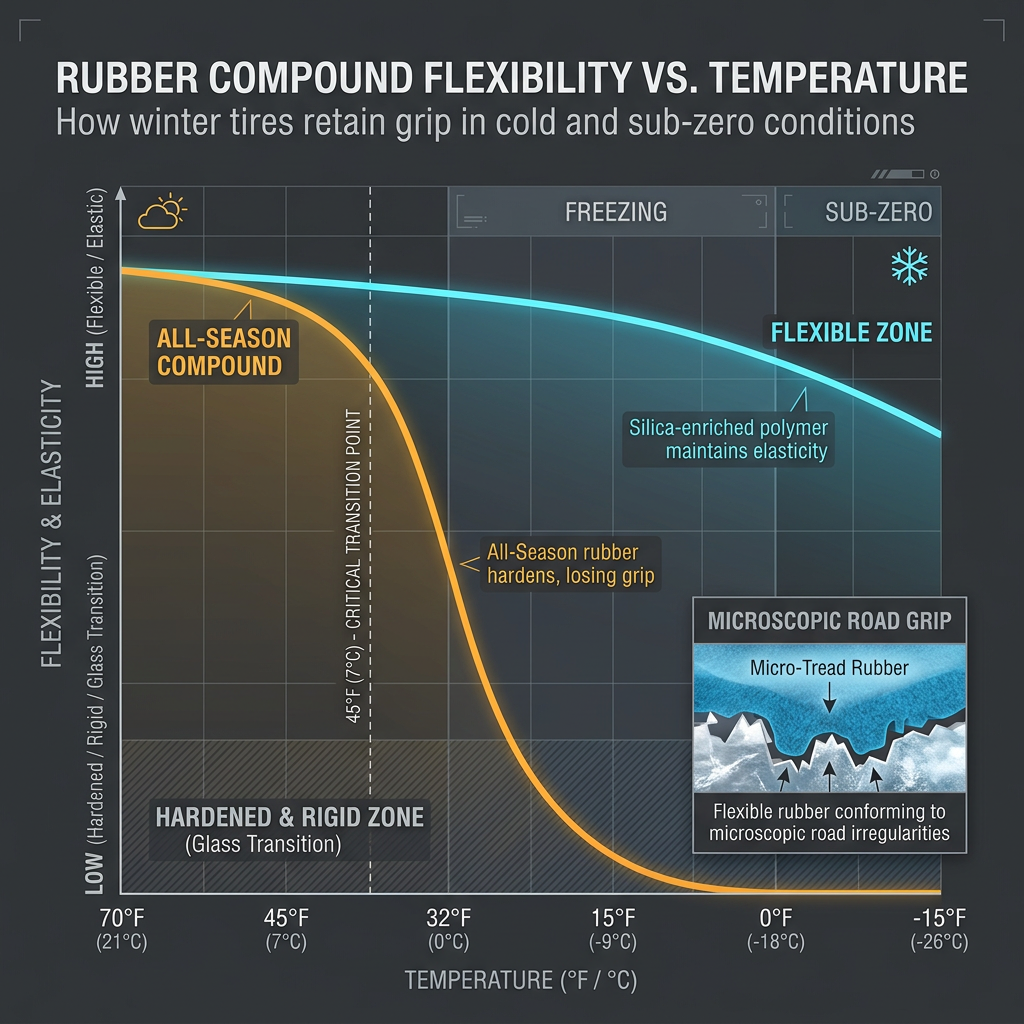
Standard all-season tires rely on rubber compounds optimized for warm to moderate temperatures. When ambient outdoor air drops below 45°F (7°C), these compounds experience thermal hardening—a chemical state often referred to as ‘glass transition.’ As rubber stiffens, the tire loses its elasticity, preventing tread blocks from conforming to fine road surface textures and dramatically reducing mechanical traction even on completely dry asphalt.
Silica-Enriched Winter Compounds
Dedicated winter tires utilize specialized hydrophilic silica polymers and flexible synthetic oils engineered specifically to maintain pliable elasticity far below zero degrees Fahrenheit. By remaining soft and pliable in sub-freezing weather, winter tire treads conform closely to micro-irregularities on frozen pavement, creating superior friction and grip when stopping or steering during cold Chicagoland winter mornings.
3D Siping & Snow Packing
Beyond rubber chemistry, winter tires incorporate thousands of high-density 3D zig-zag sipes across their tread blocks. These tiny biting edges flex open to trap packed snow within the tread grooves. Because snow sticks to snow far more effectively than rubber sticks to ice, this snow-on-snow interaction produces impressive traction during heavy snowfalls across DuPage County.
AWD vs. Winter Tires: Preparing Your Ford Escape for Northern Illinois Snowstorms
A common debate among suburban Chicago motorists revolves around whether All-Wheel Drive (AWD) replaces the need for winter tires during severe winter storms. While AWD is an exceptional drivetrain feature engineered to distribute engine torque to all four wheels, it primarily aids in acceleration and momentum from a dead stop or through deep slush drifts.
When driving along major corridors like Route 64 or Schmale Road during a heavy winter storm, all four wheels are responsible for braking and cornering regardless of your vehicle’s drivetrain setup. An All-Wheel Drive Ford Escape equipped with hard, cold-stiffened all-season tires will still slide when emergency braking or negotiating slick intersections, because AWD cannot create traction where tire compound flexibility does not exist.
Winter tires act as the foundational contact patch that enables mechanical braking systems, Anti-lock Braking Systems (ABS), and Electronic Stability Control to perform as designed. When soft, siped winter rubber engages icy roads, traction limits increase dramatically across all driving vectors.
The ultimate winter safety setup combines intelligent AWD propulsion with dedicated winter tire traction. This synergy provides confidence when pulling out onto high-speed suburban thoroughfares and ensures predictable, controlled emergency stops when conditions deteriorate unexpectedly.
Why Are Dedicated Winter Tires Recommended Even If Your Ford Escape Has AWD?
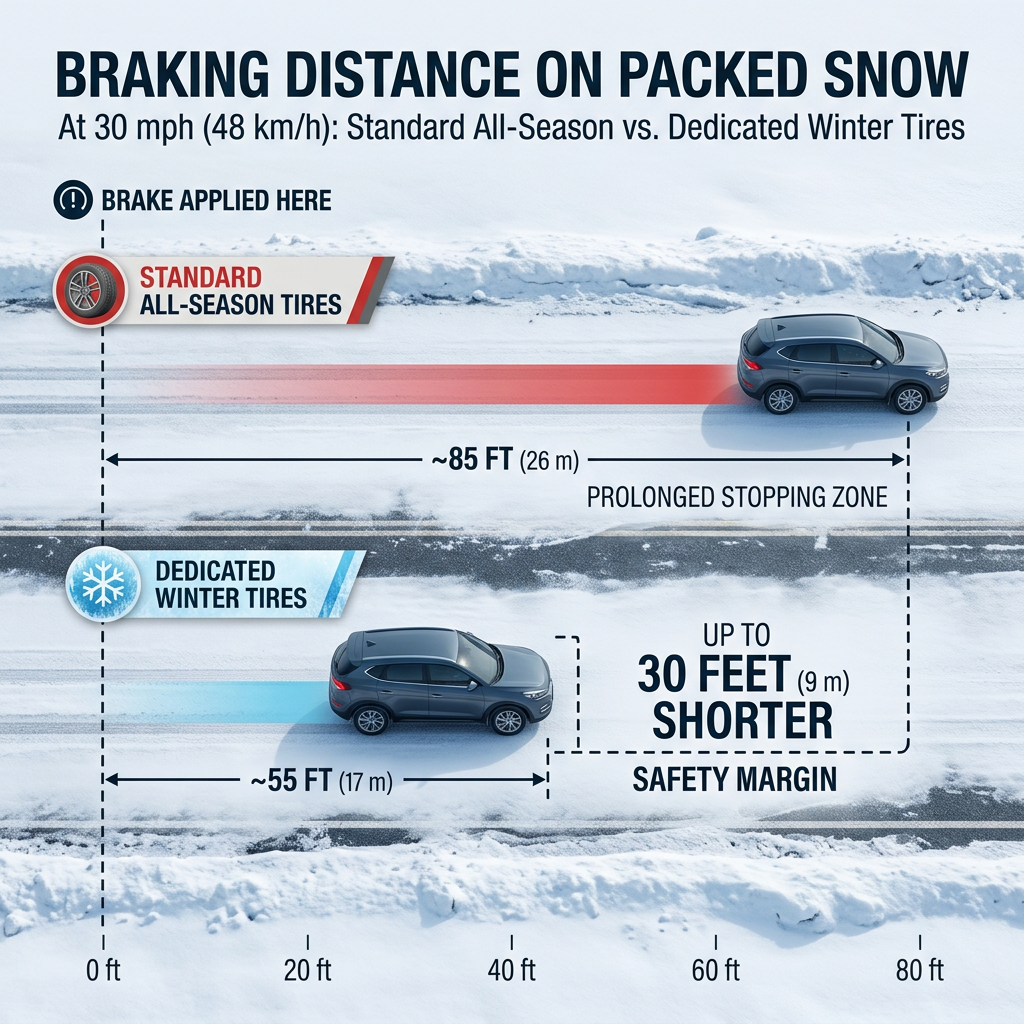
Independent automotive safety testing confirms that dedicated winter tires significantly outpace all-season tires in braking efficiency and lateral grip on ice and snow. On packed snow at 30 mph, a vehicle fitted with dedicated winter tires stops up to 30 feet shorter than an identical vehicle on all-season tires—a distance equivalent to roughly two full vehicle lengths.
On glare ice, that stopping margin expands further. Because every passenger vehicle features four-wheel braking regardless of whether it is Front-Wheel Drive or All-Wheel Drive, AWD offers zero braking advantage when stopping on icy roads. Winter tires provide the grip necessary for your vehicle’s safety features to execute quick, controlled stops.
Furthermore, lateral stability during sudden lane changes or evasive maneuvers relies heavily on tread bite. Winter tires resist lateral side-slip, enabling your Ford Escape to steer smoothly through slick turns along suburban neighborhood streets. You can browse winter-capable vehicles in our
New Vehicle Inventory to see current model setups.
How Does Ford Escape Intelligent All-Wheel Drive Perform in Heavy Snow?
Millisecond Sensor Monitoring
Ford Intelligent AWD uses an array of advanced vehicle sensors that continuously measure wheel speed, throttle position, steering wheel angle, and yaw rate every 16 milliseconds. By assessing driving telemetry dozens of times per second, the system detects micro-slippage before the driver feels loss of traction.
Predictive Torque Disconnect
Unlike older 4WD systems requiring manual lever engagement, Ford’s AWD system automatically disconnects rear axle drive during smooth highway cruising to optimize fuel economy. When slip is detected or aggressive acceleration is requested, an electronically controlled clutch seamlessly re-engages torque to the rear wheels in a fraction of a second.
Dynamic Torque Vectoring
When navigating deep snowdrifts or slushy ruts around Bloomingdale and Carol Stream, Intelligent AWD dynamically balances power front-to-back. Combining torque vectoring with winter tire tread traction enables your Escape to climb out of un-plowed parking spots and navigate snow-banked intersections with complete confidence.
Does the Ford Escape Offer Selectable Drive Modes for Winter Driving?
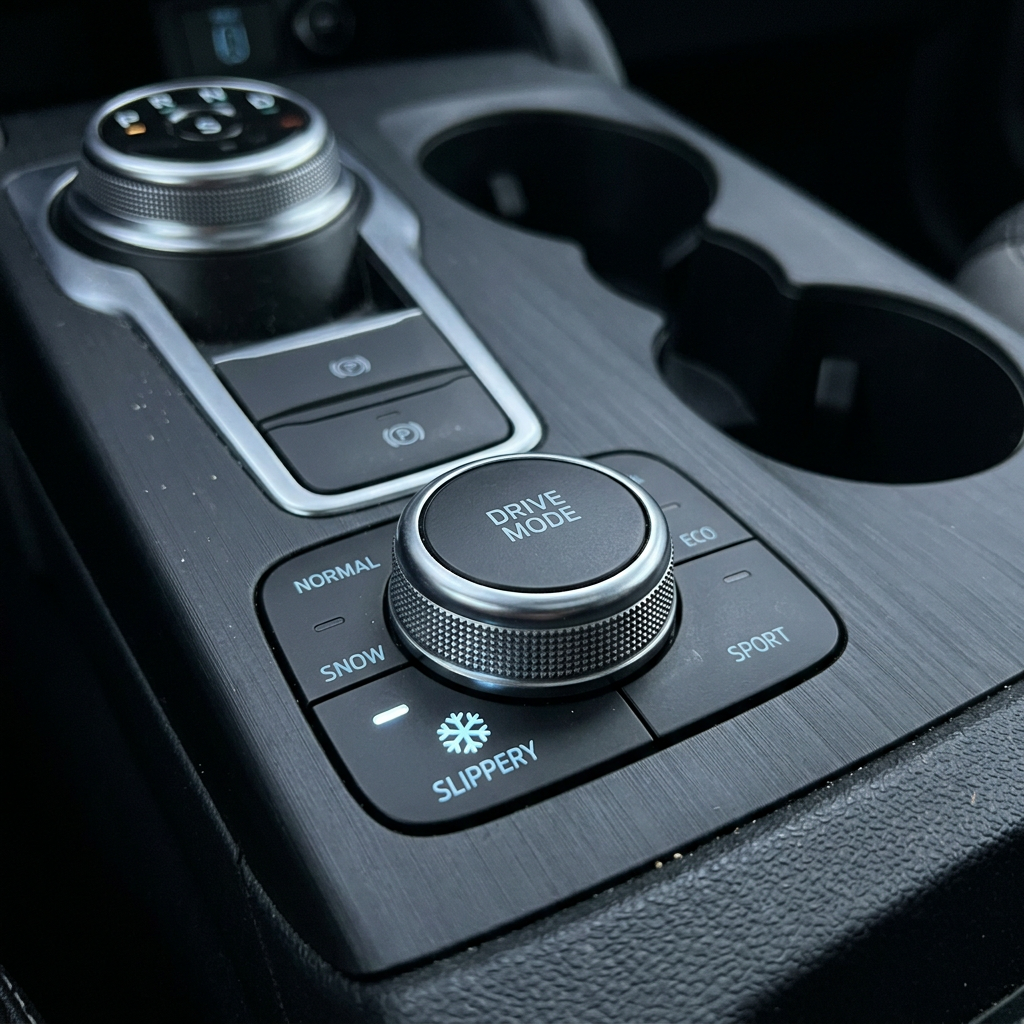
Yes, late-model Ford Escape SUVs feature an intuitive Selectable Drive Mode system located directly on the center console dial. When winter weather arrives in DuPage County, drivers can toggle between ‘Slippery’ mode and ‘Deep Snow/Sand’ mode to optimize traction response for current road conditions.
In ‘Slippery’ mode, the vehicle automatically softens throttle response, recalibrates shift points to maintain higher gears, and increases traction control sensitivity. This prevents sudden wheel spin when accelerating on ice-covered roads or packed snow along Geneva Road.
For un-plowed neighborhood streets or thick slush accumulated near curb drops, ‘Deep Snow/Sand’ mode allows controlled wheel spin to help dig out momentum while keeping AWD clutches engaged. Pair these modes with winter tires to experience optimum cold-weather driving stability.
Hidden Factors That Affect Your Seasonal Tire Change Service Invoice
TPMS Calibration & Valves
Modern Ford vehicles monitor tire pressure via electronic TPMS sensors. When changing wheels or dismounting tires, sensors must be re-paired to their relative positions on the car. Replacing corroded valve stems or service kits adds $5 to $15 per wheel but prevents slow air leaks during cold snaps.
Hub Corrosion Cleanup
Northern Illinois road salt causes galvanic corrosion between aluminum alloy wheels and steel brake hubs, making wheels difficult to detach. Cleaning hub faces with wire brushes and applying anti-seize lubricant ensures proper wheel seating, smooth running, and torque accuracy during installation.
Dynamic Wheel Balancing
Precision dynamic balancing places small weights along the rim inner barrel to eliminate high-speed vibration. While basic swaps may omit rebalancing, doing so without checking weights leads to uneven tread wear, steering wheel shake, and premature suspension component fatigue.
If you are considering upgrading your vehicle for winter or evaluating long-term vehicle ownership costs, you can also
Value Your Trade online in just a few clicks.
Seasonal Tire Maintenance Schedule for Carol Stream, Bloomingdale, and Glendale Heights Drivers
Fall Transition (Late October – November)
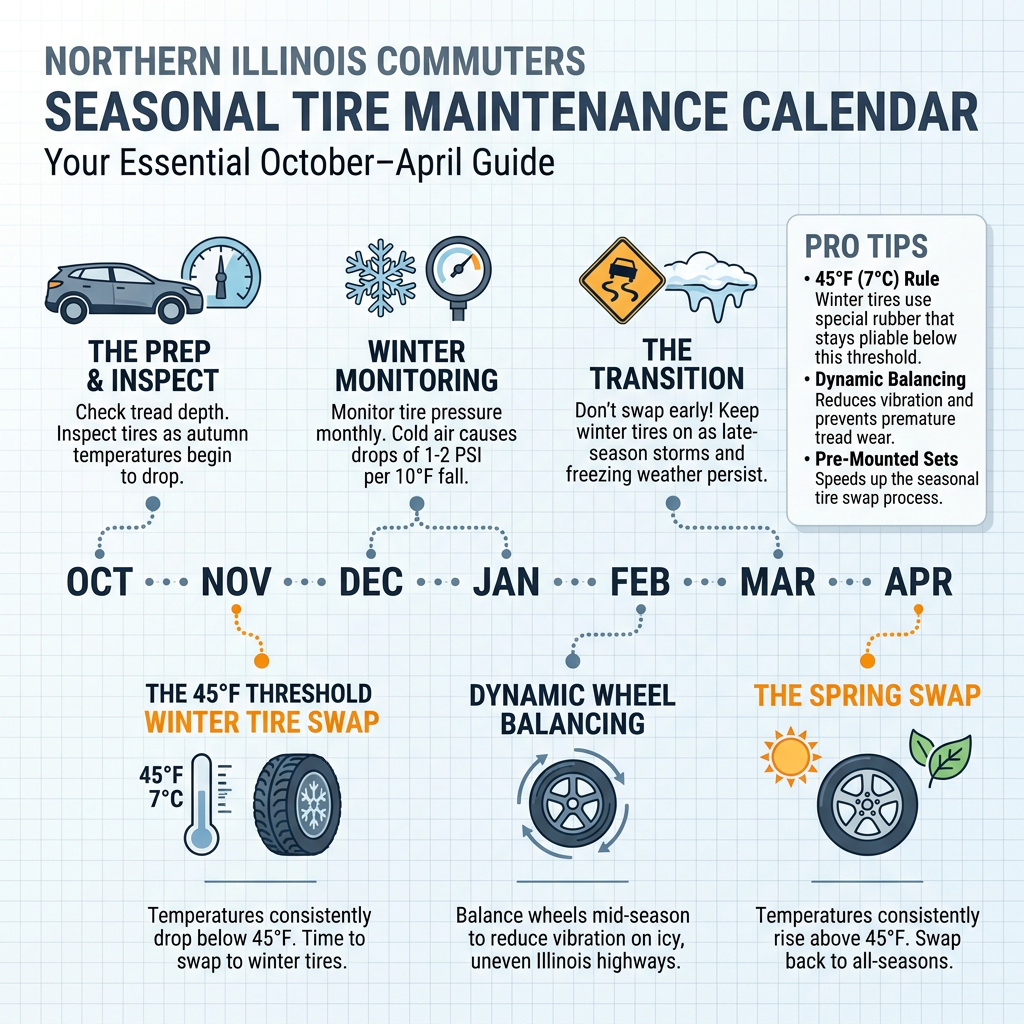
Schedule your winter tire installation when daily high temperatures consistently drop near 45°F. In Suburban Chicago, early November is ideal—well before the first major lake-effect snowfall or ice storm causes service bay backlogs. Check cold tire pressure monthly, as every 10°F drop in ambient temperature reduces tire pressure by approximately 1 PSI.
Spring Transition (April – Early May)
Switch back to all-season or summer tires once spring temperatures remain consistently above 45°F. Running winter tires on warm, dry pavement accelerates rubber compound wear and degrades fuel economy. Combine your spring tire changeover with a full wheel alignment to correct pothole damage sustained over the winter months.
Proper Storage Tips to Extend the Lifespan of Your Off-Season Tires
Storing off-season tires correctly prevents premature rubber degradation, sidewall cracking, and tread flat-spotting. Before storing, wash tires thoroughly with mild brake-safe soap and water to remove corrosive road salts, brake dust, and road grime. Allow them to dry completely before bagging.
Place each tire inside an airtight heavy-duty plastic tire tote or storage bag. Seal the bag to prevent atmospheric oxygen and ozone from evaporating essential rubber lubricating oils. Store tires in a cool, dark, climate-controlled basement or dry garage away from direct sunlight and heat sources.
For mounted tires on rims, stack them vertically on their sides or hang them from specialized tire storage hooks attached through the wheel center hub. For unmounted loose tires, stand them upright side-by-side on a clean wood rack, rotating them slightly once a month to equalize pressure.
Avoid storing tires directly on bare concrete garage floors, which draw moisture out of rubber compounds over time. Keep tires away from electric motors, generators, or arc welders, as these devices produce rubber-damaging ozone gas during operation.
Professional Tire Swap vs. DIY: Safety, Tools, and Warranty Considerations
Torque Precision & Safety
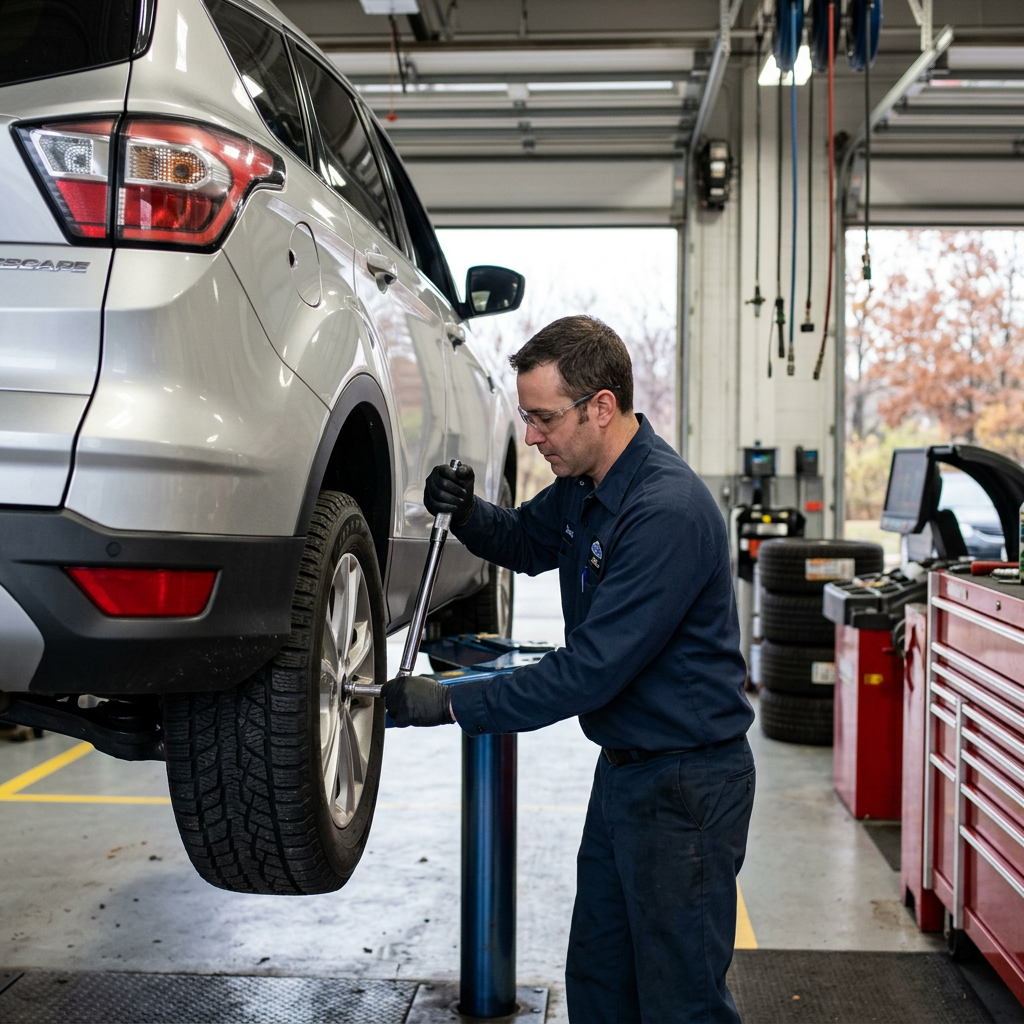
Changing tires at home with a emergency scissor jack presents serious safety hazards on cold asphalt or uneven driveways. Professional technicians lift vehicles on heavy-duty hydraulic hoists and tighten wheel lug nuts to exact foot-pound specifications using calibrated torque wrenches, preventing loose wheels or warped brake rotors.
Equipment Requirements
Proper DIY installation requires investing hundreds of dollars in heavy floor jacks, jack stands, high-torque impact wrenches, calibrated torque wrenches, and TPMS relearn tools. Professional service centers utilize commercial dynamic spin balancers and bead-sealing equipment that DIY tools cannot match.
Warranty & Inspection
Having your tire swap performed at an authorized dealership preserves manufacturer warranty compliance and includes multi-point vehicle inspections. Technicians inspect brake pad thickness, suspension bushings, tie rod ends, and CV boots during every tire swap session.
Schedule Your Seasonal Tire Swap at Hawk Ford of Carol Stream
Ensure your vehicle is fully prepared for Northern Illinois winter weather. Whether you need an unmounted tire changeover, a quick pre-mounted seasonal swap, wheel rebalancing, or a complete winter wheel package for your Ford Escape, the factory-certified service team at Hawk Ford of Carol Stream is here to deliver quick, reliable service.
We proudly serve drivers throughout Carol Stream, Glendale Heights, Bloomingdale, and the surrounding DuPage County area.
Schedule Service Now online or call our service department directly at
Call (630) 233-9696 to book your appointment.




0 comment(s) so far on Suburban Chicago Seasonal Tire Swapping Cost Guide | Hawk Ford of Carol Stream