



Is It Safe to Drive on a Flat Tire?
Driving on a flat tire is never safe under normal road conditions. A standard tire with zero air pressure loses its ability to cushion the wheel, leading to rapid internal rubber degradation within a few hundred feet. Continuing to operate a vehicle on a flat tire deforms the wheel rim, compromises steering control, and drastically increases the risk of a sudden highway blowout. Drivers should immediately ease off the accelerator pedal and carefully guide the vehicle to a safe stopping area well off the active roadway.
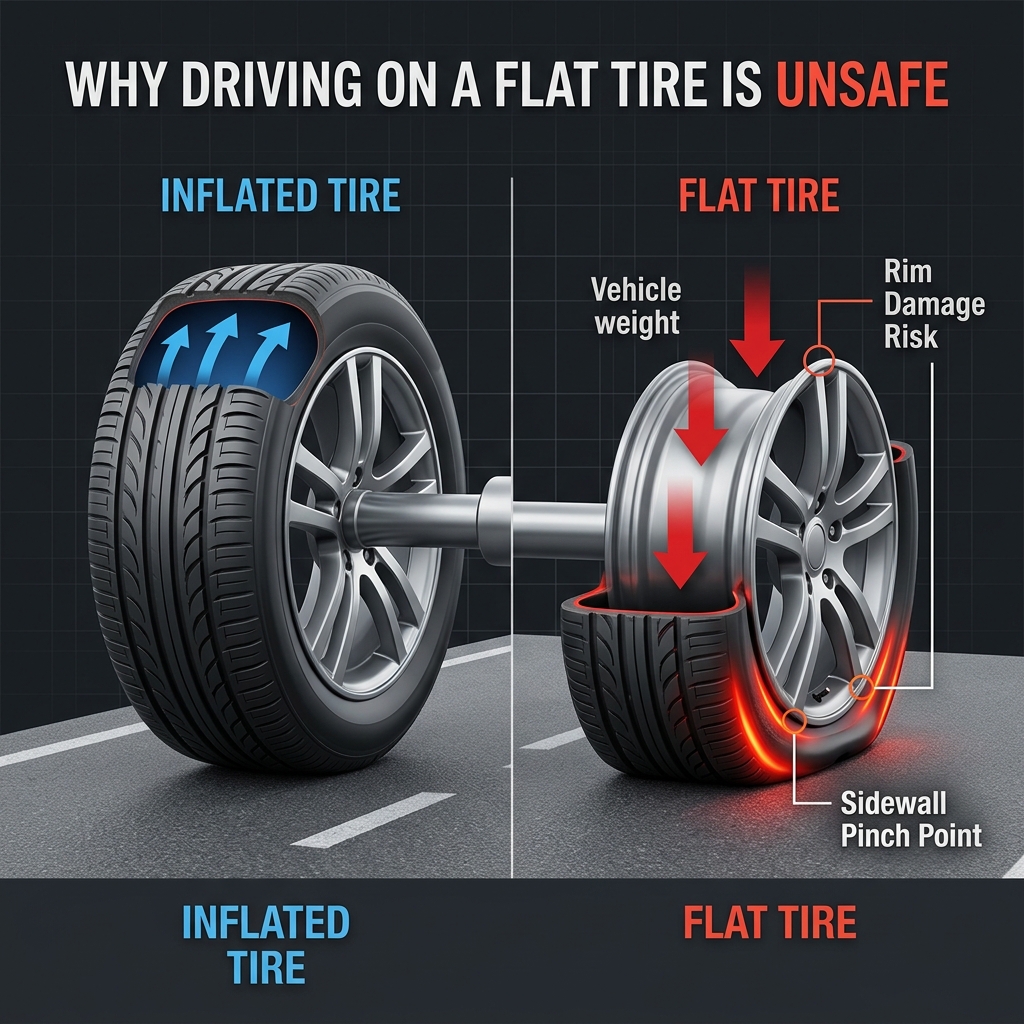
Air pressure supports the full weight of a vehicle. When air escapes through a puncture or bead seal failure, the weight shifts directly onto the flexible rubber sidewalls. Without pneumatic pressure, the tire flattens completely against the road surface. Rolling on a squashed tire causes the inner rubber layers to fold repeatedly, generating rapid thermal buildup that destroys the internal carcass.
Drivers traveling along St. Charles Road in Carol Stream should pull over immediately upon hearing a rhythmic thumping sound or noticing a low-pressure warning light. Modern vehicles equipped with Ford Co-Pilot360™ driver-assist technologies monitor wheel speed and tire pressure continuously, alerting you early so you can react before structural destruction occurs. Prompt action protects your vehicle components and prevents expensive secondary repairs.
If you suspect severe tire damage or require professional wheel inspection, you can visit our local Carol Stream facility for certified maintenance care or give our service advisors a quick call for immediate advice on handling a roadside tire emergency.
Table of Contents
- What Should You Do Immediately When You Get a Flat Tire on the Highway?
- What Physical Damage Occurs to Your Wheel Rim, Suspension, and Axle?
- Can Driving on a Flat Tire Cause a Blowout While Moving?
- How Does Driving on a Flat Tire Destroy Its Repairability?
- What Is the Max Speed and Distance You Can Drive on Run-Flat Tires?
- How Do You Safely Change a Flat Tire or Request Ford Roadside Assistance?
- Common Questions About Flat Tire Damage and Service Care
- Protecting Your Vehicle Wheels and Tires with Certified Maintenance Care
What Should You Do Immediately When You Get a Flat Tire on the Highway?
When a tire loses pressure on a high-speed road, you should immediately release the accelerator, hold the steering wheel firmly with both hands, and refrain from slamming on the brakes. Hard braking on a flat tire creates uneven traction forces that can cause the vehicle to fishtail or pull violently toward the damaged side. Allow the vehicle to slow down gradually using engine braking while keeping your direction straight and controlled.
As your speed drops below 20 mph, signal your intention and gently steer toward the safest available location off the travel lanes. A wide paved shoulder, an emergency turnout, or an off-ramp leading to a well-lit parking lot provides the necessary buffer from passing traffic. Commuters navigating Illinois Route 64 near Glendale Heights need to find a firm, flat surface away from moving vehicles before coming to a complete stop and setting the vehicle in park.
Once safely stopped, switch on your hazard lights right away to alert oncoming traffic. Engage the parking brake to prevent any vehicle movement on slight inclines. Advanced driver assistance features such as blind spot monitoring aid in identifying open traffic gaps when steering toward the shoulder, but safe physical placement remains the top priority during a roadside emergency. Remaining inside the cabin with seatbelts fastened is often the safest choice until professional assistance arrives.
What Physical Damage Occurs to Your Wheel Rim, Suspension, and Axle?
Driving on a flat tire forces the rigid metal wheel rim to crush the collapsed rubber against the pavement, causing deep gouges, severe bends, or structural cracking within less than a mile. Aluminum alloy wheels are particularly susceptible to cracking under impact forces, while steel wheels tend to bend along the outer lip. Once the rim edge scrapes directly against asphalt, the metal edge loses its smooth sealing surface, making it impossible for a new tire to maintain an airtight bead seal in the future.
Secondary structural damage extends rapidly into the vehicle undersurface. Without the dampening cushion of compressed air, every bump and surface imperfection transmits harsh kinetic shocks directly into suspension components:
- Suspension struts and shock absorbers absorb unbuffered vertical impacts, risking internal hydraulic valve failure or bent piston rods.
- Steering knuckles, tie rod ends, and lower ball joints endure extreme lateral strain, leading to premature mechanical play and loose steering feel.
- Wheel bearings experience severe thermal buildup and uneven load distribution, which can score the internal steel races and cause grinding noises over time.
- Wheel alignment angles, including camber and toe settings, get knocked out of factory specification, resulting in persistent vehicle pulling and rapid tread wear on remaining tires.
Operating a heavy truck, SUV, or crossover on a flat tire multiplies these physical forces due to increased curb weight. What begins as a minor nail puncture in the tread can escalate into multi-system mechanical damage affecting the drive axle and braking components if movement continues.
Can Driving on a Flat Tire Cause a Blowout While Moving?
The intense heat generated by the folding and flexing of unsupported rubber sidewalls during flat tire driving can cause catastrophic tire failure. Rubber is an insulator that traps heat inside the tire carcass. As internal temperatures exceed normal operating thresholds, the chemical bonds holding the rubber to the internal steel and fabric plies disintegrate rapidly.
This thermal degradation causes sudden structural collapse, frequently culminating in a high-speed tire blowout. When a blowout occurs, shredded tread sections separate from the carcass and whip violently inside the wheel well. Flying rubber debris can tear brake lines, crush plastic inner fender liners, and dent exterior body panels.
Vehicle control becomes severely compromised during a high-speed blowout. The sudden loss of drag symmetry forces the steering wheel to pull hard toward the flat side, demanding immediate driver correction. Keeping your tires properly inflated and addressing pressure drop alerts promptly prevents internal heat accumulation and protects your family during daily travel.
How Does Driving on a Flat Tire Destroy Its Repairability?
Driving even a short distance on a flat tire crushes the internal sidewall rubber between the metal rim and the road, shredding the inner liner into fine rubber dust and severing structural cords. While a simple tread puncture measuring under one-quarter inch is easily fixable with an industry-standard rubber patch and plug combination, internal sidewall destruction permanently eliminates repairability and mandates full tire replacement.
When vehicles enter our service bay after driving on an underinflated tire, our certified technicians remove the tire from the wheel to inspect the inner liner for heat-ring discoloration and fine rubber debris, which signal irreversible structural cord failure. Punctures located outside the central tread area, specifically on the tire shoulder or sidewall, can never be patched safely under industry guidelines.
| Damage Condition | Inspection Finding | Repairability Status |
| --- | --- | --- |
| Small Tread Puncture (< 1/4 in) | Clean entry in center tread | Repairable with patch-plug combo |
| Internal Sidewall Heat Ring | Dark creased ring on inner liner | Unrepairable; replacement needed |
| Shredded Rubber Debris (Marbling) | Loose rubber dust inside tire | Unrepairable; replacement needed |
| Shoulder or Sidewall Puncture | Damage outside main tread block | Unrepairable; replacement needed |
| Bent or Cracked Wheel Bead Lip | Rim surface gouged or misshapen | Wheel replacement or refinishing |
Attempting to patch a tire with compromised internal cords risks catastrophic failure under highway loads. Installing factory-approved replacement tires sourced from our genuine OEM parts center restores original handling characteristics and ensures your vehicle remains reliable for every season.
What Is the Max Speed and Distance You Can Drive on Run-Flat Tires?
Run-flat tires utilize reinforced internal sidewall inserts engineered to support vehicle weight without air pressure, allowing you to drive up to 50 miles at a maximum speed of 50 mph following a total inflation loss. These structural reinforcements keep the tire bead seated firmly on the rim, giving you sufficient time to reach a certified service center without stopping on a dangerous shoulder.
Exceeding the 50-mile distance limit or driving faster than 50 mph on a zero-pressure run-flat tire generates excessive internal heat that breaks down the reinforced sidewall inserts. Once these internal structures break down, the run-flat tire suffers total failure and can cause rim damage identical to a standard tire. Heavy cargo loads or towing trailers further reduce the effective safe distance.
Because run-flat tires maintain their physical shape even when completely devoid of air, vehicles using them rely strictly on a functional TPMS to inform the driver of pressure loss. Never treat a run-flat warning as permission for prolonged driving. It serves purely as an emergency buffer to guide you safely to professional service.
How Do You Safely Change a Flat Tire or Request Ford Roadside Assistance?
Changing a flat tire on the roadside requires strict adherence to safety protocols to prevent vehicle slippage or personal injury. Follow these essential steps if you must install a spare tire yourself:
- Park on a firm, level concrete or asphalt surface clear of passing traffic and engage the parking brake fully.
- Place wheel chocks behind the tires on the opposite end of the vehicle to prevent rolling.
- Use the lug wrench to loosen the wheel lug nuts by one-half turn while the tire is still resting on the ground.
- Position the factory jack beneath the designated vehicle frame jacking point indicated in your owner’s manual.
- Raise the vehicle until the flat tire clears the ground by approximately two inches, then remove the lug nuts and wheel.
- Mount the spare tire onto the wheel hub studs, hand-tighten the lug nuts firmly, and lower the vehicle back to the ground.
- Use a torque wrench to tighten the lug nuts in a star pattern to the exact factory torque specification.
When roadside conditions are hazardous, or if your vehicle lacks a spare tire, relying on professional emergency service is the safest choice. Drivers can request Ford Roadside Assistance: 1-800-241-3673 for factory-backed dispatch support. Manufacturer-trained technicians deliver specialized equipment, proper torque tools, and professional towing to an authorized service facility, ensuring complete peace of mind.
Common Questions About Flat Tire Damage and Service Care
Q: How can a driver tell if a tire is completely flat versus slightly underinflated?
An underinflated tire retains its general round shape and bulges slightly at the bottom, whereas a completely flat tire squashes flat against the road, allowing the metal rim to collapse onto the rubber tread. Driving on a low tire to a nearby gas station air pump is usually safe if pressure remains above 20 PSI. A completely flat tire requires immediate stopping to prevent permanent rim and sidewall destruction.
Q: Why does an internal tire repair require taking the tire completely off the wheel rim?
Proper tire repair standards mandate unmounting the tire from the wheel rim to inspect the interior rubber liner for hidden structural damage. Exterior string plugs inserted from the outside fail to seal the inner liner and cannot reveal internal rubber shredding caused by low-pressure running. A certified repair uses a combination rubber patch and stem plug applied from the inside, restoring an airtight seal across all tire layers.
Q: Will driving on a flat tire affect modern electronic driver-assist safety systems?
Operating a vehicle on a flat tire alters individual wheel rotation speeds and tire roll radii, which can trigger warning indicators for antilock braking, traction control, and electronic stability systems. Systems such as Ford Co-Pilot360™ driver-assist technologies rely on accurate wheel speed sensor data to operate safely. Restoring correct tire pressure and wheel alignment returns these driver assistance features to normal operational parameters.
Q: Can a bent aluminum wheel rim be repaired or must it always be replaced?
Minor cosmetic scraping or minor outer lip bending on a steel wheel can sometimes be corrected by specialized technicians. However, structural cracks, severe bends across the main wheel barrel, or damage to the inner mounting face on aluminum alloy rims compromise wheel strength and require complete replacement. Certified technicians evaluate rim runout and structural integrity before mounting any new tire.
Q: How often should spare tires be checked to ensure proper roadside readiness?
Compact temporary spare tires lose air pressure over time due to ambient temperature fluctuations and natural rubber permeability. Inspect your spare tire pressure at least twice a year or during every routine oil change, inflating it to the recommended 60 PSI listed on its sidewall. Checking the spare tire ensures it remains ready to use whenever an unexpected roadside flat occurs.
Protecting Your Vehicle Wheels and Tires with Certified Maintenance Care
Preventing unexpected tire damage begins with routine tire pressure checks, regular tread inspections, and timely wheel alignments. Operating your vehicle with properly inflated tires maximizes fuel efficiency, enhances wet-weather traction, and extends overall tread life across demanding Midwest driving conditions.
If you experience tire pressure warnings, vibration, or wheel damage, expert technical support is available close to home. You can get directions to our dealership location for a comprehensive wheel and tire inspection, contact our certified service team directly to discuss tire options, or schedule a service appointment online to keep your vehicle running smoothly and safely.
© 2026 Hawk Ford of Carol Stream. All rights reserved.
0 comment(s) so far on Is It Safe to Drive on a Flat Tire?