

Heavy Duty Towing F-250 and F-350 Carol Stream

July 13th, 2026 by

Unlocking the Heavy Duty Towing Power of the Ford F-250 and F-350 in Carol Stream


When it comes to moving mountains of machinery, pulling massive weekend toy haulers, or executing heavy commercial transport across DuPage County, the names Ford F-250 and F-350 stand out as undisputed icons of capability. For years, contractors, local logistics firms, landscaping crews, and recreational enthusiasts in Carol Stream and surrounding suburbs have relied on the Super Duty lineup to conquer the most challenging towing assignments. In Northern Illinois, we experience a full spectrum of demanding driving conditions—ranging from humid, high-traffic summer heatwaves along North Avenue to freezing, ice-slicked winter commutes on the Interstate. These challenging real-world scenarios require more than just raw power; they demand a sophisticated combination of structural durability, advanced cooling, intelligent driver-assist technologies, and engineered peace of mind.


At Hawk Ford of Carol Stream, we recognize that selecting a heavy-duty truck isn’t just about picking a paint color or choosing an engine off a brochure. It’s an investment in your livelihood, your safety, and your weekend freedom. Whether you are hauling heavy excavation equipment to a job site in Glendale Heights, pulling a multi-horse trailer down to central Illinois, or navigating tight suburban streets with a commercial flatbed, understanding the deep engineering differences between the F-250 and F-350 is crucial. This comprehensive guide will dissect everything from mechanical configurations, powertrain capabilities, and practical fuel economy realities to the cutting-edge smart towing technologies that keep you securely in control. Our truck experts are always ready to assist you; you can call us at Call us at (630) 233-9696 to discuss your specific fleet or personal requirements.


The Ford Super Duty architecture is engineered from the ground up with a high-strength, military-grade aluminum-alloy body mated to a fully boxed frame constructed of over 95% high-strength steel. This rigid foundation is what allows these trucks to manage extreme vertical tongue weight and immense pulling forces without flinching. To truly appreciate what these machines can do, we must examine the physical components that translate engine torque into real-world towing prowess. From heavy-duty Dana axles and robust leaf-spring suspensions to massive ventilated disc brakes, every single component under the skin of an F-250 or F-350 is built to handle severe-duty operation day in and day out. Let’s delve deep into the mechanical specifications, capacities, and technologies that make these trucks the absolute benchmark for heavy-duty towing.
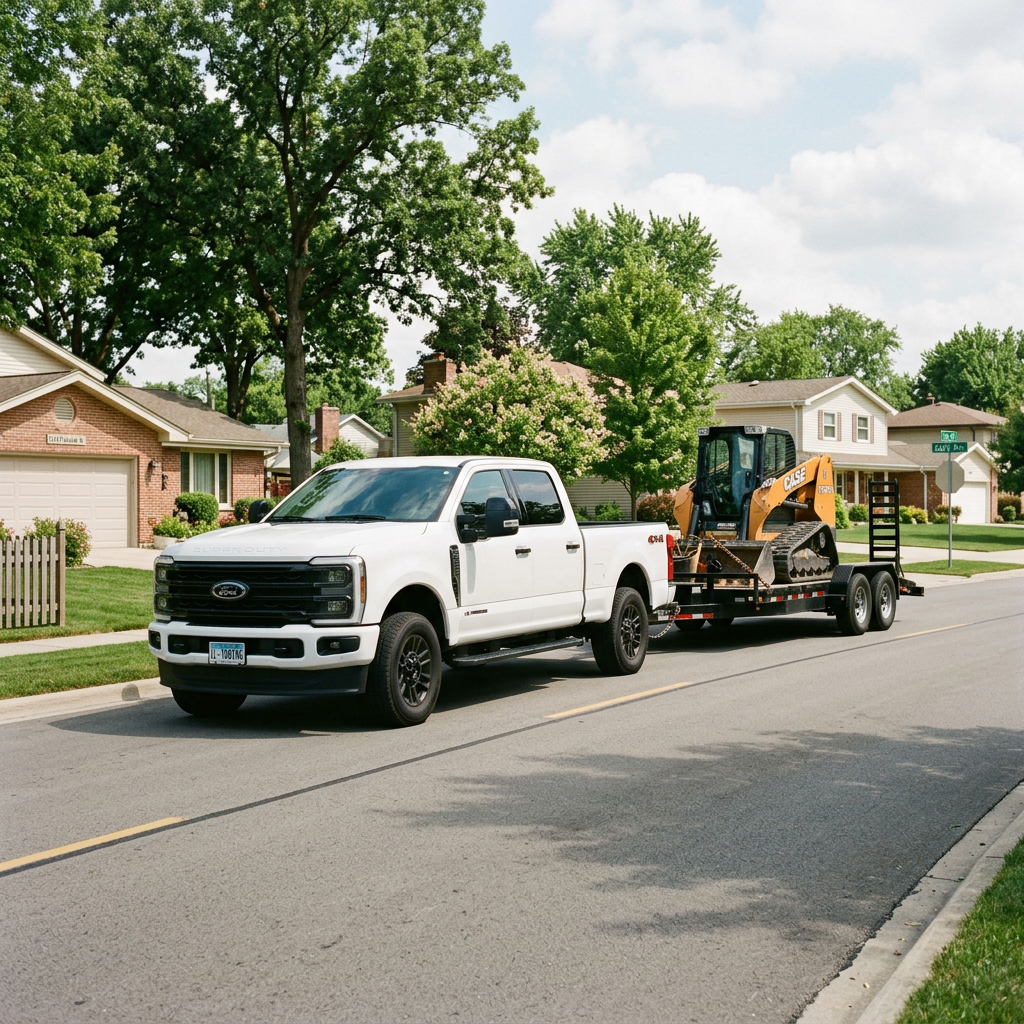
 

A white Ford Super Duty truck towing a flatbed trailer with a yellow Case compact track loader on a suburban street. (Representative image for illustration purposes only. Actual vehicle may vary based on trim and configuration.)

What is the Maximum Towing Capacity of the 2024 Ford F-250?


The 2024 Ford F-250 is a powerhouse that blurs the line between traditional three-quarter-ton capability and full-blown commercial capacity. When properly configured, the maximum conventional towing capacity of the F-250 reaches an astonishing 22,000 pounds. Conventional towing refers to pulling a trailer attached to a standard receiver hitch at the rear bumper. This is the setup most commonly used for hauling utility trailers, mid-sized construction equipment, and large recreational boats. To achieve this maximum rating, the truck must be equipped with the incredibly robust 6.7L Power Stroke V8 Turbo Diesel engine paired with the specialized high-capacity trailer tow package, which upgrades crucial mechanical components such as the rear axle, springs, and cooling systems.


For even more demanding loads, stepping up to a fifth-wheel or gooseneck trailer configuration unlocks the true potential of the F-250’s chassis. Under gooseneck towing setups, where the trailer’s weight is centered directly over the rear axle via a bed-mounted hitch, the F-250 can tow up to an incredible 23,000 pounds. This style of towing is highly favored by professional haulers and horse transport operators because it significantly improves stability, reduces trailer sway, and provides a much tighter turning radius. However, it is essential to understand that these maximum figures are highly dependent on the truck’s cab configuration, bed length, drivetrain (4×2 vs. 4×4), and rear-axle gear ratio.


For instance, a Crew Cab 4×4 model with an 8-foot long bed is inherently heavier than a Regular Cab 4×2 model with a short bed. Because the truck’s Gross Combined Weight Rating (GCWR) is a fixed maximum limit representing the total allowable weight of both the truck and the trailer, any extra weight added to the truck itself (such as extra doors, luxury interior features, or 4×4 transfer cases) directly subtracts from the maximum trailer weight you can safely pull. Additionally, choosing a taller axle ratio like 3.55 or 4.30 increases mechanical advantage, allowing the engine to stay in its powerband more effectively when moving heavy loads from a complete stop. When configuring your F-250, our team will analyze your specific trailer requirements to ensure we match you with the perfect axle ratio and cab configuration.


To illustrate how these ratings vary across popular setups, we have provided a clear breakdown of the maximum towing configurations below. It highlights the direct relationship between engine choice, hitch style, and final capability so you can make an informed decision for your daily operations.


Engine Configuration Hitch Type Max Towing Capacity (lbs) Optimal Axle Ratio
6.8L V8 Gas Conventional 14,800 lbs 3.73
7.3L Godzilla Gas Conventional 17,200 lbs 4.30
6.7L Power Stroke Diesel Conventional 22,000 lbs 3.31 / 3.55
6.7L High-Output Diesel Gooseneck / 5th Wheel 23,000 lbs 3.55


What is the Towing Capacity Difference Between F-350 SRW and DRW Models?
 

When upgrading to the Ford F-350, buyers must make a critical design decision: Single Rear Wheel (SRW) or Dual Rear Wheel (DRW), commonly known as a dually. This physical configuration choice dramatically changes the truck’s capabilities, driving dynamics, and suitability for specific towing environments. An F-350 SRW model features a standard four-wheel track, making it highly maneuverable in daily suburban driving around Carol Stream, easier to park in standard spaces, and more capable in off-road situations or deep snow. The maximum conventional towing capacity for a properly equipped F-350 SRW is an impressive 25,000 pounds, while its gooseneck rating can reach up to 27,000 pounds. This is more than enough strength for the vast majority of non-commercial operations.


However, when you step up to the F-350 DRW model, you enter a completely different class of hauling authority. By adding two additional tires to the rear axle, the DRW configuration drastically increases the truck’s footprint and rear axle weight rating. This dual-wheel setup allows the F-350 to handle immense payload and extreme tongue weights that would otherwise overload a single-rear-wheel axle. A properly configured F-350 DRW boasts a staggering maximum gooseneck/fifth-wheel towing capacity of up to 38,000 pounds. This level of capacity is designed for pulling the heaviest multi-car trailers, massive industrial flatbeds, and top-tier luxury fifth-wheel RVs that exceed 40 feet in length.


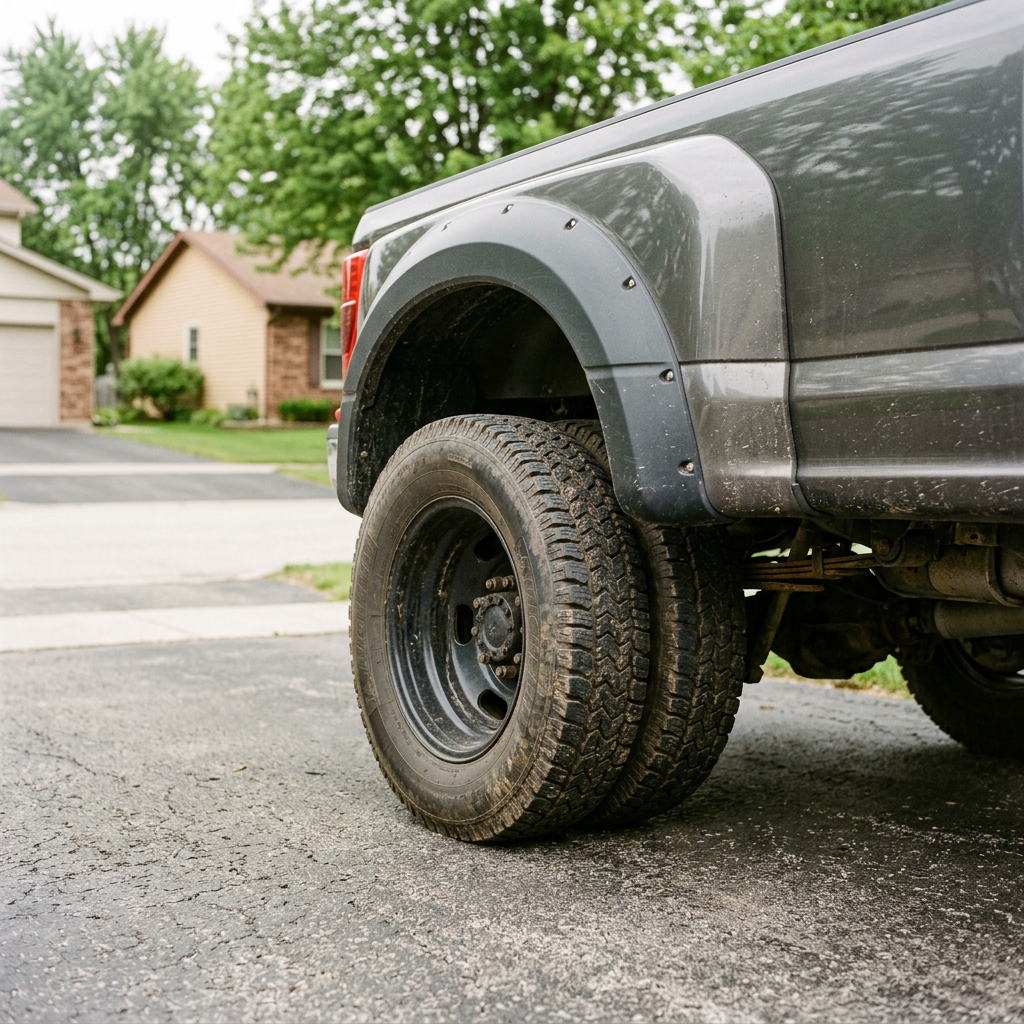
Rear dual wheels and fender flare of a gray dually pickup truck parked on an asphalt driveway. (Representative image for illustration purposes only. Actual vehicle may vary based on trim and configuration.)


Beyond pure raw capacity, the most significant practical difference between SRW and DRW is lateral stability. When pulling a high-profile trailer through crosswinds on Interstate 355 or down Interstate 88, wind shear can cause trailers to sway, transferring side-to-side forces to the tow vehicle. In an SRW truck, the rear tires must absorb these lateral forces, which can occasionally feel unsettling to the driver. In a DRW truck, the incredibly wide rear axle acts as an anchor, virtually eliminating trailer sway and providing an unmatched sense of stability. Additionally, the F-350 DRW offers a massive payload rating of up to 8,000 pounds (compared to approximately 4,000 to 5,000 pounds on the SRW), meaning you can handle extreme vertical pin weights without sagging the rear suspension.


If you are ready to experience this level of security and performance firsthand, we encourage you to explore our comprehensive inventory of heavy-duty trucks. You can view our current New Vehicle Inventory online, or if you prefer a high-quality pre-owned option, browse our Used Vehicle Inventory to find the perfect hauling rig for your business or personal adventures. Let our team guide you through the process and help you choose between SRW and DRW based on your exact trailers.


Which Heavy-Duty Truck Has a Better Diesel Engine Option?


Standard 6.7L Power Stroke V8

The standard 6.7L Power Stroke V8 Turbo Diesel is a legendary workhorse that has been refined over generations. It produces an incredibly robust 475 horsepower and a massive 1,050 lb-ft of torque. This engine delivers maximum torque low in the RPM range, which is critical for getting heavy, static loads moving from a complete stop. It utilizes a highly efficient variable-geometry turbocharger that optimizes throttle response and provides excellent exhaust braking capabilities, helping to save your service brakes on steep downgrades.


6.7L High-Output (HO) Power Stroke

For those who demand absolute pinnacle performance, Ford offers the High-Output (HO) version of the 6.7L Power Stroke. This advanced powerplant elevates output to a class-leading 500 horsepower and an earth-shaking 1,200 lb-ft of torque. To manage this increased energy, the HO engine features a water-jacketed turbocharger, upgraded exhaust manifolds, and unique steel pistons. This results in relentless pulling power that can accelerate heavy commercial trailers up steep grades with effortless ease and minimal strain.


Comparing to Gas Alternatives

While Ford’s gas engines (the 6.8L and 7.3L V8s) are highly capable and cost-effective, they cannot compete with the diesel engines’ low-end torque profiles. Gas engines rely on higher RPMs to generate their peak power, which leads to more downshifting and higher engine noise when pulling heavy loads. The diesels, mated to the smooth TorqShift 10-speed automatic transmission, maintain low RPMs, run quieter under load, and provide integrated exhaust braking that gas engines simply cannot match.


What is the Fuel Economy Difference Between the 7.3L Gas and 6.7L Diesel?
 

When configuring a heavy-duty truck, operating cost is a major consideration for both small business fleets and individual owners. The choice between the ‘Godzilla’ 7.3L V8 naturally aspirated gas engine and the 6.7L Power Stroke V8 Turbo Diesel represents a classic trade-off between lower upfront purchase costs and long-term fuel efficiency. The 7.3L gas engine is renowned for its simple, durable, pushrod design. It offers a lower initial purchase price, cheaper routine maintenance, and runs on standard unleaded gasoline. However, because it is a large-displacement gas engine, its fuel economy is highly sensitive to loads. When unladen, you can expect around 11 to 14 MPG on the highway; when towing a heavy trailer, that figure can drop to 7 to 9 MPG.


On the other hand, the 6.7L Power Stroke diesel engine is an efficiency champion, especially under heavy load. Diesel fuel contains higher energy density than gasoline, and the diesel combustion cycle is inherently more efficient. Unladen, a 6.7L diesel Super Duty can achieve 15 to 19 MPG on highway cruises around Bloomingdale and Carol Stream. More importantly, when hooked to a heavy trailer, the diesel’s efficiency remains highly resilient, typically delivering between 10 to 13 MPG. Over tens of thousands of towing miles, this fuel economy advantage can result in substantial savings at the pump.


Beyond pure fuel mileage, you must also consider the driving environment. In stop-and-go suburban traffic along Gary Avenue, the gas engine’s fuel consumption is elevated due to the constant energy required to accelerate a heavy vehicle from a dead stop. The diesel engine manages these low-speed transitions with minimal effort due to its massive torque, keeping fuel consumption more stable. However, diesel ownership also involves accounting for Diesel Exhaust Fluid (DEF) consumption and slightly higher routine maintenance costs (such as larger oil capacities and fuel filter replacements). Ultimately, if you tow frequently or cover high annual mileages, the diesel is the clear financial and operational winner.


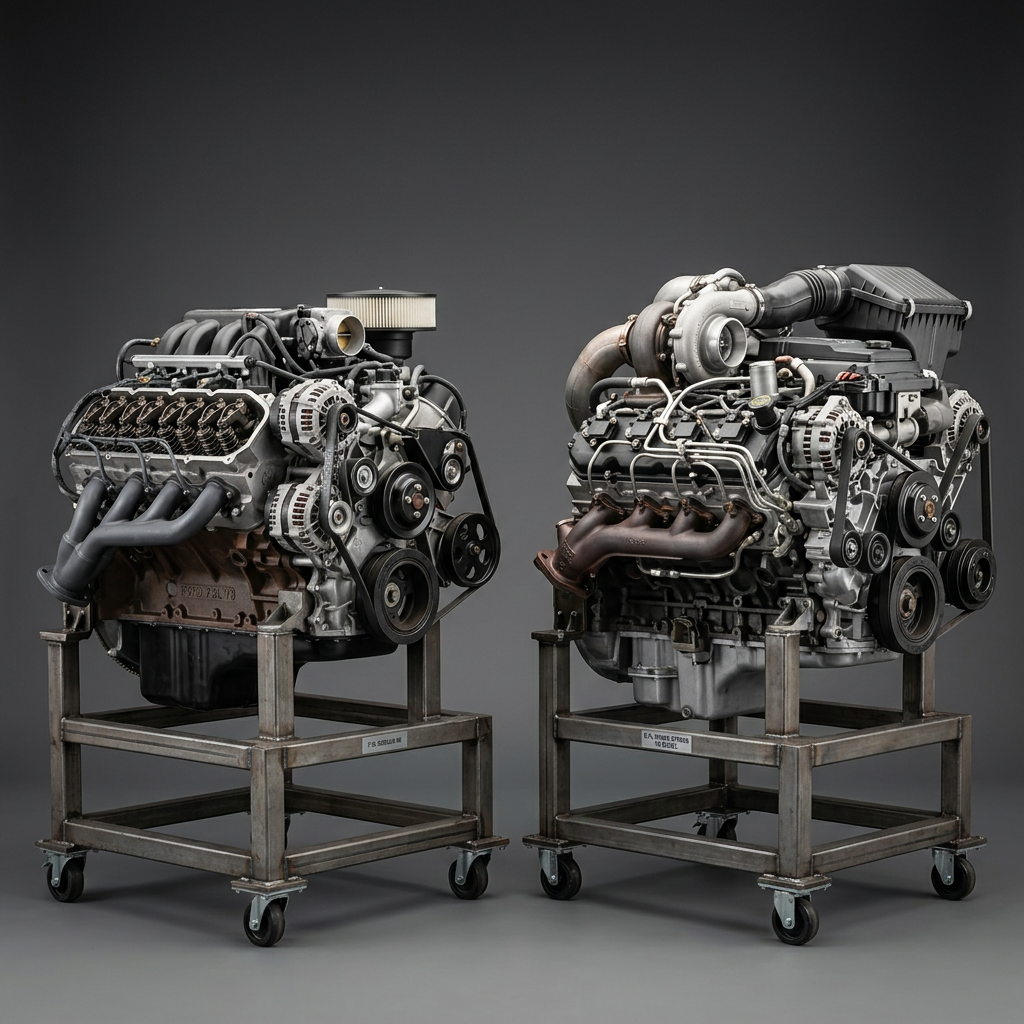
Two high-performance automotive engines mounted on metal rolling stands side-by-side against a gray background. (Representative image for illustration purposes only. Actual vehicle may vary based on trim and configuration.)

How Does Pro Trailer Hitch Assist Work on the Super Duty?


One of the most stressful aspects of towing is the physical act of aligning the truck’s hitch ball with the trailer’s receiver, especially when working alone. Ford has completely solved this pain point with its industry-first, award-winning Pro Trailer Hitch Assist technology. Utilizing advanced machine learning, computer vision, and the truck’s rear-facing camera systems, this intelligent feature automates the entire hitching process with the simple hold of a button. It eliminates the need for a spotter, prevents frustrating ‘trial-and-error’ alignment attempts, and eliminates the risk of accidentally dinging your rear bumper.


To operate the system, you simply back your F-250 or F-350 to within approximately 20 feet of the trailer. Once the trailer tongue is in the camera’s field of view on your massive center touchscreen, you activate the system. By holding down the designated button on the instrument panel, the truck takes complete autonomous control of the steering, throttle, transmission shifting, and braking. It slowly and precisely reverses the truck, calculating the optimal path in real-time, and stops perfectly positioned directly under the trailer receiver. It is a game-changing technology that saves immense time and stress at crowded local boat launches, busy construction job sites, or tight agricultural yards.


Complementing this is Pro Trailer Backup Assist, which makes reversing a trailer as easy as turning a small dial on your dashboard. Instead of trying to remember which way to turn the steering wheel (which is counterintuitive when backing up a trailer), you simply rotate the control knob in the direction you want the trailer to go. The truck handles the steering inputs automatically. If you’d like to see these incredible systems demonstrated in person by our experienced truck specialists, please visit our showroom. You can Get Directions to Hawk Ford of Carol Stream and come experience the future of towing today.


Essential Super Duty Towing Tech: Smart Scales and Blind Spot Coverage
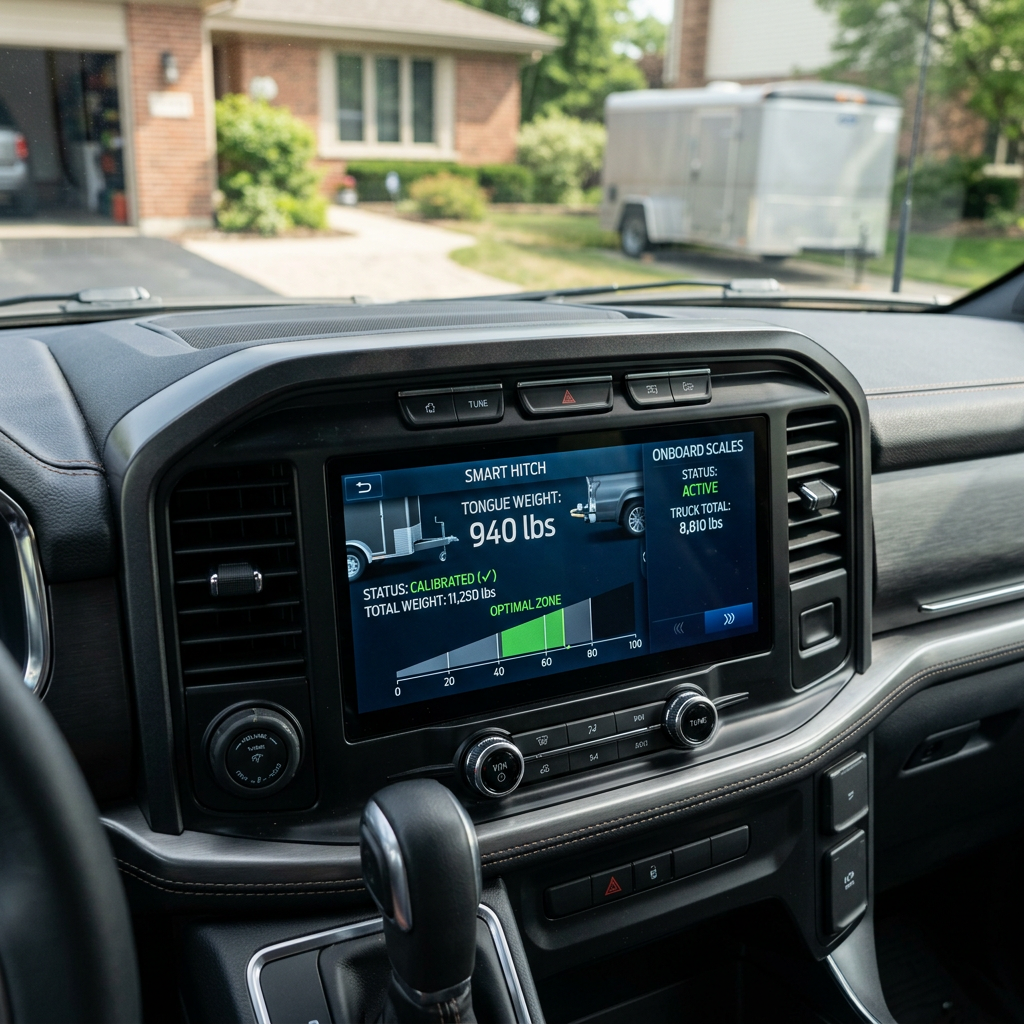
 

Onboard Scales & Smart Hitch

Overloading a truck is illegal and highly dangerous. Ford’s Onboard Scales estimate the weight of cargo in the bed in real-time, displaying the payload level on the center screen or via smart LED taillights that illuminate like a battery charge indicator. The integrated Smart Hitch measures the tongue weight of your connected trailer, guiding you to distribute the load perfectly for maximum steering and braking control.


BLIS with Trailer Coverage

Changing lanes with a 30-foot trailer on a busy expressway like I-355 requires extreme focus. Ford’s Blind Spot Information System (BLIS) extends its radar detection down the entire length of your trailer. It alerts you via side-mirror indicators if a vehicle is traveling in your truck or trailer’s blind spot, providing an extra layer of awareness and preventing high-speed highway collisions.


A truck's dashboard screen showing the Smart Hitch feature measuring a tongue weight of 940 lbs. (Representative image for illustration purposes only. Actual vehicle may vary based on trim and configuration.)

How Often Should I Change the Oil Under a Severe Towing Schedule?


Towing heavy loads puts immense thermal and mechanical stress on a truck’s engine, transmission, and cooling systems. When operating under what Ford classifies as ‘severe duty’ conditions—defined as frequent towing, hauling heavy payloads, operating in dusty environments, or idling for extended periods—routine maintenance schedules must be accelerated. While Ford’s intelligent Oil-Life Monitor will calculate oil degradation based on engine speeds, temperatures, and load factors, relying strictly on normal-use intervals (such as 10,000 miles) can lead to premature engine wear when towing heavy loads on a daily basis.


Under a severe towing schedule, it is highly recommended to change your engine oil and filter every 5,000 to 7,500 miles (or every 6 months, whichever comes first). For heavy-duty diesel engines, clean oil is vital to protect the complex turbocharger bearings and fuel injection systems. Furthermore, severe-duty service extends far beyond just engine oil. Your transmission fluid, transfer case lubricant, and front/rear differential fluids must be inspected and replaced more frequently. The extreme heat generated by towing heavy trailers down the highway accelerates the breakdown of these vital gear lubricants.


Additionally, your braking system must be monitored closely. Even with advanced trailer brakes and engine exhaust braking, the truck’s service brakes handle significant heat dissipation. Regular brake inspections, brake fluid flushes, and suspension checks ensure your vehicle remains safe and dependable. At Hawk Ford of Carol Stream, our certified master technicians specialize in heavy-duty truck maintenance. We stock genuine Motorcraft parts designed specifically for your Super Duty. To keep your commercial or recreational rig operating at peak performance, you can easily Schedule Service Now to book an appointment with our truck service experts.


Whether you need a heavy-duty oil change, a transmission fluid flush, a brake system overhaul, or specialized diesel engine diagnostic work, our state-of-the-art service center has the heavy-duty lifts and specialized diagnostic tools required to handle these commercial-grade vehicles. If you need replacement filters, belts, or fluid top-offs, visit our dedicated Parts Center for OEM Ford components.


Are There Demo Models Available for Testing Towing Capabilities at Dealerships?
 

Purchasing a heavy-duty truck is a major decision, and experiencing how these vehicles handle, accelerate, and brake is highly recommended before finalizing your configuration. At Hawk Ford of Carol Stream, we maintain a robust inventory of new and pre-owned Ford Super Duty trucks. While insurance and liability regulations generally prevent dealerships from allowing customers to attach their own fully-loaded trailers during standard test drives, we offer the next best thing: immersive, expert-led demonstrations of the truck’s towing technologies and powertrain capabilities.


Our commercial fleet and truck specialists can walk you through the operation of Pro Trailer Hitch Assist, activate the Onboard Scales to show you how payload is calculated, and explain the physical differences in ride quality between an F-250 and an F-350 SRW or DRW. We can arrange back-to-back test drives of the 7.3L Godzilla gas engine and the 6.7L Power Stroke diesel, allowing you to feel the massive difference in low-end torque, throttle response, and cabin noise for yourself.


If you are considering upgrading your current towing vehicle, we make the transition incredibly seamless. You can use our online tool to Value Your Trade in minutes, giving you a clear, competitive estimate of your current truck’s value. Applying this equity toward a new Super Duty is a fantastic way to lower your monthly payments. Visit our showroom in Carol Stream to speak with our finance and truck specialists today.


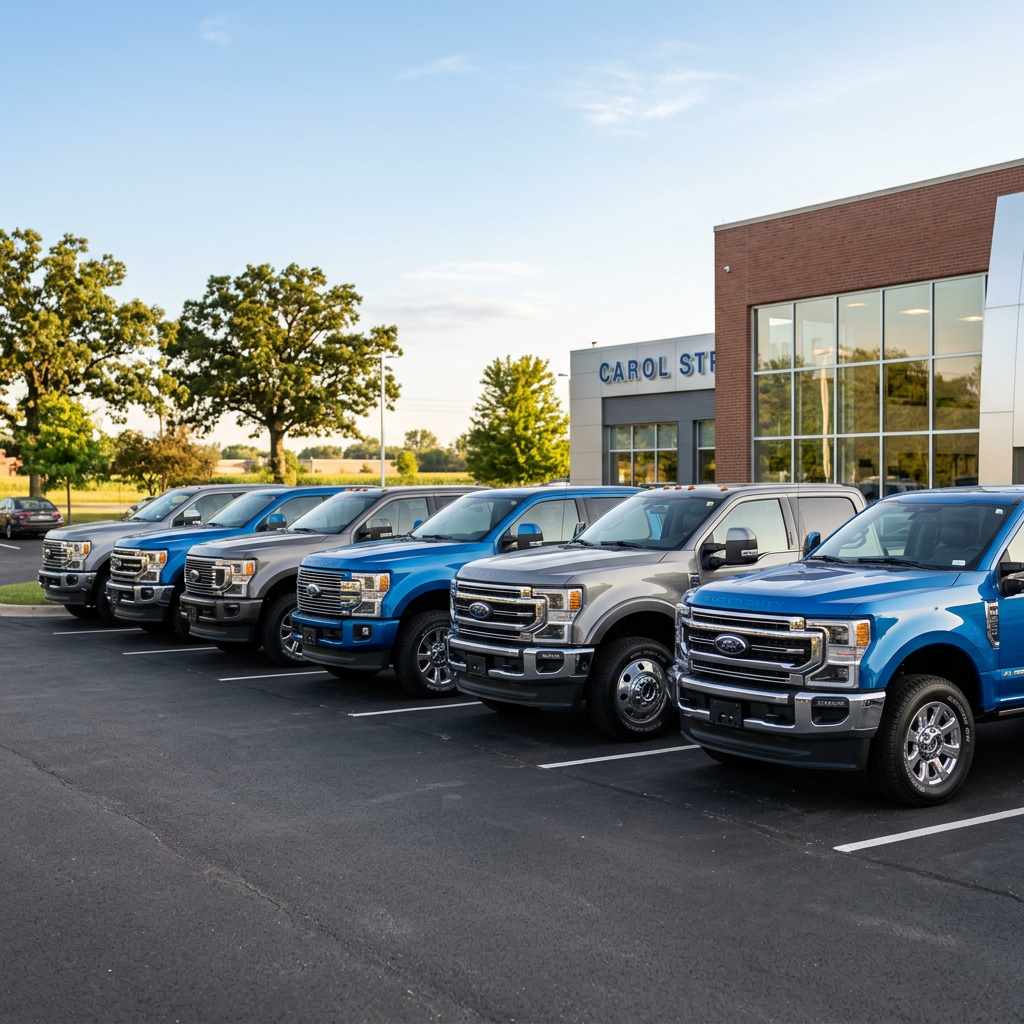
Line of Ford Super Duty pickup trucks in blue and gray parked outside a dealership (Representative image for illustration purposes only. Actual vehicle may vary based on trim and configuration.)

Find Your Next Heavy-Duty Rig at Hawk Ford of Carol Stream


Choosing the right heavy-duty truck is about finding the perfect balance between raw mechanical capacity, advanced safety technology, and long-term operating efficiency. Whether you’ve decided on the extreme versatility of the F-250 or the unmatched commercial-grade hauling power of the F-350 DRW dually, Hawk Ford of Carol Stream is your premier destination in Northern Illinois. Our dedicated commercial truck team has decades of collective experience helping business owners and weekend haulers configure the perfect trucks for their exact needs. We invite you to explore our extensive inventory, take a test drive, and discover why we are the trusted automotive resource for DuPage County.


To streamline your purchasing process, we recommend taking advantage of our convenient online tools before visiting our physical dealership. You can easily Apply for Credit from the comfort of your home or office, allowing our finance team to secure competitive loan or lease terms that fit your budget. If you have any questions, need more information about specific payload configurations, or want to check current vehicle availability, please do not hesitate to contact us directly. Let us help you put the legendary power of a Ford Super Duty to work for you today.


}