


Ford Explorer Seating Guide: Captain’s Chairs vs Bench

July 24th, 2026 by

Choosing Your Ford Explorer Cabin: Second-Row Captain’s Chairs vs. Bench Seating for Carol Stream Families


For families navigating life in Carol Stream, Glendale Heights, and the surrounding Chicago suburbs, choosing the right midsize three-row SUV is one of the most significant automotive decisions you will make. The 2026 Ford Explorer stands out as an absolute benchmark in this class, offering an outstanding combination of rugged capability, modern safety features, and flexible cabin spaces. However, once you decide on the Explorer, you face an essential interior configuration question that will shape your daily commute, weekend road trips, and carpooling routines: should you choose the second-row captain’s chairs or stick with the traditional second-row bench seat?


At Hawk Ford of Carol Stream, we understand that every family’s routine is different. Some families are constantly managing sports gear for games at McCaslin Park, while others are loading up heavy winter coats and strollers for trips to the Morton Arboretum. This comprehensive guide is designed to walk you through the structural, practical, and financial distinctions between these two seating configurations, helping you determine which layout fits your specific lifestyle.
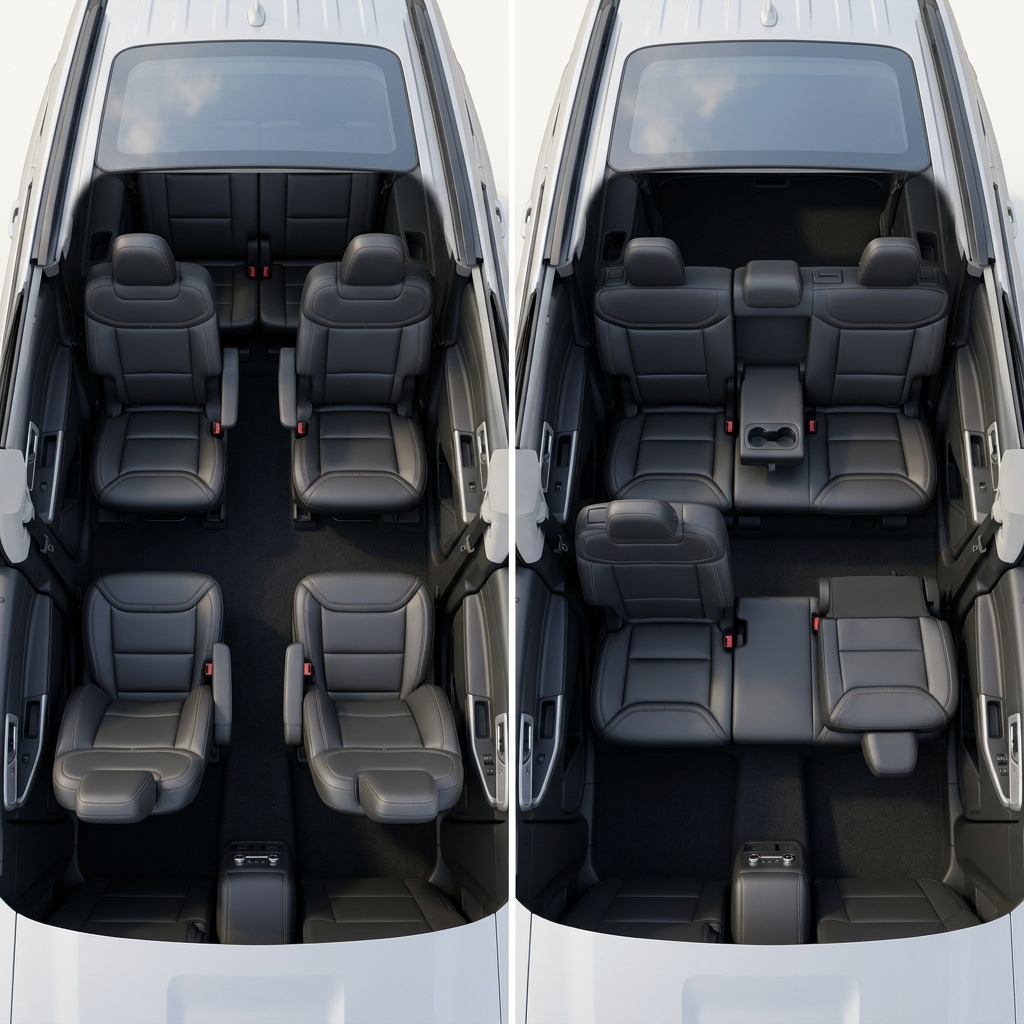
 

Top-down view comparing two different interior seating configurations of a modern SUV. (Representative image for illustration purposes only. Actual vehicle may vary based on trim and configuration.)


Ultimately, this is more than just a matter of adding or subtracting a single seat. The choice between second-row captain’s chairs and a second-row bench seat impacts passenger ingress and egress, cargo utility, overall shoulder room, the installation of child safety seats, and even the resale value of your vehicle. Let’s dive deep into the specific details of how these configurations behave in real-world scenarios so you can make an educated, confident decision.


What is the Seating Capacity of a 2026 Ford Explorer with Captain’s Chairs Versus a Bench Seat?


Let’s address the most fundamental metric first: absolute capacity. When you choose a 2026 Ford Explorer equipped with second-row captain’s chairs, your total passenger capacity is limited to six people. This configuration utilizes a 2-2-2 layout. The front row holds two passengers, the second row features two individual buckets, and the third-row bench accommodates two additional passengers. If you prioritize maximum occupancy, this is a crucial distinction to keep in mind, especially when you are responsible for neighborhood carpools or have a larger family.


On the other hand, selecting the traditional second-row bench seat increases your total capacity to seven passengers. This layout adopts a 2-3-2 configuration. Here, the second-row bench is split in a 35/30/35 fashion, allowing three passengers to sit side-by-side in the middle row. For families with three children, or those who frequently travel with grandparents and friends, having that seventh seat can make the difference between taking a single vehicle or having to coordinate a two-car caravan for dinner in downtown Wheaton.


Metric Captain’s Chairs Bench Seating
Total Capacity 6 Passengers 7 Passengers
Second-Row Layout 2 Individual Buckets 35/30/35 Split Bench
Third-Row Layout 2 Seats (50/50 Split) 2 Seats (50/50 Split)
Pass-Through Lane Yes (Center Aisle) No (Requires Folding Seat)


Beyond simple numbers, the capacity difference dictates how you utilize the vehicle’s interior volume. In the six-passenger configuration, the physical space between the two captain’s chairs is left open, creating a natural walkway or “pass-through” to the third row. In contrast, the seven-passenger bench layout seals this space completely, establishing a solid barrier that blocks off the third row unless one of the outboard second-row seats is tilted and slid forward. This structural variation drastically changes how passengers move within the cabin, which we will explore in detail below.


How Many Passengers Can the 2026 Ford Explorer Seat with Captain’s Chairs vs. a Bench in the Second Row?


To understand how passenger distribution works in daily practice, we have to look closely at the dimensions, physical boundaries, and ergonomic realities of both layouts. Let’s break down how occupants actually experience these spaces across all three rows of the 2026 Ford Explorer.
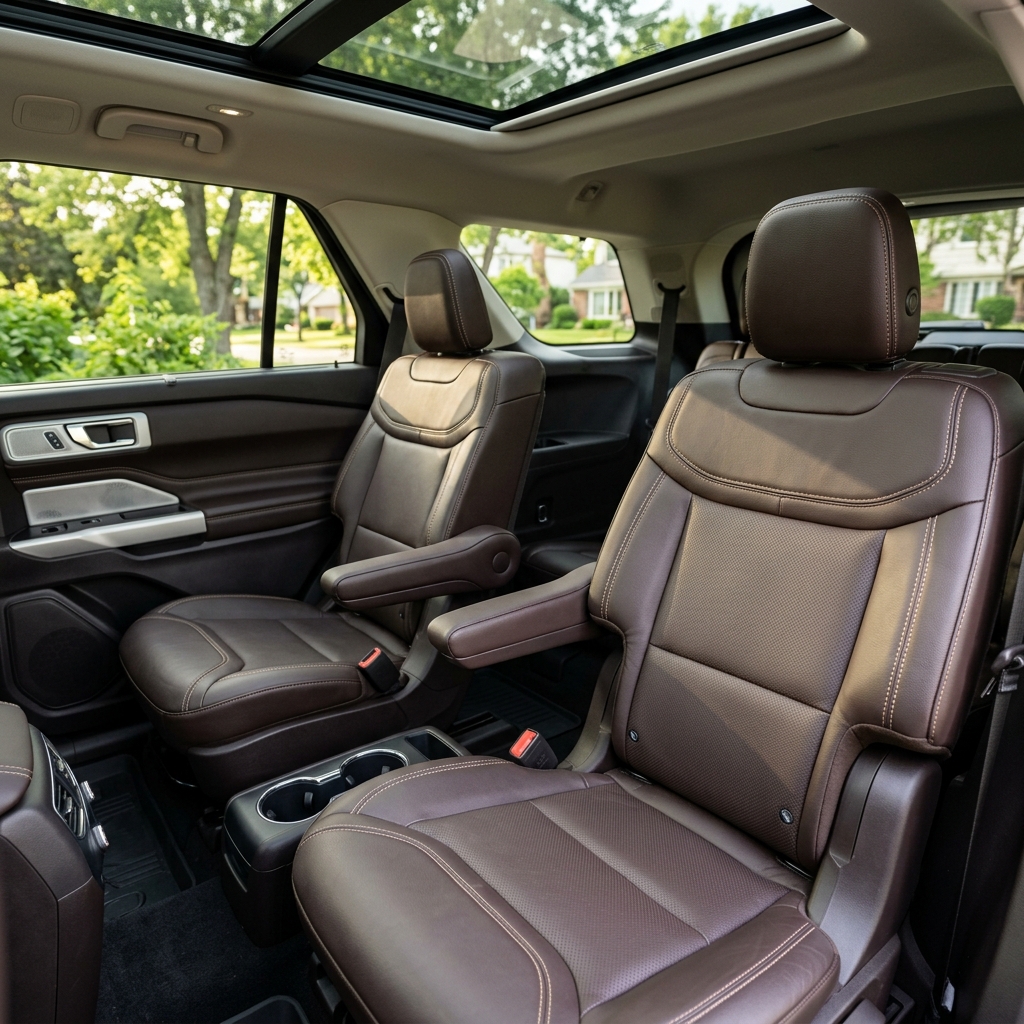
 

Row 1: Driver & Co-Pilot


Regardless of your second-row choice, the front row remains identical. The driver and front passenger enjoy premium bucket seats with up to 43 inches of legroom and 59.2 inches of shoulder room. This space is designed for long-distance comfort, featuring excellent lumbar support and, on higher trims, massage and ventilation options.


Row 2: The Core Difference


With captain’s chairs, you get two highly adjustable, deeply contoured individual seats with armrests, offering 39 inches of legroom and 61 inches of shoulder room. With the bench, you get a continuous three-person seat. While legroom remains identical, shoulder and hip room are shared, meaning three adults sitting together will feel much tighter.


Row 3: Access & Comfort


The third row offers a 50/50 split-folding bench with 32.2 inches of legroom, best suited for children or teenagers. In the captain’s chairs layout, third-row passengers can stretch their legs forward into the center aisle. In the bench layout, third-row passengers are completely boxed in by the solid seatback in front of them.


{ "altText": "Brown leather captain's chairs in the second row of a modern SUV under a panoramic sunroof.", "title": "SUV (Representative image for illustration purposes only. Actual vehicle may vary based on trim and configuration.)


This physical layout means that if you have a family of four or five, the captain’s chairs feel vastly superior. Everyone gets their own personal ‘zone’ with individual climate controls and USB ports accessible without reaching across another passenger. However, if your family regularly exceeds five people, the bench seat is not just an option—it is a necessity. It ensures that you do not have to relegate a fifth passenger to the third row on every single short drive, saving that rear row for when you truly have a full house.


Is It Easier to Seat Three Kids Across the Second Row with a Bench in the Explorer?


For parents of younger children, child safety seats represent a major logistical puzzle. If you need to fit three kids across the second row, the bench seat is structurally designed to handle this—but with some caveats. The Explorer’s second-row bench features LATCH attachment points on the outboard seats, with top tether anchors on all three positions. Fitting three car seats side-by-side (often referred to as ‘3-across’) is technically possible, but it requires selecting slim, specialized car seats. Standard, bulky infant seats or convertible car seats will likely overlap, making it extremely difficult to buckle them securely.


Conversely, the captain’s chairs completely eliminate the physical struggle of fitting three car seats in a single row by spreading the children across the second and third rows. You can install two car seats in the second-row captain’s chairs using the highly accessible LATCH anchors, and place a third child (perhaps an older sibling in a booster seat) in the third row. The center pass-through aisle makes it incredibly simple for the third-row passenger to climb back to their seat without needing to tilt, slide, or disturb the car seats installed in the second row.


If you are managing a mix of toddlers in car seats and older, independent kids, the captain’s chairs layout is almost always the preferred choice. It keeps the toddlers easily within arm’s reach of the front seats while allowing the older kids to access the third row independently. If you want to check out how different family-oriented trims look in person, we highly recommend exploring our New Vehicle Inventory to find the exact configuration that aligns with your family’s daily needs.


What Are the Main Disadvantages of Second-Row Captain’s Chairs for Daily Commutes?
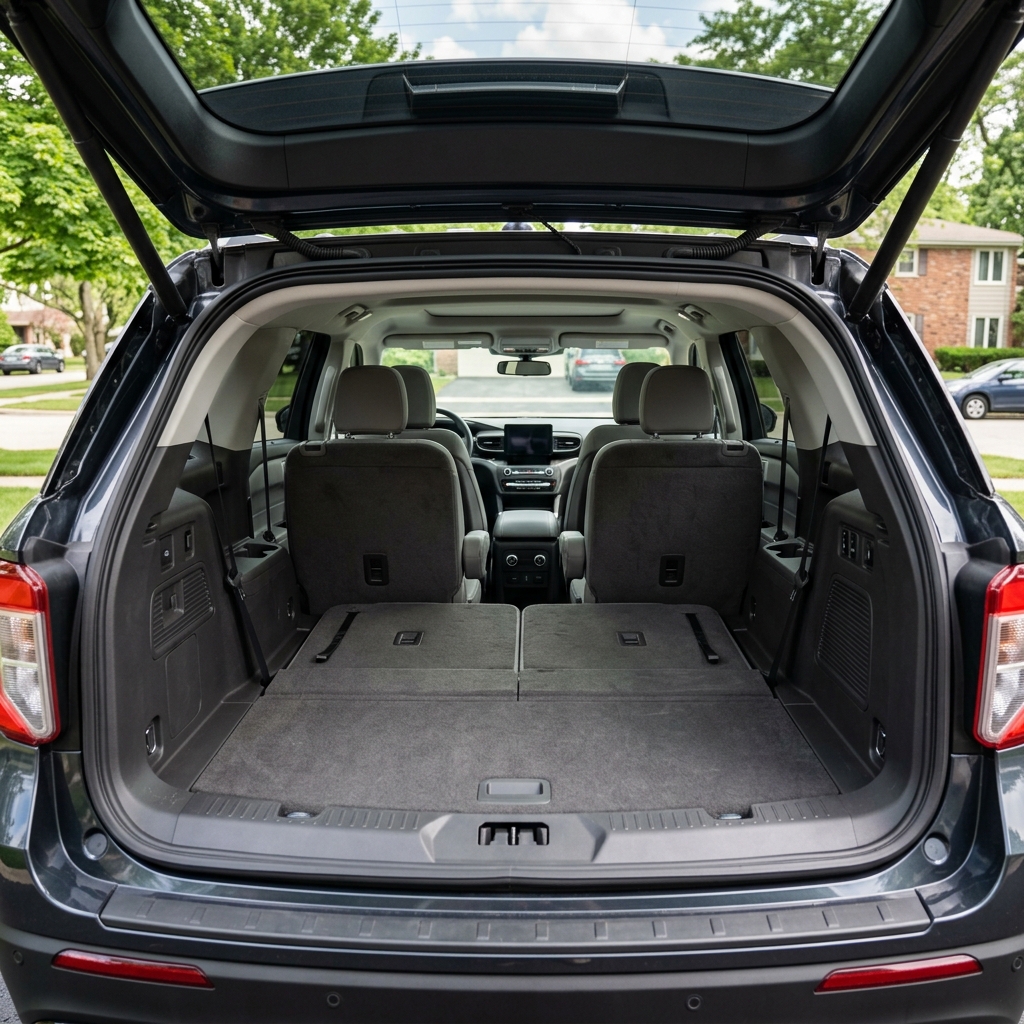
 

While captain’s chairs offer undeniable luxury and ease of access, they are not without their disadvantages. The most glaring drawback is the immediate loss of a seating position. If you are a family of five, a six-passenger Explorer with captain’s chairs forces you to use the third row 100% of the time. This means you lose a significant portion of your cargo capacity just to transport your immediate family, as you cannot keep the third row folded flat. For daily driving in Glendale Heights or commuting on I-355, this constant trade-off between passenger space and cargo room can quickly become frustrating.


Another overlooked disadvantage is the physical ‘gap’ between the two captain’s chairs. While this space serves as an excellent pass-through, it also acts as a gravity well for loose items. Groceries, backpacks, water bottles, and mobile devices have a tendency to roll off the seats and slide through the gap into the rear footwells. This is especially true during sudden stops or sharp turns on local roads. If you travel with pets, this gap also means your dog can easily wander from the back of the SUV up to the front console, creating a potential driving distraction.


Open rear trunk of a gray SUV showing a spacious cargo area with the third-row seats folded flat. (Representative image for illustration purposes only. Actual vehicle may vary based on trim and configuration.)


Finally, when you need to haul long items like lumber, skis, or camping gear, the captain’s chairs configuration prevents you from creating a completely continuous, sealed load floor. While the seats do fold flat, the open center gap remains. This means smaller items can fall through or shift unexpectedly during transit, unlike the solid, unbroken flat surface provided by a folded second-row bench seat.


Comparing Cargo Space and Third-Row Access for Glendale Heights Activities


Whether you are packing up coolers for a summer picnic at Hampe Park or loading bulky boxes from a local home improvement store, cargo volume and loading efficiency are critical. Let’s analyze how each configuration alters the cargo capability of the Ford Explorer, as well as how easily your passengers can climb into the back.


Cargo Dimensions


The overall cargo volume of the 2026 Ford Explorer is highly competitive. Behind the third row, you get 18 cubic feet of space. Fold the third row down, and that expands to 48 cubic feet. With all rear seats folded flat, the Explorer offers up to 88 cubic feet of cargo room. These numbers remain virtually identical for both seating configurations, but the utility of that space is what changes. The bench seat provides a solid floor that prevents dirt, sand, and small items from slipping into the passenger areas.


The Pass-Through Lane


With captain’s chairs, third-row passengers have a built-in walkway. This center aisle is roughly 7 to 8 inches wide, allowing children and nimble teenagers to simply walk directly to the back without moving any seats. It is an incredibly convenient feature for quick school drop-offs or when passengers are wearing heavy winter parkas that restrict their movement. It also allows third-row occupants to stretch out their legs by utilizing the center aisle space.


Tilt-and-Slide Access


To access the third row with a bench seat, you rely on Ford’s E-Z Entry system. With the press of a single button or pull of a lever, the second-row outboard seat tilts forward and slides along its tracks, creating a wide opening to climb into the third row. While this mechanism is highly engineered and easy to operate, it requires physical effort. Furthermore, if you have a child seat securely latched into that outboard position, you cannot utilize the tilt-and-slide function without first removing the car seat entirely.


What Is the MSRP Range for New Explorers, and How Does Trim Choice Affect Seating Configuration Cost?
 

The pricing structure of the 2026 Ford Explorer is highly dependent on your choice of trim level. The lineup spans from the practical Active and XLT trims, up through the luxurious Limited and Platinum, to the high-performance ST. The base MSRP for a new Explorer typically starts in the low-$40,000 range and can stretch past $60,000 for fully loaded ST or Platinum configurations. When shopping, it is essential to understand that your preferred seating layout is closely tied to these trims.


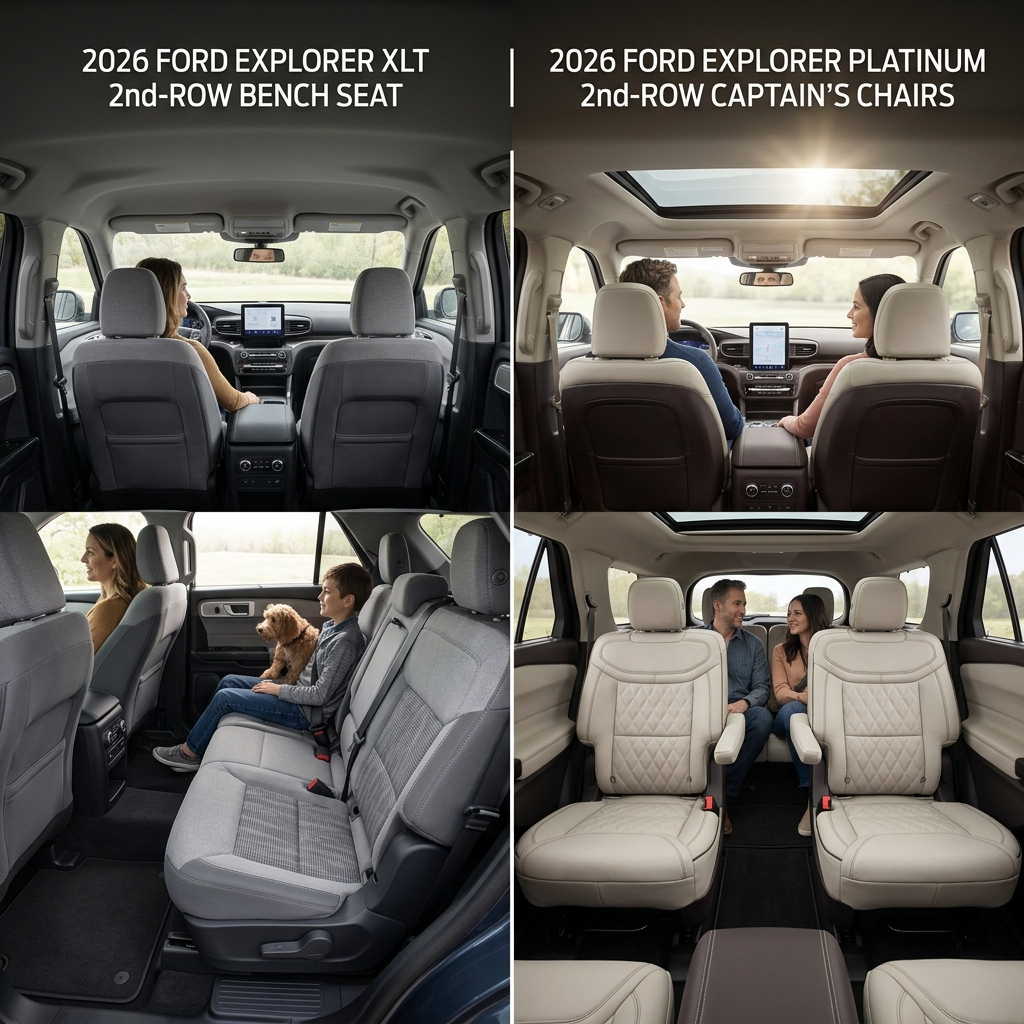
In many mid-to-high level trims like the Limited, ST, and Platinum, second-row captain’s chairs come standard. If you prefer a bench seat on these premium models, you must specifically opt for the second-row bench, which is sometimes offered as a no-cost option or a nominal credit/charge depending on the model year packaging. Conversely, on entry-level models like the Active or XLT, the second-row bench seat is often the standard offering, with the individual captain’s chairs requiring an additional package charge (often around $495 to $695).


Comparison of 2026 Ford Explorer XLT second-row bench seats and Platinum second-row captain's chairs. (Representative image for illustration purposes only. Actual vehicle may vary based on trim and configuration.)


Because these packages and standards shift dynamically, it is highly beneficial to evaluate how this affects your overall monthly payment or financing terms. To get a clear picture of your purchasing power and explore customized lease or loan packages, we invite you to Apply for Credit online. This simple, secure step saves you valuable time at the dealership and helps narrow down the perfect trim level for your budget.


What Other Key Specs Should I Consider Alongside Second-Row Seating When Shopping for an Explorer Locally?


While your seating configuration dictates your daily interior comfort, the mechanical and safety specifications of the 2026 Ford Explorer determine how the vehicle performs on Chicago’s challenging roads. When shopping for an Explorer in the DuPage County area, you should pay close attention to several critical engineering choices that will impact your ownership experience.


Feature / Spec 2.3L EcoBoost I-4 Engine 3.0L EcoBoost V6 Engine
Horsepower 300 hp @ 5,500 rpm 400 hp @ 5,500 rpm
Torque 310 lb-ft @ 3,500 rpm 415 lb-ft @ 3,500 rpm
Max Towing Capacity Up to 5,300 lbs Up to 5,600 lbs
Drivetrain Availability Rear-Wheel Drive or Intelligent 4WD Standard Intelligent 4WD (ST/Platinum)


Engine Performance: The standard 2.3-liter EcoBoost four-cylinder engine is an absolute workhorse, delivering a robust 300 horsepower and 310 lb-ft of torque. It offers a great balance of acceleration and fuel economy. If you crave a more spirited drive or plan to tow heavy trailers regularly, the available 3.0-liter EcoBoost V6 engine pumps out an impressive 400 horsepower and 415 lb-ft of torque. This V6 transforms the Explorer into a high-performance cruiser, making highway merging completely effortless.


Intelligent 4WD System: Living in northern Illinois means dealing with heavy lake-effect snow, slush, and icy winter roads. Opting for an Explorer equipped with Intelligent 4WD is highly recommended. This advanced system continuously monitors road conditions and driver inputs to seamlessly distribute power between the front and rear wheels, maximizing traction before wheel slip can even occur. Combined with the Terrain Management System, which features dedicated modes like Slippery and Deep Snow/Sand, the Explorer provides unmatched peace of mind during our harsh Midwestern winters.


Towing Capacity: If your family enjoys outdoor recreation, you’ll appreciate the Explorer’s class-leading towing capabilities. When properly equipped with the Class IV Trailer Tow Package, the 2.3L engine can tow up to 5,300 pounds, while the 3.0L V6 increases that capacity to 5,600 pounds. This is more than enough strength to haul a speed boat, a pair of jet skis, or a medium-sized camper for a weekend getaway. If you currently own a vehicle you plan to replace, we highly encourage you to Value Your Trade online to see how much equity you can apply toward your new, tow-ready Explorer.


Which Other Three-Row SUVs Besides the Explorer Offer Second-Row Captain’s Chairs?


If you are cross-shopping the midsize three-row SUV segment, you will find that several other major manufacturers offer second-row captain’s chairs. Vehicles like the Honda Pilot, Toyota Highlander, Kia Telluride, and Chevrolet Traverse all feature variations of this comfortable cabin layout. However, the Ford Explorer maintains several distinct advantages over these key competitors that make it an exceptionally compelling choice.
 

Rear-Wheel Drive Architecture


Unlike the front-wheel-drive platforms of the Honda Pilot and Toyota Highlander, the Ford Explorer is built on a performance-minded rear-wheel-drive platform. This architecture drastically improves weight distribution, steering precision, and driving dynamics, giving the Explorer a much sportier, car-like feel on the road.


Superior Towing Capability


With a maximum towing capacity of up to 5,600 pounds, the Explorer easily out-muscles the Pilot, Highlander, and Telluride, which typically max out at 5,000 pounds. If you regularly tow trailers, the Explorer’s structural rigidity and robust powertrain options provide a much more stable, confident towing experience.


Advanced Safety Features


The Ford Co-Pilot360 suite comes standard on the Explorer, providing a comprehensive collection of driver-assist technologies. This includes Pre-Collision Assist, Blind Spot Information System (BLIS), and Lane-Keeping Assist, helping keep your family protected on busy suburban streets and highways.


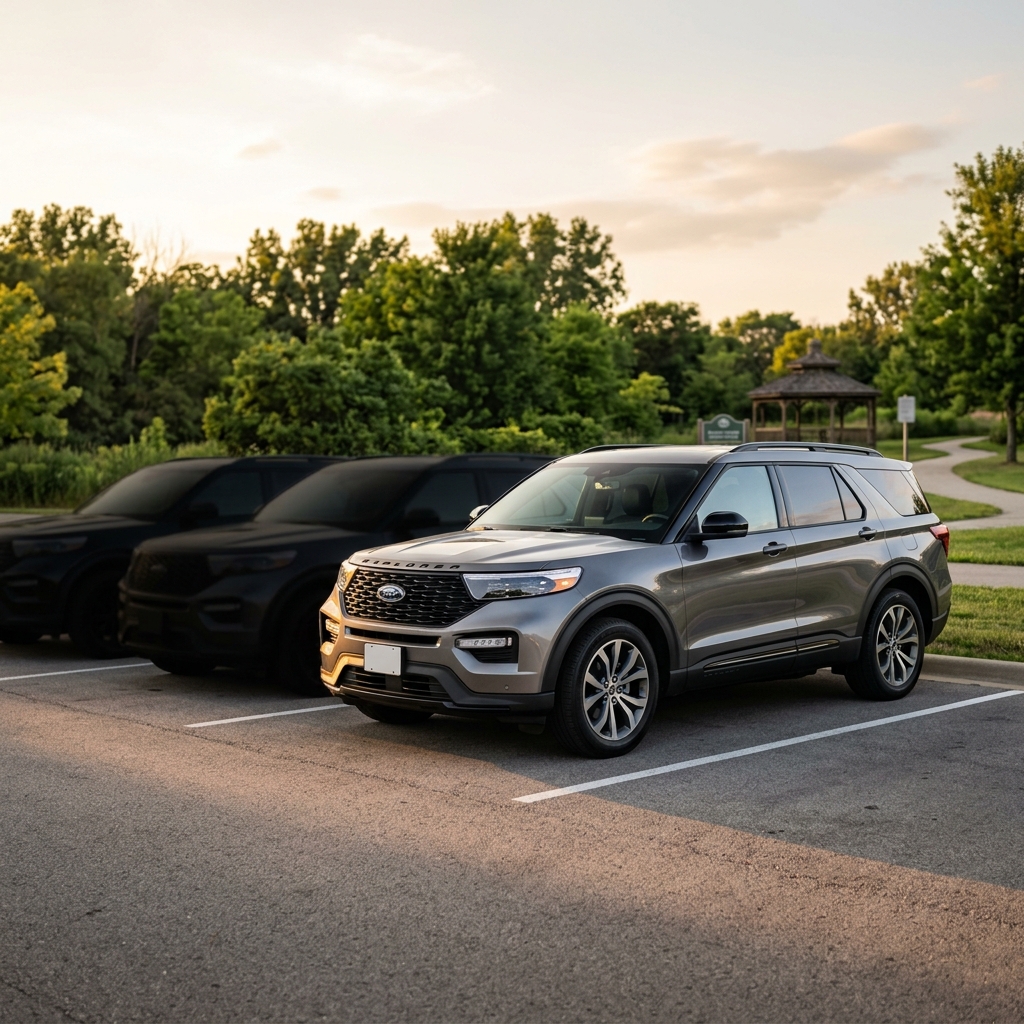
A silver Ford Explorer parked in a paved lot next to two black SUVs during sunset. (Representative image for illustration purposes only. Actual vehicle may vary based on trim and configuration.)


By combining this high-performance foundation with an incredibly versatile interior, the Explorer proves that you do not have to sacrifice driving pleasure for family utility. Whether you opt for the passenger-focused captain’s chairs or the cargo-friendly bench, you are investing in a vehicle designed to excel in every metric.


How Illinois Weather and Family Lifestyles in Bloomingdale Shape Your Seating Decision


Living in the Bloomingdale and Carol Stream area means preparing for dynamic, often unpredictable weather. Our local lifestyle requires vehicles that can seamlessly transition from hot, humid summer afternoons spent at the park to freezing, snow-covered winter mornings. Your choice of second-row seating can play a surprising role in how comfortably your family navigates these seasonal changes.


During our freezing winters, cabin heating efficiency is a major comfort factor. In an Explorer equipped with second-row captain’s chairs, the center pass-through allows warm air from the front climate zones to circulate more rapidly into the third row. Additionally, because captain’s chairs are individual seats, they often come equipped with independent heating elements on mid-to-high trim levels. This means your second-row passengers can enjoy heated seats, helping them warm up quickly after a chilly morning hockey practice or a winter walk.


In contrast, the second-row bench seat acts as a physical thermal barrier. While this can slow down the initial warming of the third-row area, it actually helps keep the front and middle rows insulated and cozy by trapping heat in the main cabin space. Furthermore, the bench seat is ideal for active families who deal with mud, slush, and wet gear. By covering the entire floor with a durable, continuous all-weather floor mat, you can prevent melting snow and mud from reaching the carpets. With captain’s chairs, the open center carpet is highly vulnerable to salt stains and wet boots if not protected by a specialized pass-through floor liner.


Consider your family’s primary activities. If you are constantly hauling muddy sports equipment, wet dogs, or home improvement gear, the continuous flat floor of the folded bench seat is incredibly practical. If your primary focus is keeping teenage passengers separated and perfectly comfortable on long drives to out-of-town tournaments, the individualized comfort of the captain’s chairs is tough to beat.


Test Drive Both Seating Layouts at Hawk Ford of Carol Stream


No amount of reading can completely substitute for the physical experience of sitting in both cabin configurations. At Hawk Ford of Carol Stream, we invite you to bring your entire family—including your child safety seats—to our showroom. You can physically install your car seats, climb into the third row, test the E-Z Entry tilt-and-slide mechanism, and feel the individual comfort of the second-row captain’s chairs for yourself.

 

Hawk Ford car dealership building exterior on a clear day.


Our highly knowledgeable sales professionals are here to answer all your questions and help you compare different trim packages side-by-side. Additionally, we are fully committed to supporting you throughout your entire vehicle ownership journey. From our expert finance department to our state-of-the-art service center, we provide the resources you need. If you ever require routine maintenance or factory-certified replacement parts down the road, you can easily Schedule Service Now or visit our dedicated Parts Center to keep your Ford running like new.


Find Your Perfect Ford Explorer Match in Carol Stream Today


Your family deserves an SUV that fits seamlessly into your life, making every commute, school run, and vacation completely stress-free. Whether you choose the luxurious ease of second-row captain’s chairs or the maximum utility of a seven-passenger bench, Hawk Ford of Carol Stream is here to help you drive home in your dream Ford Explorer. Browse our expansive inventory online, Call us at (630) 233-9696 to speak with an advisor, or stop by our showroom today!


}