What Emergency Warning Signs Require Immediate Suspension Repair?
Your vehicle’s suspension system is far more than a luxury designed to ensure a smooth ride—it is a critical safety system responsible for keeping your tires firmly connected to the asphalt, maintaining steering stability, and controlling vehicle body motion during sudden stops and sharp turns. When components within this intricate network of springs, shocks, struts, control arms, and ball joints fail, your ability to safely control your vehicle diminishes exponentially.
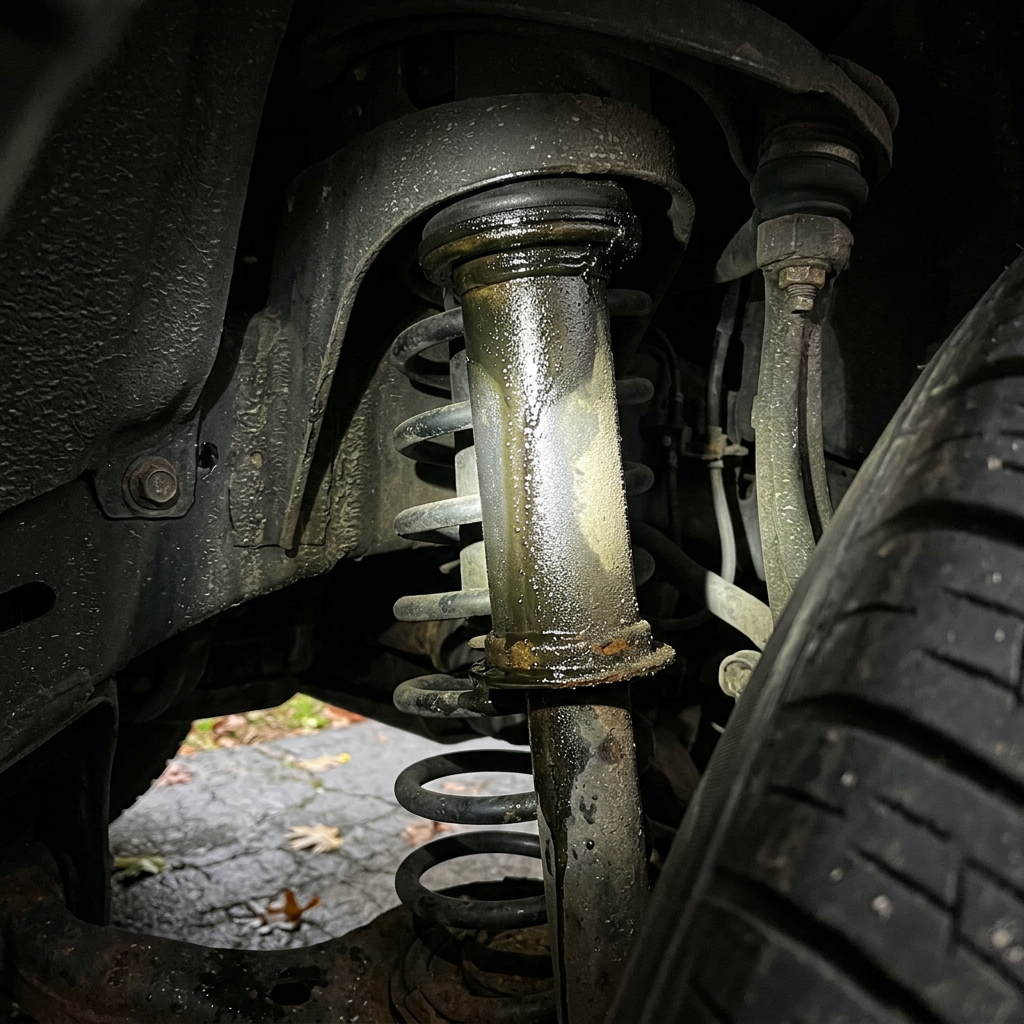
Recognizing key warning signs early can mean the difference between a routine maintenance visit and a catastrophic hardware failure on high-speed thoroughfares like North Avenue or I-355. Critical emergency red flags include severe vehicle pulling to one side, dangerous nose-diving when braking, visible hydraulic fluid leaking from shock absorbers or strut housings, violent metallic clunking sounds over road irregularities, and visible vehicle corner sagging. Driving with broken suspension components drastically increases stopping distances, severely compromises directional stability, and exposes you and your passengers to extreme safety hazards. If you suspect severe component compromise,
schedule service now with factory-trained experts to diagnose and repair the issue before it leads to total mechanical control failure.
Severe Driving Instability: Recognizing Critical Red Flags That Demand Immediate Towing or Service
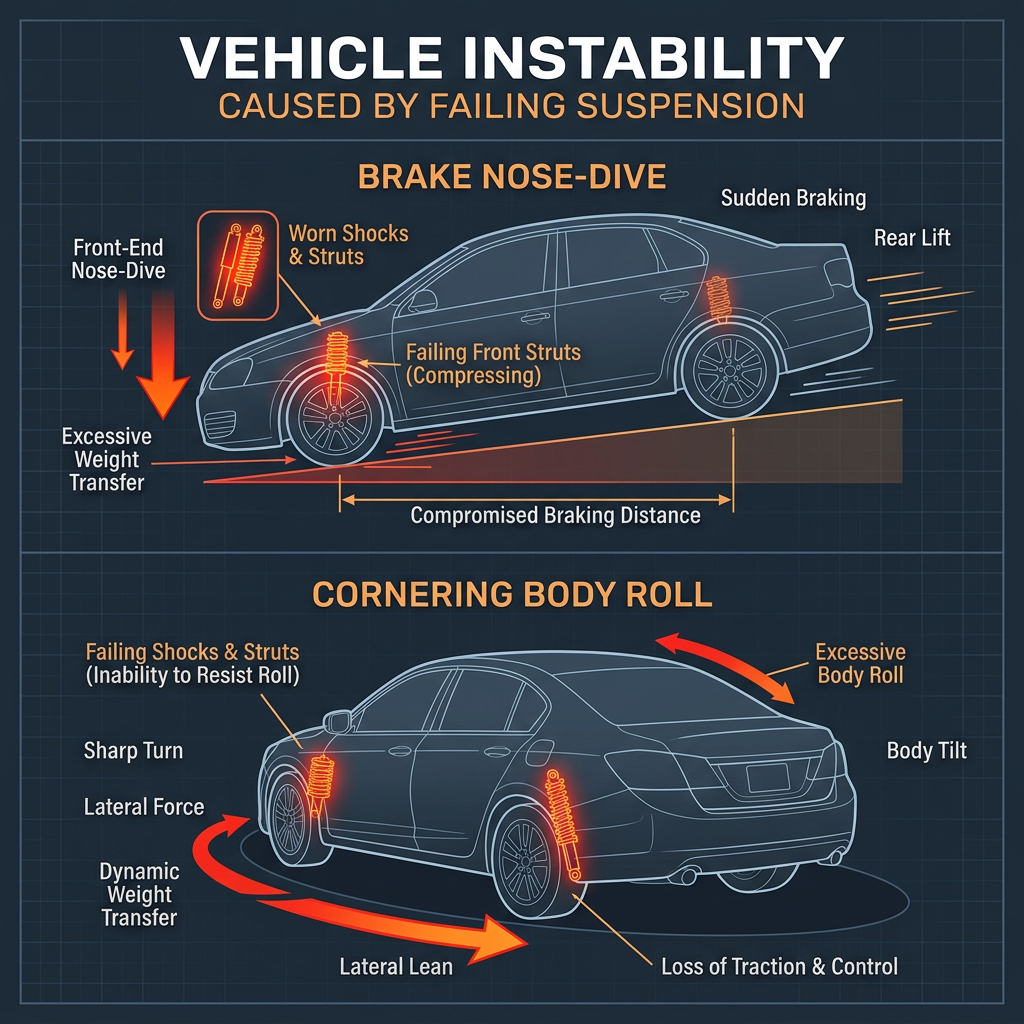
When suspension components suffer major structural fatigue or mechanical fracture, vehicle dynamics change rapidly. One of the most severe indicators of immediate failure is extreme body roll or lean while negotiating routine turns. If your car or SUV pitches heavily to one side at moderate speeds through local intersections in Carol Stream or Glendale Heights, your sway bar, sway bar links, or coil springs may be fractured.
Another critical red flag is severe front-end nose-diving during braking. When struts or shocks lose internal hydraulic fluid or dampening pressure, the front weight of your vehicle surges forward violently under braking. This motion unweights the rear tires, reducing rear traction and extending your total stopping distance by up to 20%—a dangerous situation in heavy traffic.
Furthermore, if you experience violent steering wheel shaking, continuous highway lane drift, or persistent car bouncing after hitting routine road bumps, your vehicle is unsafe to operate at highway speeds. Severe instability under load demands immediate roadside assistance or flatbed towing directly to a certified repair facility.
Strange Auditory Cues: Diagnosing Clunking, Squeaking, and Grinding Sounds Below Your Chassis
Metallic Clunks & Thumps
Heavy metallic clanking or thumping noises when driving over small bumps, potholes, or expansion joints usually signify snapped coil springs, completely blown strut mounts, or severed stabilizer bar end links. These metal-on-metal impacts mean the component can no longer absorb energy, passing destructive forces straight into your frame.
Dry High-Pitched Squeaks
Pitched squeaking or creaking sounds that occur when going over speed bumps or turning the steering wheel point toward dry, unlubricated ball joints or dry-rotted rubber control arm bushings. Without proper lubrication, friction rapidly grinds down joint internals until total mechanical separation occurs.
Deep Grinding & Popping
Deep grinding signals severely damaged strut top bearing plates, while distinct popping or snapping sounds while turning indicate failing constant velocity (CV) joints or dangerously worn steering tie-rod ends. These symptoms indicate components on the verge of total binding or complete collapse.
What Are the Signs of Bad Control Arms and Ball Joints?
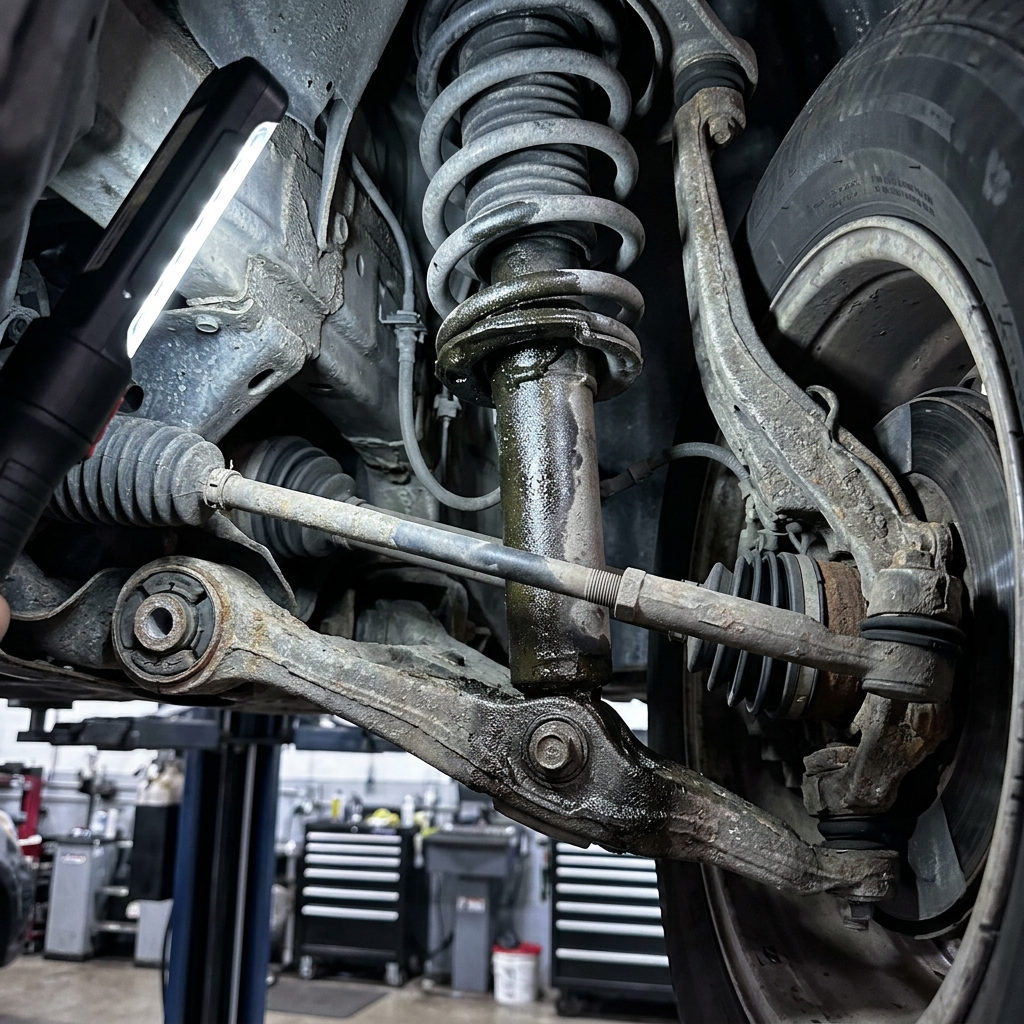
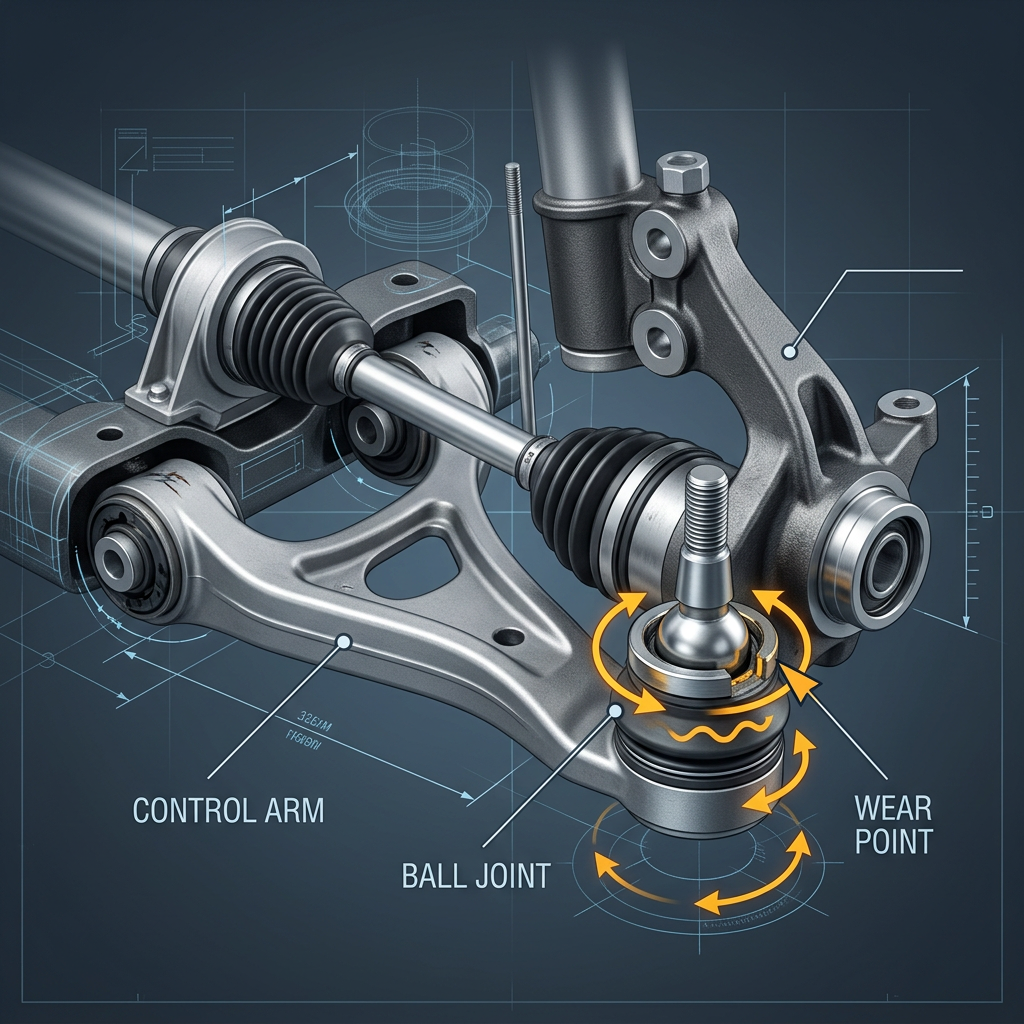
Control arms and ball joints serve as the critical mechanical hinges that connect your wheels to your vehicle’s frame. Control arms manage wheel alignment and vertical movement, while ball joints provide a pivot axis for steering. When these parts deteriorate, safety drops significantly.
Primary symptoms of failing control arms and worn rubber bushings include persistent steering wander—where the vehicle drifts left or right despite holding the steering wheel straight—and erratic steering response. Worn ball joints manifest as popping or clicking noises during sharp low-speed maneuvers, paired with severe, uneven wear along the inner edge of your front tires.
The ultimate hazard of ignoring ball joint wear is complete separation while driving. If a ball joint fails entirely, the wheel disconnects from the upper or lower control arm, slamming into the wheel well and instantly causing a severe crash. Immediate inspection is essential at the first sign of popping or steering instability.
What Is Tire Cupping and How Does Bad Suspension Cause Scalloped Tread Patterns?
Tire cupping—also referred to as scalloping—is a distinct, high-risk pattern of irregular wear characterized by smooth, scooped-out valleys or dips across the tread perimeter. Rather than wearing down flat and evenly, the rubber resembles a series of wavy hills and valleys around the tire circumference.
This condition is almost exclusively caused by severely worn or blown shock absorbers and strut dampers. When a shock absorber loses its valving or hydraulic fluid, it can no longer damp the vertical movement of the coil spring. Instead of remaining planted firmly against the highway pavement on North Avenue or I-355, the tire literally bounces down the road thousands of times per minute. Every time the tire re-engages the asphalt after bouncing, friction carves out a small section of rubber.
Driving on cupped tires creates a loud, low-frequency humming or roaring sound inside the cabin that mimics a failed wheel bearing. More importantly, cupped tires create intense wheel vibration at high speeds, reducing brake traction on wet roads and causing premature destruction of underlying wheel bearings and steering gear.
Simply replacing worn cupped tires without addressing worn shocks or struts will result in the new set suffering identical scalloping within just a few thousand miles.
How to Perform a DIY Suspension Check: Visual Inspection and the Bounce Test
Step 1: The Push-Down Bounce Test
Park your vehicle on flat, level ground. Walk to one corner, place both hands firmly on the bumper or fender frame, and push down with all your weight to compress the suspension. Release suddenly. A healthy strut or shock will rebound once and instantly stabilize. If the body bounces two, three, or more times, the internal valving is worn and replacement is required.
Step 2: Hydraulic Leak Visual Test
Turn your front wheels fully outward and shine a flashlight into the wheel arch. Inspect the metal body of the shock absorber or strut. A light film of road dust is normal, but visible wet, dark hydraulic oil coating the exterior cylinder indicates damaged shaft seals that require replacement.
Step 3: Corner Height Check
With the vehicle unloaded on level pavement, measure the distance from the center of each wheel hub straight up to the top edge of the fender arch. Compare all four corners. A height disparity greater than 0.5 to 0.75 inches on one corner usually indicates a cracked, sagging, or collapsed coil spring.
How Much Does It Cost to Replace Shocks and Struts Individually Versus in Pairs?
A frequent question from vehicle owners experiencing suspension degradation is whether it is acceptable to replace only one blown shock or strut rather than both across an axle pair. While replacing a single unit carries a lower initial invoice, automotive engineers universally recommend replacing shocks and struts in axle pairs (both fronts or both rears simultaneously).
When a new strut with 100% dampening resistance is paired with an older strut that has lost 40% of its dampening strength, the vehicle’s dynamic handling becomes asymmetrical. Under emergency braking or sharp steering maneuvers, the side with the older strut compresses faster and further, causing unpredictable vehicle rotation, uneven body roll, and dangerous stability control intervention.
| Service Factor |
Single Unit Replacement |
Axle Pair Replacement |
| Handling & Balance |
Uneven roll & pulling |
Perfect left/right symmetry |
| Four-Wheel Alignment |
Required ($100-$150) |
Required once ($100-$150) |
| Labor Cost Efficiency |
Pays labor twice when 2nd fails |
Bundled labor saves up to 30% |
| Tire Longevity |
Accelerates wear on weak side |
Ensures even tread wear |
Are Aftermarket Suspension Components Cheaper Than OEM Parts?
When budgeting for major suspension repairs, drivers often evaluate generic aftermarket replacement parts against Original Equipment Manufacturer (OEM) components built specifically by the auto manufacturer. While low-grade aftermarket shocks and control arms may advertise lower retail price tags, they frequently compromise quality, fitment precision, and long-term durability.
Generic components are manufactured with compromise dimensions to fit dozens of different vehicle models, often resulting in minor fitment offsets, altered ride heights, and premature bushing degradation. OEM components, such as genuine Motorcraft hardware, are engineered precisely to your vehicle’s original curb weight, spring rates, and safety specifications.
Furthermore, factory OEM replacement parts installed at authorized dealer centers come backed by a comprehensive nationwide warranty covering both parts and labor for 2 years with unlimited mileage. Generic auto parts stores rarely cover labor costs when their budget components fail prematurely. Contact our specialized
Parts Center team to check precise OEM factory replacement availability for your vehicle.
How Chicagoland Winter Freeze-Thaw Cycles and Potholes Accelerate Suspension Wear in Carol Stream
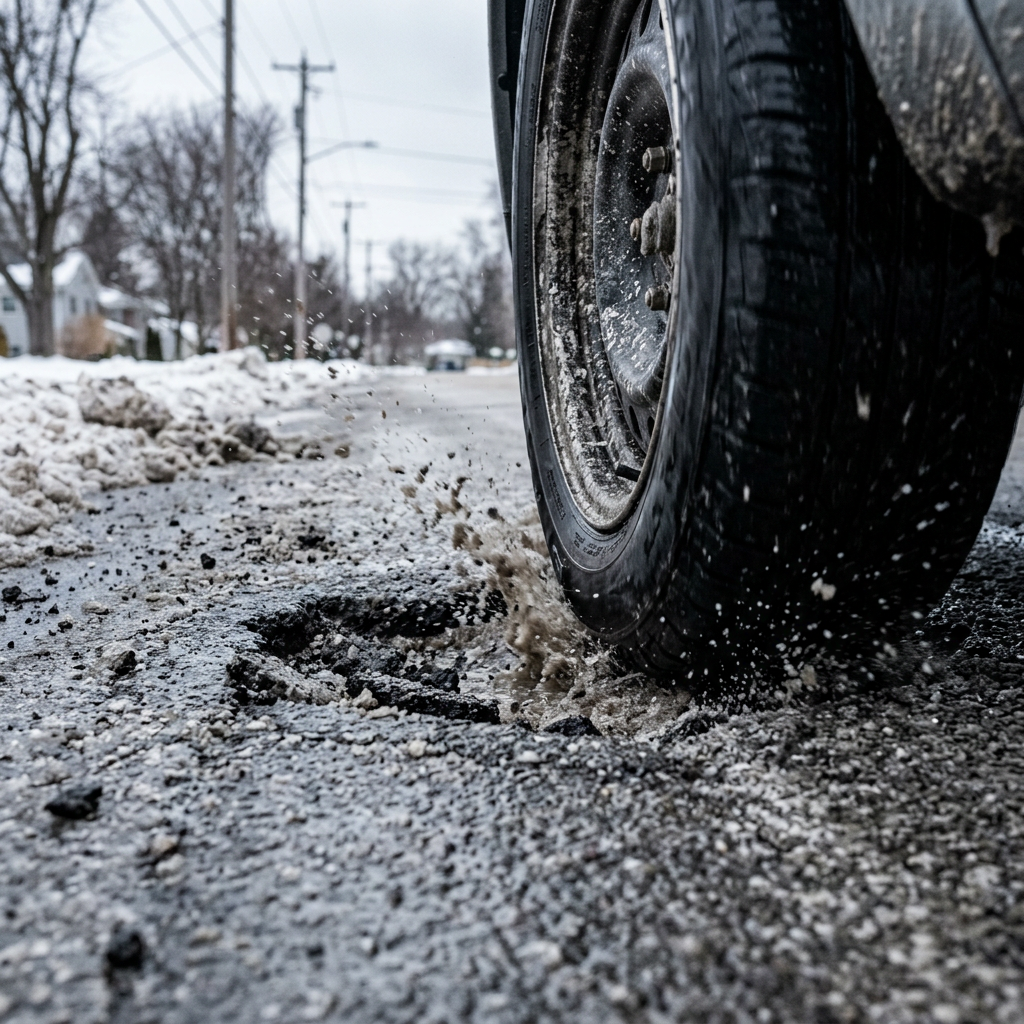
Vehicle owners operating in Carol Stream, Bloomingdale, and surrounding DuPage County communities encounter uniquely punishment-heavy roadway conditions every year. The brutal Chicagoland winter freeze-thaw cycle forces moisture deep into cracking asphalt on major thoroughfares. As temperatures drop below freezing, expanding ice explodes road surfaces from beneath, opening severe, deep-edged potholes across high-volume commuter routes.
Impacting a sharp crater-like pothole at 45 MPH transfers thousands of pounds of kinetic energy directly into your suspension geometry. These severe blunt forces bend control arms, crack coil springs, rupture internal strut dampening valves, and throw wheel alignment out of tolerance instantly. Compounding this structural stress is heavy winter road salt exposure. Highly corrosive magnesium and calcium chloride compounds accelerate oxidation on exposed steel springs, deteriorating rubber ball joint boots and seizing alignment cam bolts solid.
Signs of Bad Suspension and When to Schedule Repairs: Immediate vs Maintenance Timelines
TIER 1: Immediate Tow Required
• Fractured or snapped coil spring
• Completely separated ball joint
• Wheel collapsed inside fender arch
• Total loss of steering direction control
• Severe frame strut tower tearAction: Do not drive. Tow immediately.
TIER 2: Repair Within 48 Hours
• Active hydraulic oil leaking on shocks
• Severe front-end nose-diving under braking
• Pronounced tire cupping or tread scalloping
• Loud metallic clunking over small bumpsAction: Limit speed and repair within 48 hours.
TIER 3: Routine Maintenance
• Slight vehicle drift on highway
• Minor squeaking from rubber bushings
• Vehicle mileage approaching 80,000 miles
• Slight bounce during manual push-testAction: Inspect during next oil change.
Professional Suspension Diagnostics: What to Expect at Hawk Ford of Carol Stream
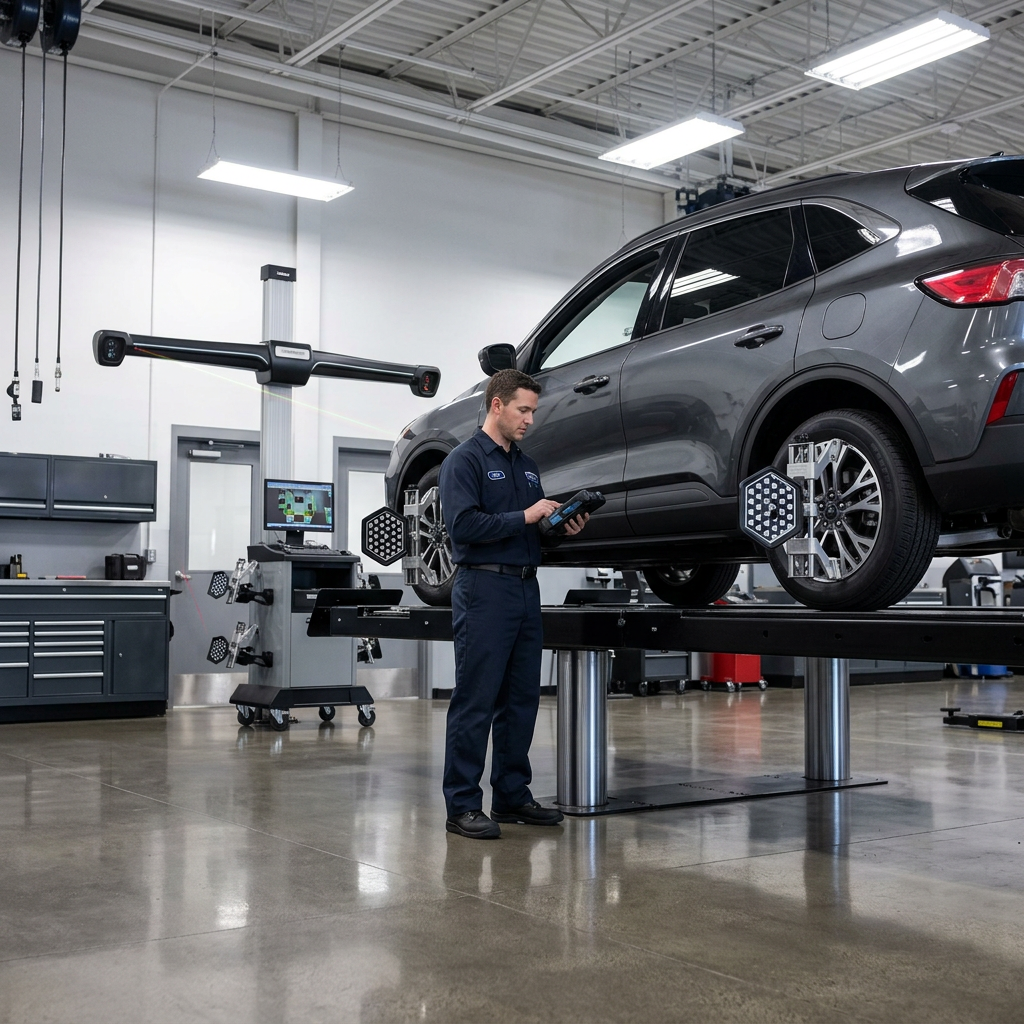
When you bring your car, truck, or SUV to Hawk Ford of Carol Stream for suspension evaluation, our factory-certified master technicians utilize state-of-the-art diagnostic tools to isolate hidden wear points. Every inspection begins with a comprehensive road test to evaluate high-speed dampening, steering center tracking, and braking pitch.
Once in our service bay, we raise your vehicle to perform a multi-point steering and chassis inspection, utilizing mechanical dial indicators to measure microscopic play in ball joints and tie-rod ends. Following component replacement, your vehicle undergoes a precision digital laser four-wheel alignment to calibrate caster, camber, and toe settings back to exact factory specifications.
We offer rotating service specials, transparent upfront estimates, genuine OEM replacement parts, and flexible service financing options to ensure your essential safety repairs fit comfortably into your household budget.
Don’t Risk Steering Safety: Schedule Certified Suspension Service at Hawk Ford of Carol Stream
Never ignore steering drift, metallic chassis clunks, erratic tire cupping, or front-end nose-diving under braking. Continuing to operate a vehicle with compromised suspension components endangers your passengers and dramatically increases repair costs when failing parts damage surrounding mechanical systems.
Trust the certified chassis specialists at Hawk Ford of Carol Stream to restore your vehicle’s factory ride comfort, precise steering control, and maximum stopping performance. Visit us at 175 North Ave, Carol Stream, IL 60188 or call our service department at
(630) 233-9696. You can also
Get Directions to Hawk Ford of Carol Stream for direct walk-in consultation.



0 comment(s) so far on Emergency Suspension Repair Warning Signs