Do Electric AWD Systems Respond Faster on Ice Than Mechanical AWD?
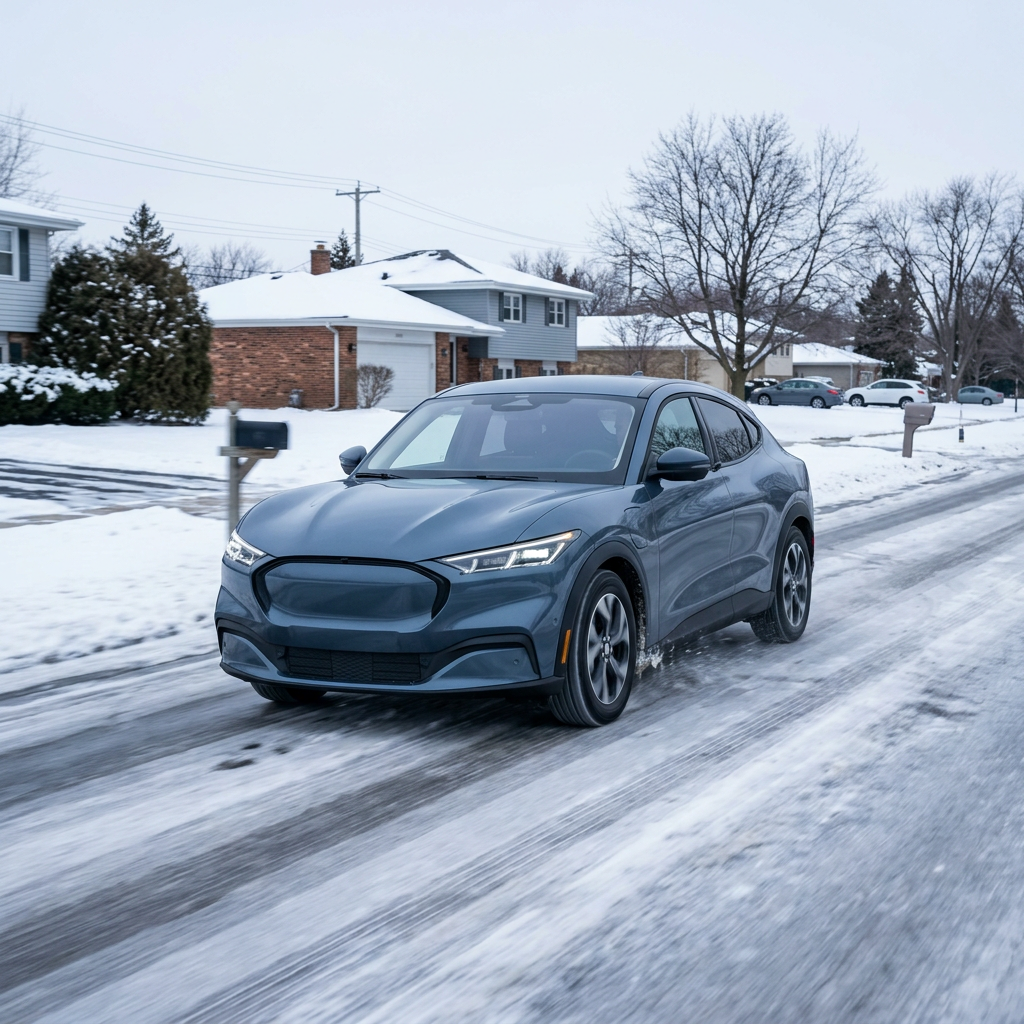
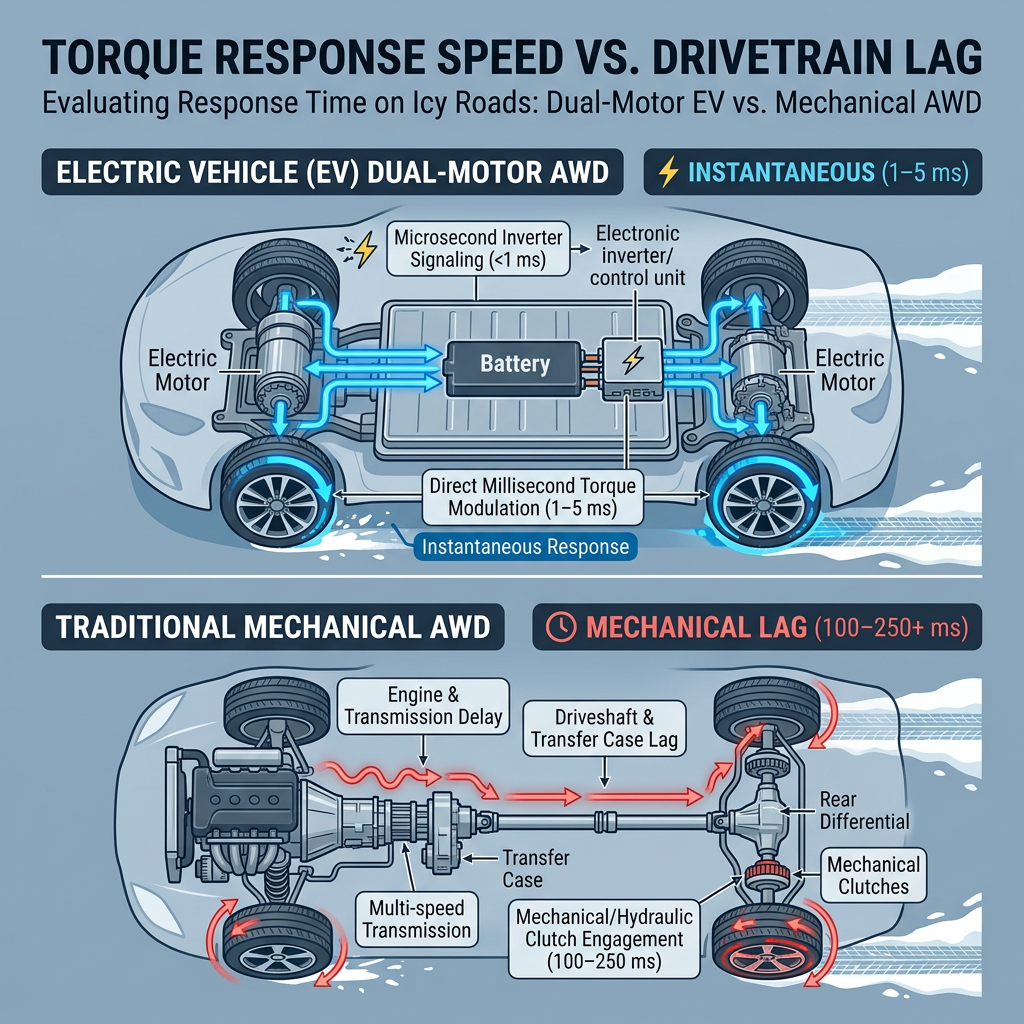
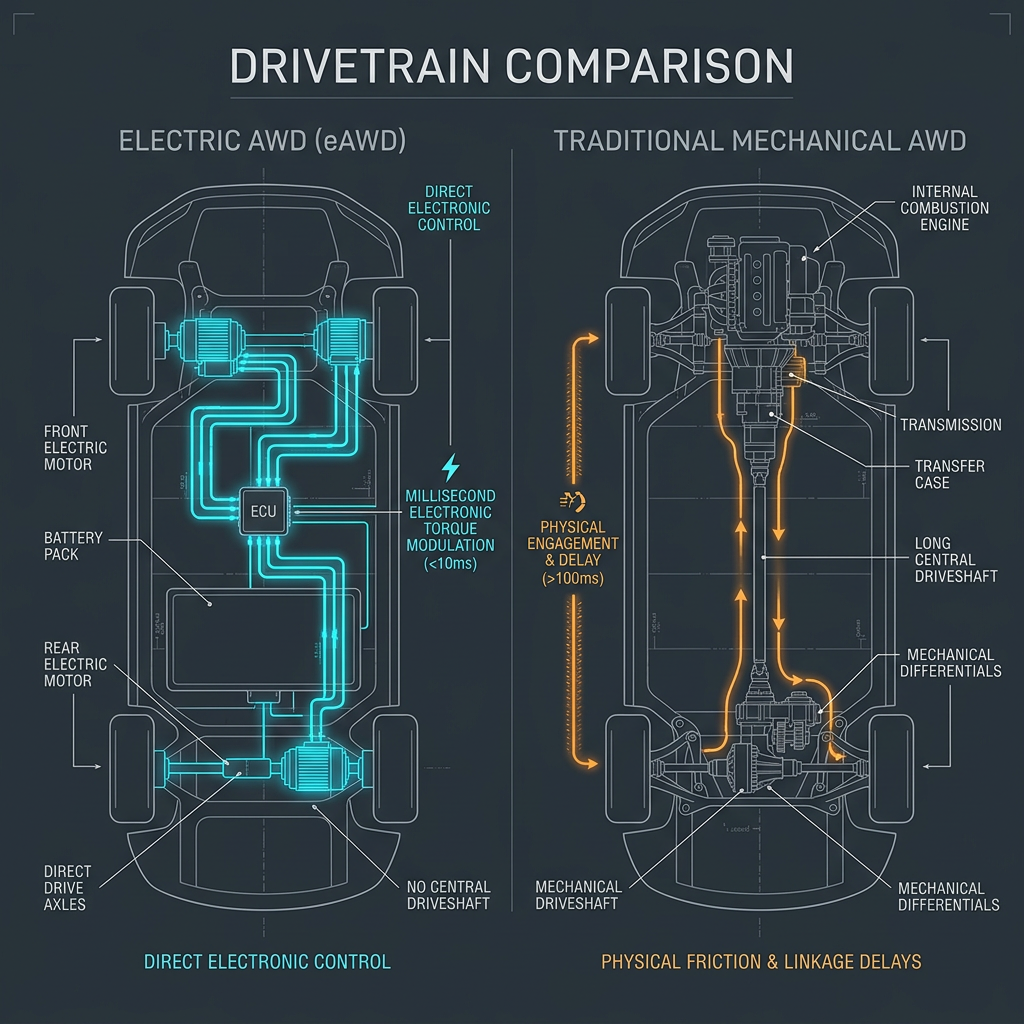
When sub-zero Chicagoland winter storms hit DuPage County, drivers traversing North Avenue and Army Trail Road face one of the most unpredictable hazards on the road: black ice. The short answer to whether electric drive systems respond faster on icy roads than traditional mechanical All-Wheel Drive (AWD) is an emphatic yes. Electric drive systems adjust torque output in milliseconds, compared to the tens or hundreds of milliseconds required for conventional combustion engine vehicles with mechanical transfer cases, driveshafts, and differential clutches to engage.
In a traditional gasoline vehicle, when a tire loses grip on a patch of sleet or ice, slip detection depends on physical rotation changes that trigger mechanical switches, hydraulic pressure building within a clutch pack, or viscous fluid resistance inside a transfer case. By the time that physical chain reaction occurs, the vehicle may already have begun to slide. In contrast, an electric vehicle like the Ford Mustang Mach-E utilizes electronic motor controllers that communicate directly with wheel speed sensors thousands of times per second. Power can be modulated instantly at the electric motor shaft without waiting for engine revs to change or mechanical gears to bind.
Millisecond Torque Control: The Physics of EV Drive Motors vs Mechanical AWD
To understand why electric drive dominates slick surfaces, one must compare the fundamental physics of internal combustion powertrains against electric motor architecture. In a traditional gas vehicle, engine torque travels through a torque converter or clutch, through a multi-speed transmission, along a central driveshaft, into a transfer case, and finally out to front and rear differentials. When a tire spins on ice, torque vectoring requires mechanical braking application or clutch lockup—processes bound by mechanical inertia and hydraulic actuation delays.
Electric drive systems eliminate these physical bottlenecks entirely. Electric motors produce full torque instantly from zero RPM, controlled by silicon-carbide inverters that switch electric current at microsecond speeds. When wheel slip occurs on icy Carol Stream side streets, the power output to that specific electric motor can be reduced or redistributed up to 20 times faster than a engine’s throttle body can respond or a mechanical clutch can open.
| System Characteristic |
Electric eAWD (Mustang Mach-E) |
Traditional Mechanical Gas AWD |
| Response Latency |
10 – 20 Milliseconds |
100 – 300 Milliseconds |
| Torque Adjustment Method |
Direct Inverter Frequency Shift |
Mechanical Clutches & Engine Throttle |
| Torque Split Capability |
100% Front or Rear Independently |
Fixed Ratios (e.g. 50/50 max rear split) |
| Sub-Zero Fluid Drag |
None (Direct Electromagnetic Drive) |
High (Thick Transfer Case / Diff Fluid) |
How Does the Mustang Mach-E eAWD System Split Torque Between Axles in Snow?
Front Motor Control
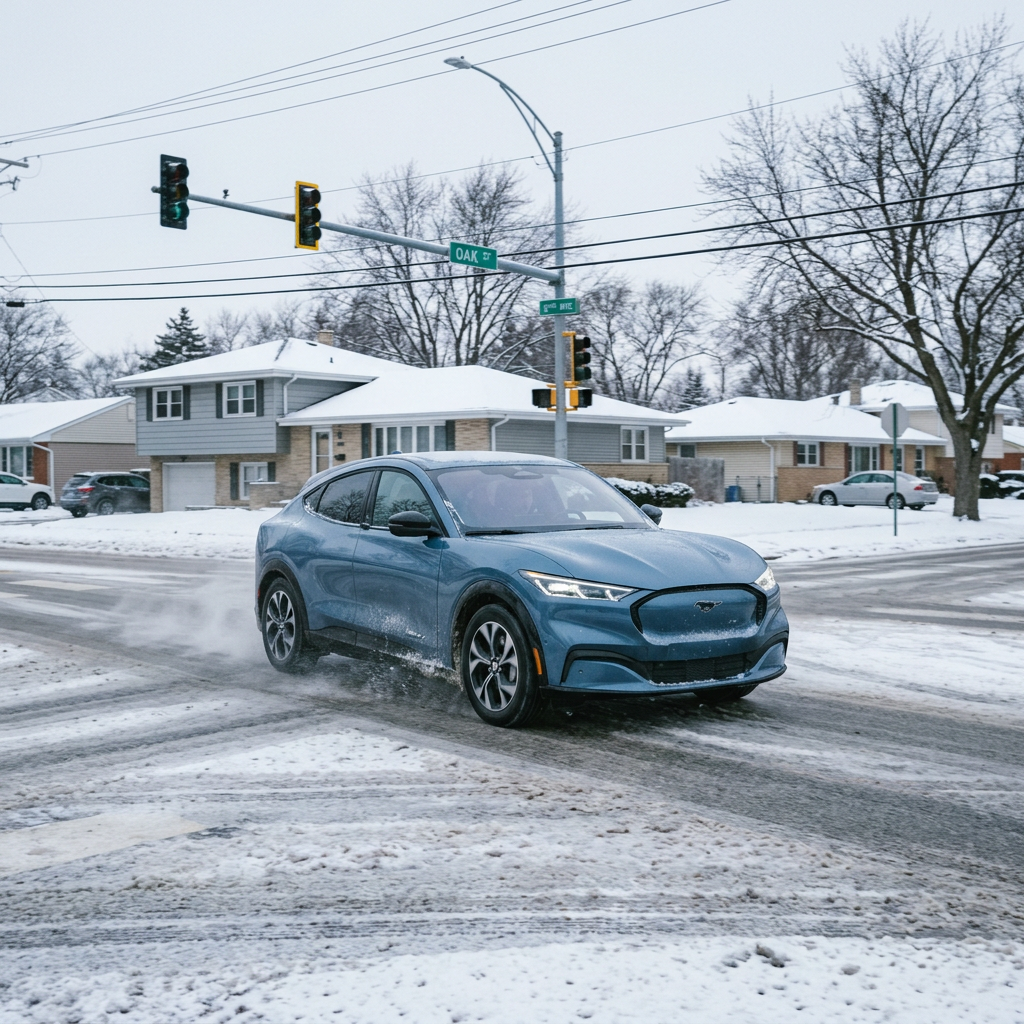
The front primary or secondary electric motor on the Mustang Mach-E handles precise steering stabilization and directional traction. In heavy slush or snow, it modulates pull force to keep the vehicle pointed straight along Gary Avenue without causing front end push or understeer.
Rear Motor Dynamics
The rear electric motor provides smooth propulsion and immediate launching power. When pulling out onto Route 64 (North Avenue) during an active snowfall, independent rear-motor management prevents power hop and limits rear break-out before stability systems are forced to intervene.
Independent Micro-Adjustments
Because there is no physical driveshaft connecting the axles in Ford eAWD, the onboard computer can split torque 0/100, 50/50, or 100/0 front-to-rear continuously. Processing data thousands of times per second, it delivers predictive stability before human drivers even feel a loss of grip.
Test Drive Ford eAWD Technology at Hawk Ford of Carol Stream
Experience the near-instantaneous control of dual-motor Ford electric drive firsthand. Whether you are coming from Bloomingdale, Wheaton, or West Chicago, our sales specialists at Hawk Ford of Carol Stream can walk you through the advanced driver-assist features and show you why eAWD is changing winter commuting across northern Illinois. Explore our latest
new Mustang Mach-E inventory today.
How Much Range Does the Ford Mustang Mach-E Lose in Cold Chicagoland Winter Weather?
Cold weather naturally affects all motor vehicles. While gas engines experience reduced fuel economy due to winter fuel blends and idling, electric vehicles experience range loss caused by reduced lithium-ion electrochemical mobility and cabin heating demand. During typical Chicagoland winter temperatures ranging from 10°F to 30°F, drivers can expect a temporary range reduction of roughly 20% to 30%.
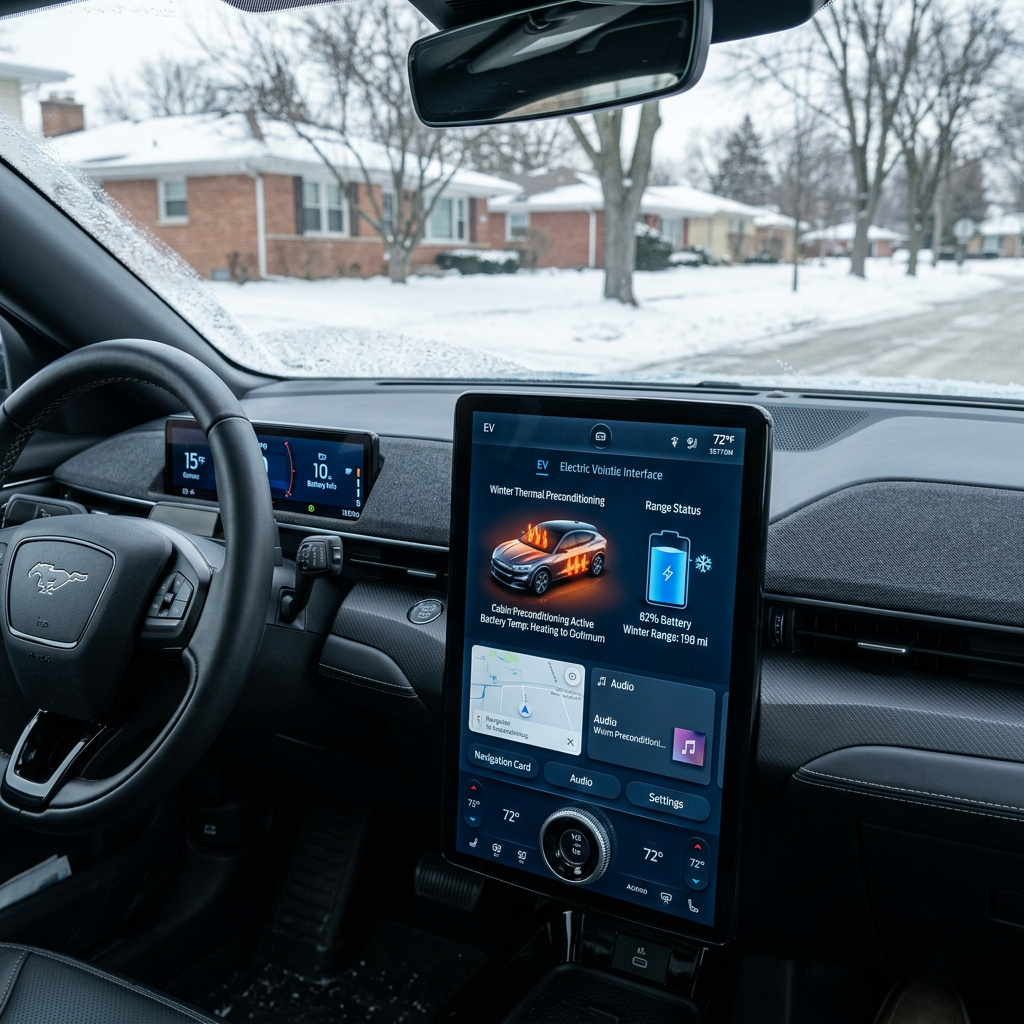
It is important to understand that cold temperatures do not damage the battery pack permanently; chemical activity slows down when cold, temporarily holding back full battery capacity. Once the battery warms to its optimal operating temperature window, standard driving range returns completely. Utilizing built-in preconditioning strategies can drastically reduce this cold-weather penalty during daily suburban commutes.
How Do You Schedule Departure Times and Preconditioning in the FordPass App?
Step 1: Plug In at Home
Connect your Mustang Mach-E to a 240V Level 2 charger at home overnight. Preconditioning draws energy directly from the electrical grid, saving 100% of your high-voltage battery charge for driving.
Step 2: Set Departure Schedule
Open the FordPass app on your mobile device, select ‘Vehicle’, navigate to ‘Departure Times’, and choose your habitual morning commute time (e.g., 7:30 AM weekdays). Set your desired cabin temp.
Step 3: Thermal Optimization
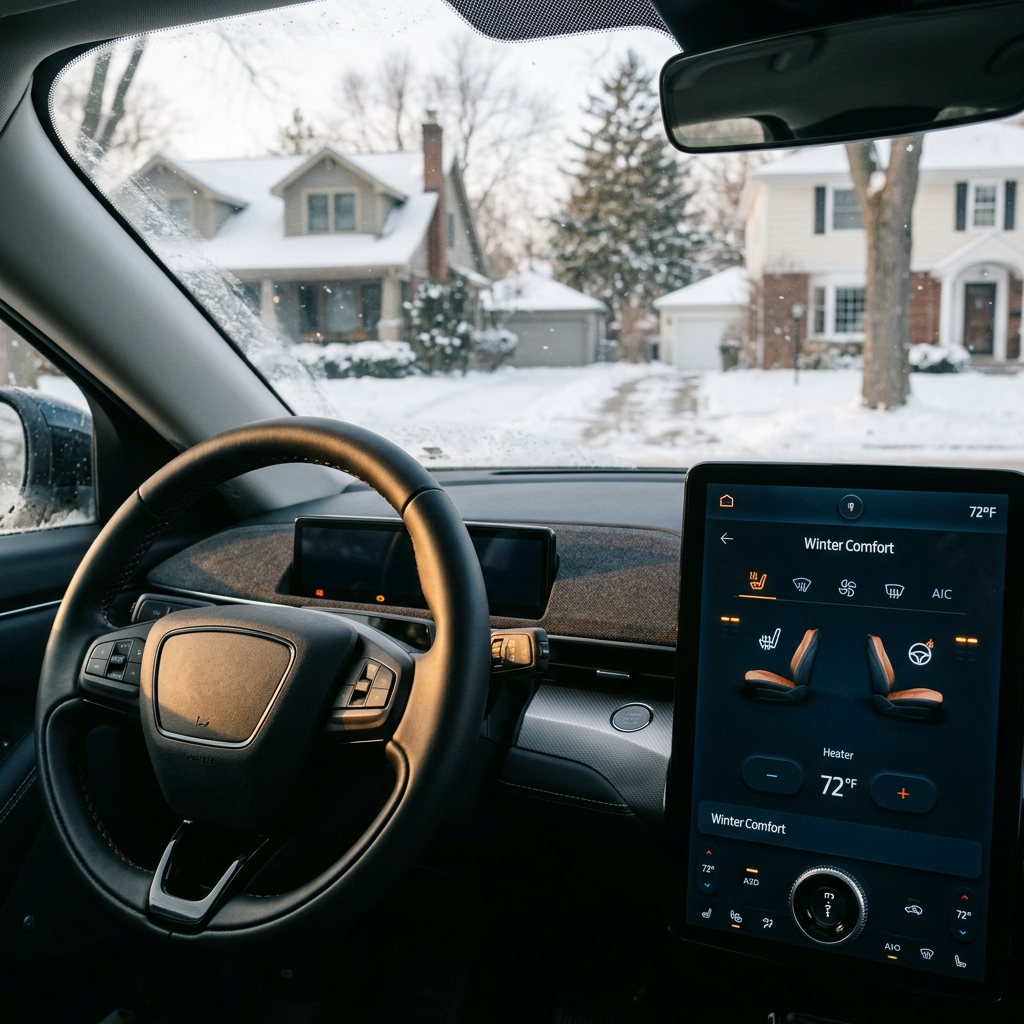
30 to 45 minutes prior to departure, your Mach-E automatically warms its liquid-cooled battery pack to the ideal operating window while defrosting windows and warming your cabin and heated steering wheel.
Does the Mustang Mach-E Handle Cold Weather Cabin Heating Better Than the Tesla Model Y?
In extreme Midwest freeze conditions, cabin heating performance becomes a safety feature as much as a comfort feature. When evaluating the Ford Mustang Mach-E against competitors like the Tesla Model Y, key differences in cabin climate control engineering and thermal insulation emerge during winter testing.
The Mustang Mach-E features robust weather-sealing, thick acoustic glass options, and standard high-output electric heating elements designed for quick windshield defrosting. Ford’s interior design retains physical air direction louvers and predictable defrost controls, whereas many drivers find Tesla’s touch-screen-only defrost adjustments more distracting to operate while wearing winter gloves on frozen roads.
Schedule Winter EV Maintenance & Tire Service in Carol Stream
To maintain optimal eAWD traction on ice, your electric vehicle requires proper winter tires, accurate alignment, and cold-weather multi-point inspections. Our factory-certified Ford technicians at Hawk Ford of Carol Stream are fully trained on high-voltage battery cooling circuits and EV tire technology.
Schedule your service appointment online today to keep your Mach-E performing at its peak all season long.
Navigating Winter Driving Conditions Across Carol Stream, Glendale Heights, and Bloomingdale
Navigating heavy traffic along North Avenue or navigating snow-packed neighborhood streets in Glendale Heights requires smart driving mode utilization. In the Mustang Mach-E, switching to Whisper Mode adjusts accelerator pedal sensitivity to deliver extremely smooth, gradual torque delivery—ideal for preventing wheel spin when starting on slick ice.
Furthermore, while 1-Pedal Drive is a favorite feature during summer commuting, experts recommend moderating regenerative braking settings on glare ice. Softening regenerative braking prevents unexpected rear torque drag when lifting off the accelerator over icy overpasses on I-355.
How Do Buyers Qualify for the Illinois EV Rebate Program in Carol Stream?
Illinois $4,000 Rebate
Illinois residents purchasing an eligible new electric vehicle can apply for up to a $4,000 state rebate during open funding cycles administered by the Illinois EPA. Vehicles must be purchased from a licensed dealer in Illinois.
Federal Tax Incentives
Depending on battery sourcing and manufacturing location, qualifying EV purchases or leases may also benefit from federal clean vehicle tax credits, offering upfront savings or lower monthly lease payments directly at sign-off.
Hawk Ford Financing
Our finance department works directly with regional and national lenders to combine state rebates, federal credits, and flexible Ford financing rates. You can
apply for credit online before visiting our showroom.
Comparing Electric eAWD vs Ford Mechanical Intelligent AWD for Winter Reliability
Ford’s mechanical Intelligent AWD systems—found on popular models like the Explorer, Edge, and Escape—are highly capable and time-tested for Midwest winters. However, dual-motor electric eAWD offers distinct mechanical simplicity advantages that enhance long-term winter reliability.
Without a drive shaft, power take-off unit (PTU), differential clutches, or fluid couplings to maintain, eAWD systems eliminate several physical wear components. Fewer moving parts exposed to cold-weather friction means fewer potential points of failure over years of harsh Carol Stream winters.
Value Your Trade-In and Explore Winter-Ready Ford Inventory
Ready to upgrade your current vehicle for a winter-proven Ford EV or AWD SUV? Hawk Ford of Carol Stream makes it effortless to trade in your car. Use our online tool to
value your trade in minutes, or explore our complete line of pre-owned vehicles by browsing our
used vehicle inventory.
Visit Hawk Ford of Carol Stream for Your Electric AWD Upgrade
When it comes to mastering icy winter roads, millisecond torque response and dual-motor precision give electric drive a clear engineering advantage. Visit Hawk Ford of Carol Stream at 175 North Ave, Carol Stream, IL 60188 to test drive the Ford Mustang Mach-E eAWD today.



0 comment(s) so far on Does Electric Drive Respond Faster on Icy Roads Than Mechanical AWD?