Key Payload & Electrical Specifications to Evaluate in a 2027 Ford Transit-250 Commercial Van
Assessing a 2027 Ford Transit-250 Cargo Van for commercial service requires matching its robust 9,070-lb Gross Vehicle Weight Rating (GVWR) and maximum payload capacity (reaching up to approximately 4,000 lbs depending on roof height and powertrain configuration) directly to your job site demands. Equally vital for modern trades is the van’s electrical architecture: evaluating optional dual 250-amp alternators, dual AGM deep-cycle batteries, auxiliary fuse panels, and Pro Power Onboard exportable power systems ensures your mobile workshop stays fully operational without risking battery drain or electrical overload.
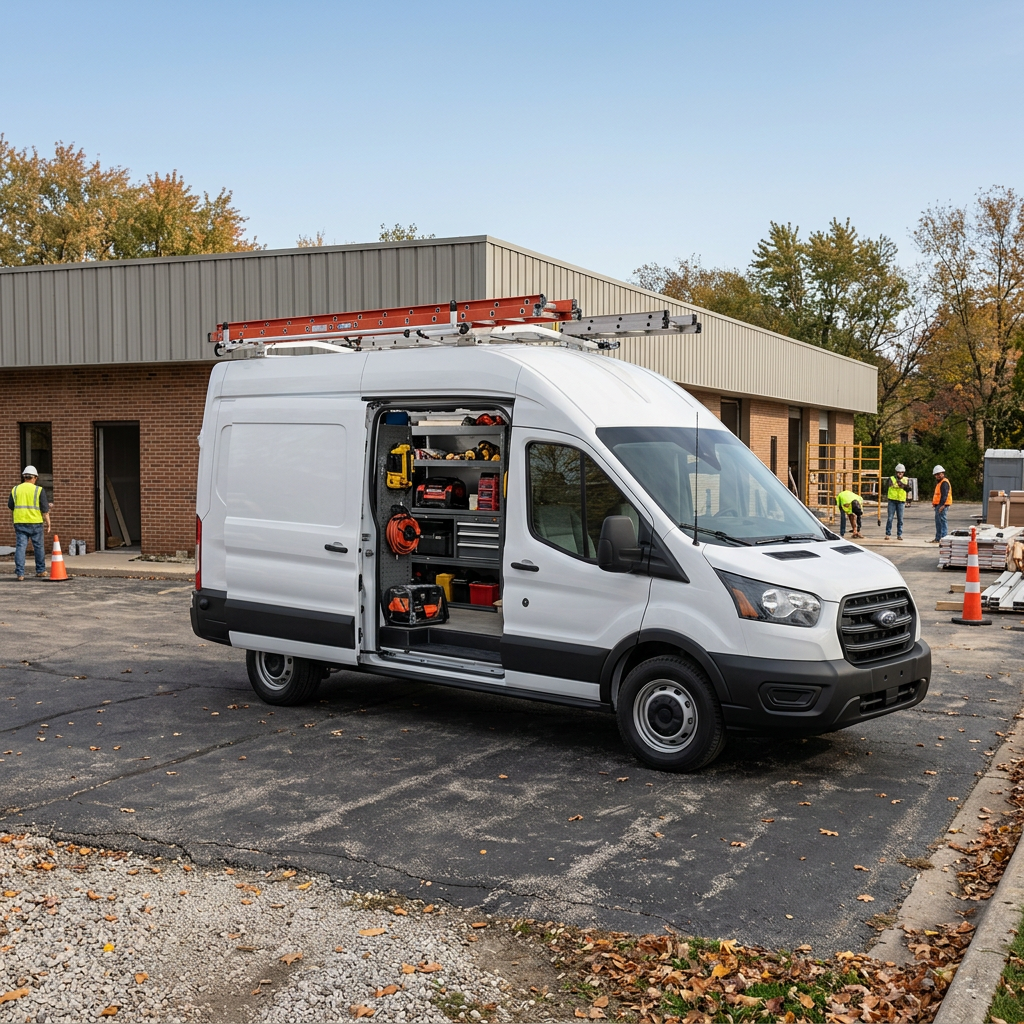
Selecting the proper commercial vehicle for your business in DuPage County is not just about moving goods from point A to point B—it is an investment in daily operational efficiency, crew safety, and long-term asset longevity. When evaluating the 2027 Ford Transit-250, fleet managers and independent contractors must look beyond surface dimensions. Understanding how gross vehicle weight ratings interact with custom upfits, heavy cargo, and high-draw electrical equipment like air compressors, battery chargers, and power tools is the key to preventing premature wear on suspension components, brakes, and electrical systems. At Hawk Ford of Carol Stream, we work closely with local tradespeople—from plumbing contractors in West Chicago to electrical specialists in Carol Stream—to configure vehicles engineered specifically for their daily duty cycles. Whether your business requires a high-roof layout for standing workspace or specialized auxiliary power configurations, the 2027 Transit-250 offers unprecedented flexibility across multiple body lengths and powertrain options.
| Specification / Feature |
2027 Ford Transit-250 Baseline |
Heavy-Duty Commercial Upgrade Options |
| Gross Vehicle Weight Rating (GVWR) |
9,070 lbs. |
Configurable axle & suspension packages |
| Maximum Net Payload |
~3,300 lbs to ~4,000 lbs (varies by trim) |
Optimized with Low Roof & Regular Body |
| Alternator Output |
Single 250-Amp Heavy-Duty |
Dual 250-Amp Alternators (500-Amp total) |
| Battery Setup |
Single 70 Ah AGM Battery |
Dual Heavy-Duty AGM Batteries (70 Ah each) |
| Onboard Exportable Power |
Standard 12V / USB Ports |
Pro Power Onboard 2.4kW Outlets (E-Transit / Selected Trims) |
| Engine Options |
3.5L PFDi V6 (275 hp / 262 lb-ft) |
3.5L EcoBoost V6 (310 hp / 400 lb-ft) |
What is the Gross Vehicle Weight Rating (GVWR) and Cargo Capacity of the 2027 Ford Transit-250?
Understanding GVWR and Net Payload Mathematics
The 2027 Ford Transit-250 operates with a maximum Gross Vehicle Weight Rating (GVWR) of 9,070 lbs. The GVWR represents the maximum allowable total weight of the vehicle when fully loaded—including the van’s curb weight, driver, passengers, fluids, interior shelving, tools, and cargo.To calculate your true usable net payload, subtract the vehicle’s unladen curb weight from 9,070 lbs. Depending on whether you choose a Low, Medium, or High Roof configuration—and select Regular, Long, or Extended body lengths—curb weights typically range between 4,800 lbs and 5,700 lbs. Consequently, max payload ratings hover between 3,300 lbs and 4,000 lbs. Commercial buyers must account for permanent upfits (such as steel racking or partition bulkheads) as part of the vehicle’s base weight to avoid illegal overloading and excessive tire or brake strain.
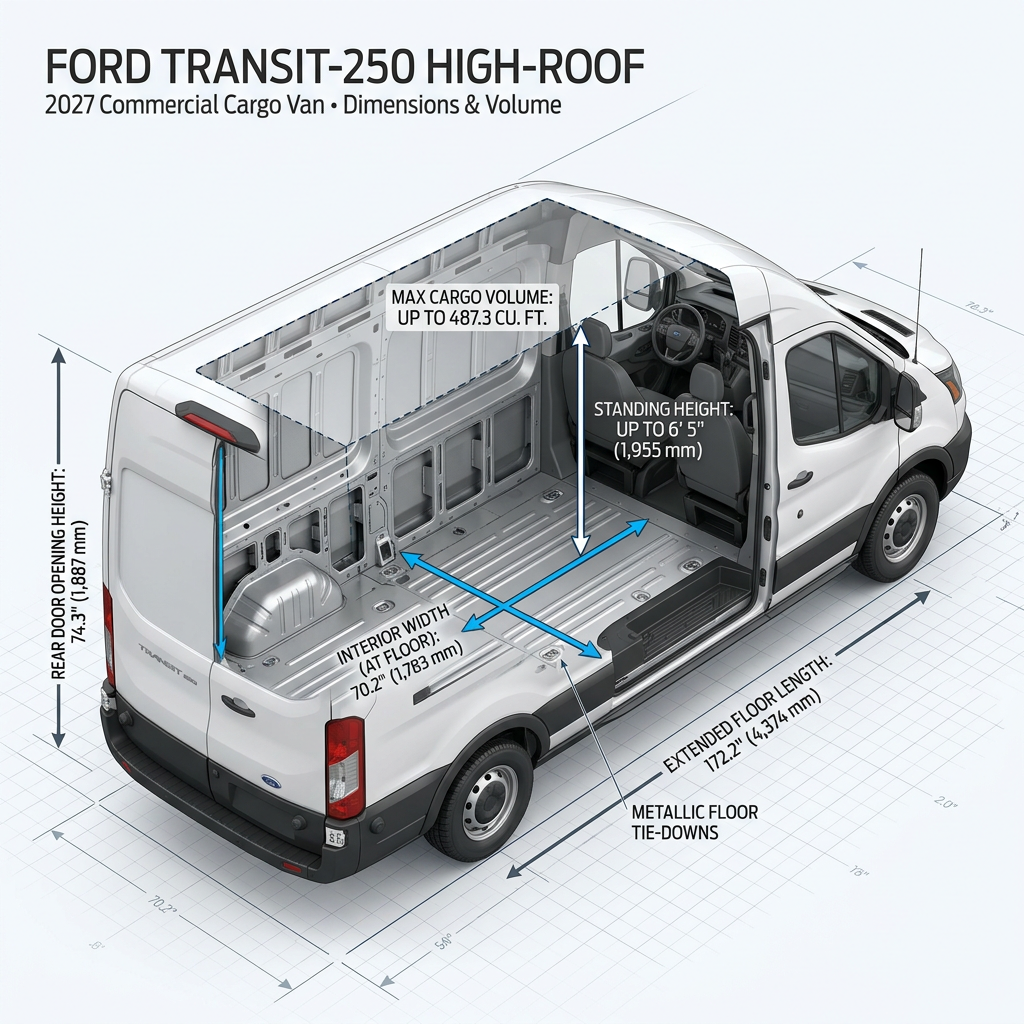
Usable Cargo Volumes Across Roof Configurations Cargo volume expands dramatically based on roof height: • Low Roof:~247 cu. ft. cargo volume (fits standard garage doors, max payload priority). • Medium Roof:~315.2 to 357 cu. ft. (allows 5’11” standing height for technicians). • High Roof: Up to 487 cu. ft. on Extended Length models (allows 6’5″ standing room for mobile workshops).
Choosing the right combination ensures optimal volumetric capacity without exceeding rear axle load capacities when transporting heavy equipment or bulk materials across West Chicago corridors.
Evaluating Alternator Output, Dual Batteries, and Auxiliary Power Options for On-Site Equipment
Single vs. Dual 250-Amp Alternator Configurations Modern commercial vans function as mobile command centers. The standard single 250-amp alternator on the 2027 Ford Transit-250 provides adequate amperage for standard lighting, infotainment, and basic battery maintenance. However, for work vans equipped with high-amp draw equipment—such as commercial inverter systems, auxiliary heating units, or continuous power tool charging stations—the available Dual 250-Amp Alternators system delivers a staggering 500 amps of total charging capacity.
This dual-alternator setup rapidly replenishes auxiliary battery banks while engine idling, preventing voltage drops that can damage sensitive field electronics or leave crews stranded with depleted starter batteries.
Dual AGM Batteries and Auxiliary Fuse Panels
To complement high-output alternators, Ford offers heavy-duty dual AGM (Absorbed Glass Mat) batteries providing 70 Ah each (140 Ah total reserve capacity). AGM batteries handle deep electrical cycling and extreme Midwest winter cold significantly better than traditional flooded lead-acid batteries.Furthermore, adding the optional Ford factory auxiliary fuse panel provides pre-wired connection points and programmable switches. This eliminates invasive, unapproved wiring taps into primary harnesses, preserving factory electrical warranties while providing clean 12V circuits for interior workspace lighting, strobe safety beacons, and exterior work lights.
Pro Power Onboard and Electrified Options: Is the All-Electric Ford E-Transit Right for Your Work Routes?
2.4kW Pro Power Onboard
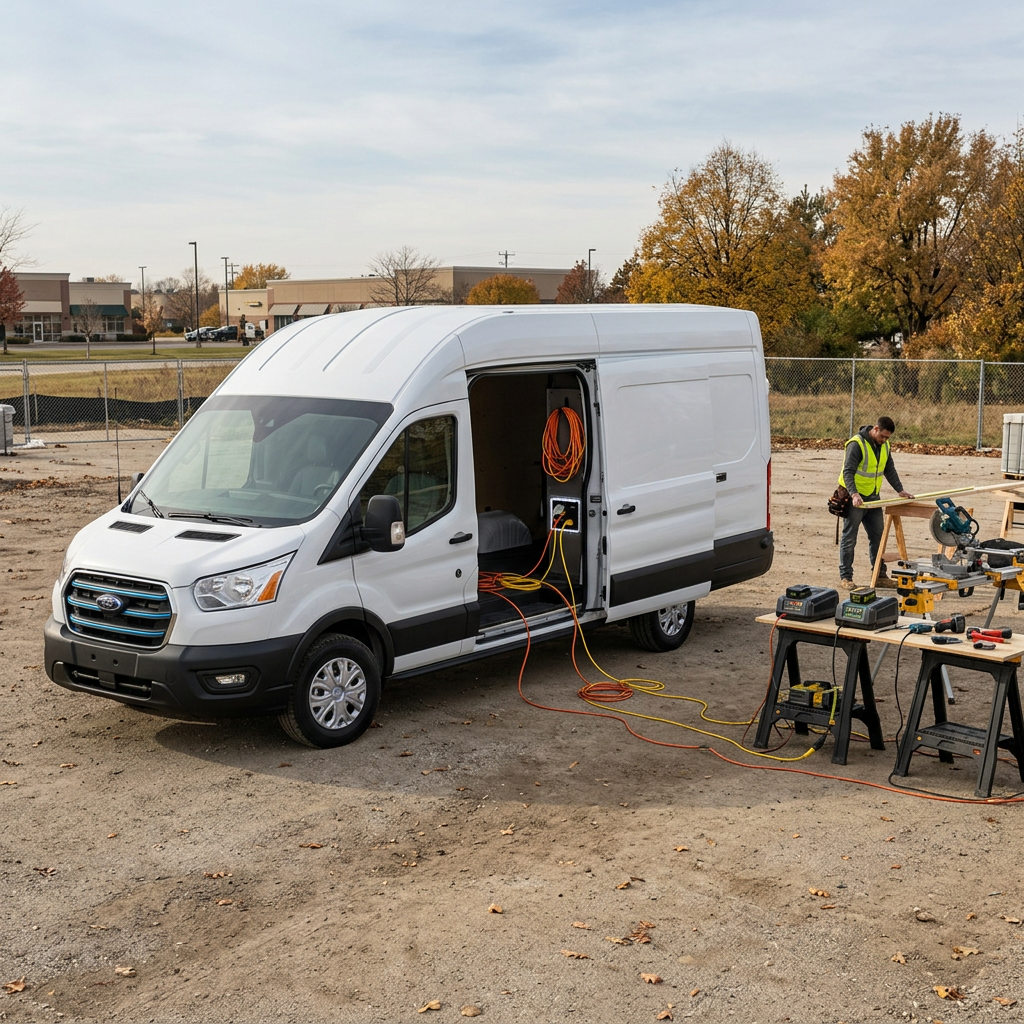
Ford’s integrated Pro Power Onboard system turns your van into a mobile generator delivering up to 2,400 watts of clean 120V electrical export power. Contractors can operate miter saws, circular saws, air compressors, and battery chargers directly from outlet taps in the cargo area without lugging gas generators or smelling exhaust fumes on job sites.
E-Transit Driving Range
For local service companies, urban delivery fleets, and trades operating within DuPage and Cook counties, the zero-emission Ford E-Transit offers estimated driving ranges between 159 to 186 miles (depending on battery pack configuration and cargo payload). Overnight depot Level 2 charging ensures full operational readiness each morning.
Federal Commercial EV Incentives
Commercial purchasers of qualified zero-emission work vans in 2026 and 2027 may benefit from federal commercial clean vehicle tax credits under Internal Revenue Code Section 45W (up to $7,500 per eligible commercial EV vehicle), substantially lowering initial acquisition costs for modernizing fleets.
How Does the Ford Transit-250 Compare to the Mercedes-Benz Sprinter 2500 for Commercial Fleet Buyers?
When evaluating commercial cargo vans in the 250/2500 class, fleet decision-makers frequently compare the Ford Transit-250 against the Mercedes-Benz Sprinter 2500. While both platforms present capable work solutions, key differences in initial purchase cost, routine maintenance accessibility, electrical export options, and powertrain availability make the Transit-250 the preferred choice for many Midwest fleets.
| Evaluation Category |
2027 Ford Transit-250 |
Mercedes-Benz Sprinter 2500 |
| Base Powertrain |
3.5L Gasoline V6 (275 hp) / 3.5L EcoBoost (310 hp) |
2.0L 4-Cylinder Turbo Diesel (170-211 hp) |
| All-Wheel Drive System |
Intelligent AWD (Automatic Torque-on-Demand) |
Electronic AWD / 4MATIC System |
| Exportable Auxiliary Power |
Pro Power Onboard (2.4kW Outlets available) |
Aftermarket Inverter Required |
| Service & Parts Availability |
Widespread nationwide Ford commercial network |
Specialized dealer network with higher shop rates |
| Estimated Initial Purchase Cost |
Highly competitive starting price point |
Premium luxury commercial price premium |
Total Cost of Ownership & Upkeep
The Sprinter 2500 utilizes diesel powertrains that require specialized diesel exhaust fluids (DEF), expensive fuel filter intervals, and specialized service facilities. In contrast, the Ford Transit-250 features responsive gasoline engines (3.5L PFDi and 3.5L EcoBoost) that run on standard regular unleaded fuel, drastically simplifying fueling routines for multi-driver fleets and reducing lifetime maintenance overhead.
Local Fleet Service Convenience
Accessing fast, dedicated fleet maintenance is essential to minimizing downtime. Hawk Ford of Carol Stream provides commercial service bays, factory-certified master technicians, and readily available OEM parts. This localized support network guarantees faster turnaround times for scheduled maintenance compared to imported commercial brands with limited regional service footprints.
Matching Engine Powertrains and Axle Ratios to Your Daily Hauling Requirements
3.5L PFDi V6 vs. 3.5L EcoBoost V6 Performance Ford offers two proven engine choices for the 2027 Transit-250: • 3.5L PFDi V6: Generates 275 horsepower and 262 lb-ft of torque. Utilizing dual port-fuel and direct-injection, this naturally aspirated engine is ideal for light-to-medium delivery operations, urban service routes, and low-maintenance longevity. • 3.5L EcoBoost V6: Delivers a muscular 310 horsepower and 400 lb-ft of low-end torque. Twin turbochargers deliver immediate throttle response under maximum gross loads or when pulling heavy trailers up steep highway gradients.
Both engines are paired with Ford’s smooth-shifting 10-speed SelectShift automatic transmission, optimizing engine RPMs for fuel economy and torque output.
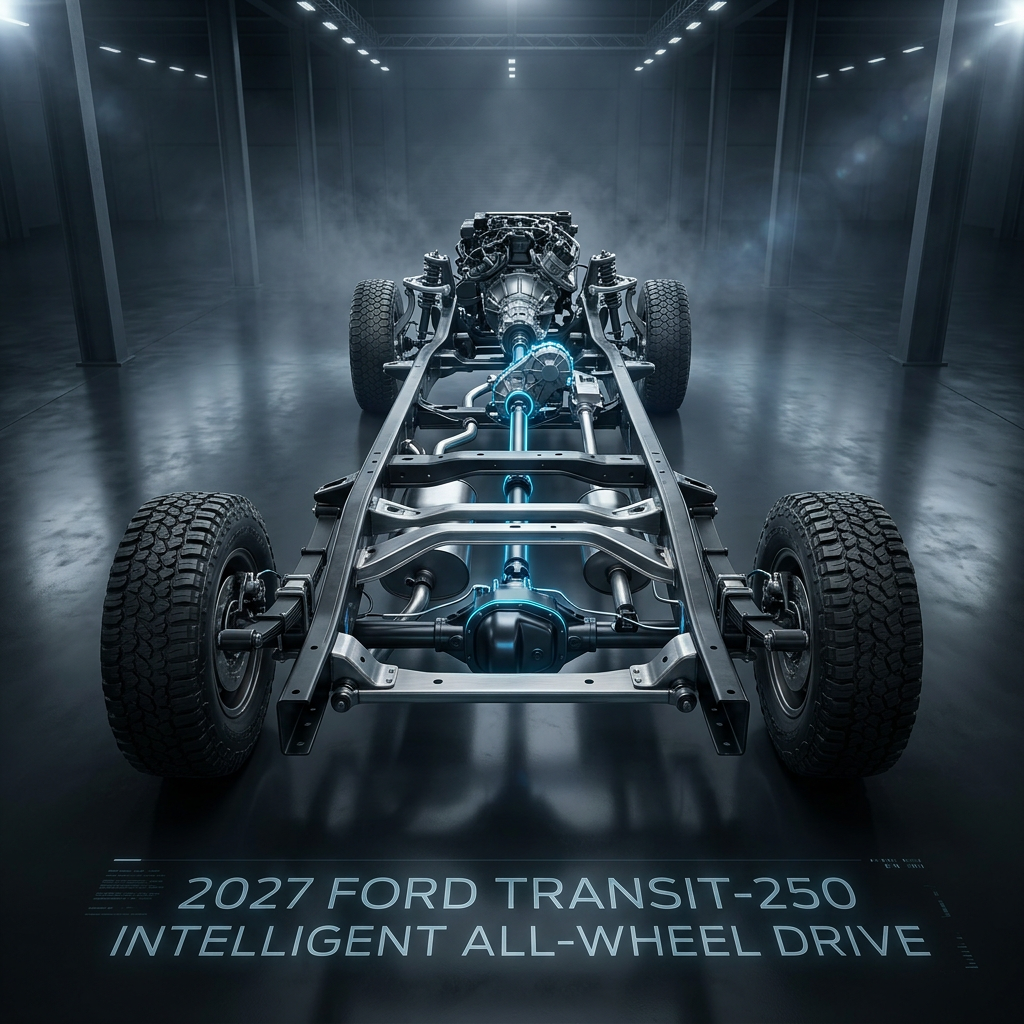
Intelligent AWD & Axle Ratio Selection Navigating Northern Illinois winters demands superior vehicle stability. Ford’s available Intelligent All-Wheel Drive (AWD) continuously monitors road traction, proactively transferring power to front wheels before slippage occurs without increasing load floor height. Selecting the proper rear axle ratio is equally critical: • 3.73 Axle Ratio: Excellent balance of highway fuel efficiency and suburban towing power. • 4.10 Axle Ratio (with Limited-Slip): Essential for heavy payloads, steep grades, and maximum low-end launching capability on unpaved construction sites.
What Are the Estimated Maintenance Costs and Service Requirements for a Commercial Ford Transit Fleet?
Preventive Maintenance Schedule
Routine oil changes using Motorcraft synthetic blend motor oil every 7,500 to 10,000 miles help protect internal engine components. Multi-point inspections during service visits ensure fluid levels, belts, and filters remain optimal for high-mileage commercial operation.
Brake & Tire Wear Management
Heavy cargo weights increase friction wear on brake pads, rotors, and heavy-duty load-range C/E tires. Regular tire rotations and digital brake inspections at Hawk Ford help fleet managers forecast component replacement long before job site breakdowns occur.
Ford Telematics Integration
Integrated Ford Telematics modem hardware provides fleet directors real-time diagnostics, oil life tracking, fuel efficiency analytics, and driver behavior monitoring. Easily
Schedule Service Now online to keep maintenance seamless.
Optimizing Your Fleet: How the 2027 Ford Transit-250 Cargo Van Serves West Chicago and Carol Stream Businesses
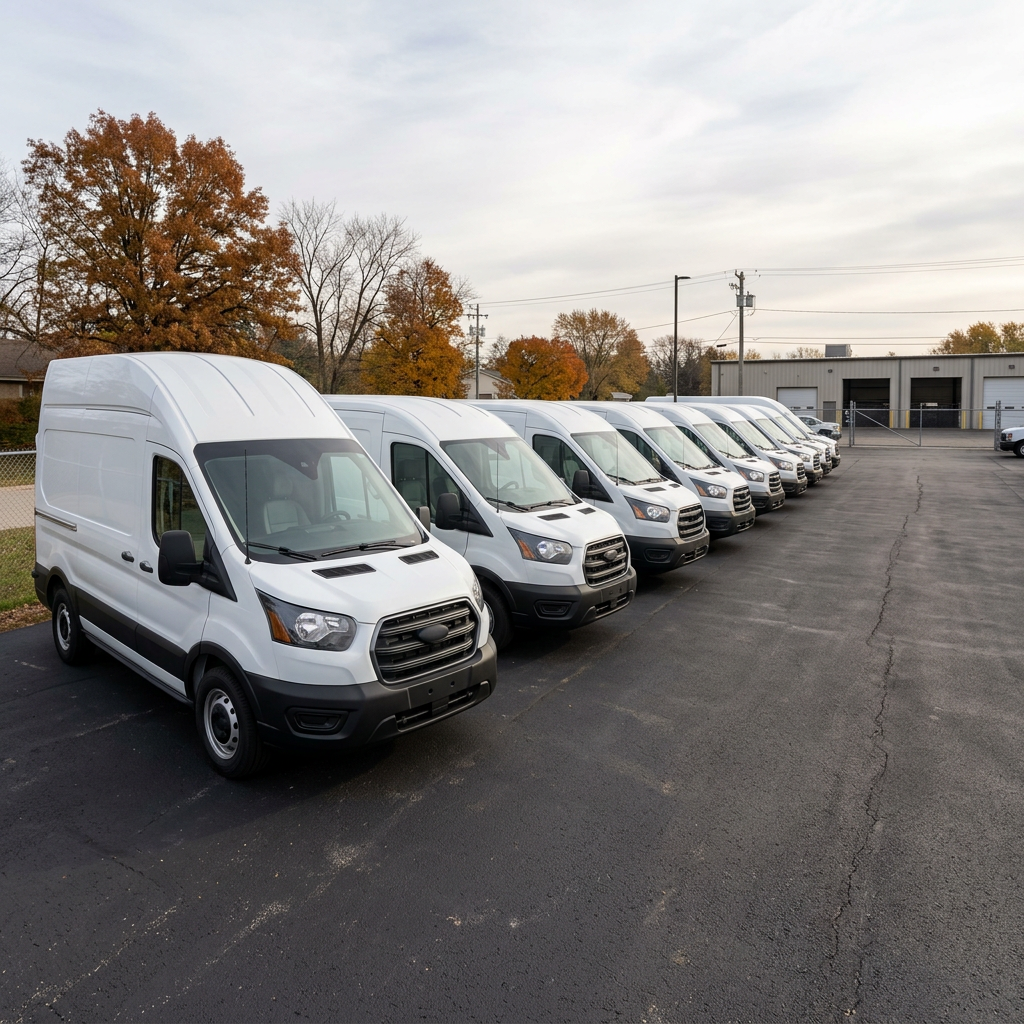
Navigating the industrial corridors and residential developments of DuPage County requires a fleet vehicle engineered for versatility. Commercial operations traveling along North Avenue (Route 64), Gary Avenue, and Army Trail Road encounter a distinct mix of heavy stop-and-go traffic, variable weather conditions, and diverse customer demands. The 2027 Ford Transit-250 stands out as the ideal platform for local business operations:
• HVAC & Plumbing Contractors: Extended high-roof configurations allow technicians to transport 10-foot copper pipe bundles, water heaters, and heavy recovery tanks in organized vertical racks, while maintaining standing workspace inside the cargo bay. • Electrical & Telecom Trades: Utilizing the dual 250-amp alternator package and interior auxiliary power panels, local electricians run specialized testing equipment, wire spools, and battery charging racks without depleting the starting battery. • Parcel & Last-Mile Delivery: The available low step-in height, power sliding side doors, and 270-degree swing-open rear doors drastically reduce operator fatigue and accelerate unloading speeds on busy suburban delivery routes in Carol Stream, Bloomingdale, and Glendale Heights.
Customizing Your Interior: Racking, Upfitting, and Weight Distribution Best Practices
Racking Systems and Proper Weight Distribution
Installing modular steel or lightweight aluminum racking systems drastically improves tool organization, but improper upfit layout can negatively alter vehicle handling. Heavy items—such as portable generators, hardware bins, and compressor units—should always be mounted low to the floor and centered over the rear axle.Uneven side-to-side weight distribution can cause uneven tire wear, compromised braking stability, and unwanted body roll during high-speed cornering along I-355. Always factor the total weight of empty upfit racks (typically 300 to 700 lbs) into your total payload budget before loading tools.
Ford Pro Upfit Integration System (UIS)
The 2027 Ford Transit features the advanced Ford Pro Upfit Integration System (UIS). This innovative module enables upfitters and fleet operators to program aftermarket equipment—such as exterior liftgates, safety warning strobes, and boom lifts—directly into the vehicle’s SYNC 4 touchscreen interface.UIS eliminates the need to cut factory wires or install unsightly aftermarket rocker switches on the dashboard. It also allows safety interlocks, such as preventing an exterior liftgate from operating unless the transmission is safely locked in Park.
Fleet Financing, Commercial Tax Incentives, and Trade-In Upgrades in DuPage County
Section 179 Tax Deductions
Under IRS Section 179, qualifying businesses can expense up to 100% of the purchase cost of eligible new and used commercial vehicles like the Transit-250 in the year placed into service, significantly accelerating tax savings for local business owners.
Commercial Lines of Credit
Hawk Ford offers tailored Ford Credit commercial financing products, including TRAC Leases, municipal finance, and dedicated Commercial Lines of Credit (CLOC) that preserve your business’s bank credit lines for daily operational cash flow needs.
Fleet Trade-In Valuations
Upgrading aging work vans to modern 2027 Transit models reduces fuel overhead and repair costs. Easily evaluate your current commercial assets online to
Value Your Trade toward your new fleet purchase.
Checklist for Assessing Your Commercial Van Specifications Before Purchase
Before placing your 2027 Ford Transit-250 order, review this practical decision-making audit checklist with your fleet management team:
1. Payload Audit: Have you calculated the weight of all drivers, passenger crews, permanent shelving, partitions, and maximum expected cargo payload to stay under 9,070 lbs GVWR? 2. Electrical Draw Evaluation: Will your crew run high-wattage power tools or heavy equipment on job sites? If yes, specify the Dual 250-Amp Alternators and Dual AGM Battery options. 3. Roof Clearance Needs: Do your operations require crew members to stand upright inside the van (Medium/High Roof), or must the van park inside standard 7-foot commercial parking garages (Low Roof)? 4. Traction & Driving Terrain: Will the vehicle operate in snow, unpaved construction sites, or muddy utility access roads? Consider ordering Intelligent All-Wheel Drive (AWD). 5. Power Outlet Requirements: Can your operations benefit from replacing portable gasoline generators with Ford’s built-in 2.4kW Pro Power Onboard exportable power system? 6. Racking & Upfit Integration: Have you consulted with certified upfitters to ensure your custom shelving mounts safely into factory pre-drilled hardpoints without damaging wiring harnesses? 7. Fuel & Engine Selection: Does your route profile favor the efficient standard 3.5L PFDi V6, or do heavy loads/towing demand the high-torque twin-turbo 3.5L EcoBoost V6? 8. Fleet Telematics Readiness: Have you set up Ford Telematics accounts to track preventive maintenance schedules, driver safety metrics, and real-time GPS fleet locations?
Test Drive and Upfit Your 2027 Ford Transit-250 Commercial Van at Hawk Ford of Carol Stream
Ready to build or expand your commercial fleet with the industry’s leading work van? The dedicated commercial vehicle team at
Hawk Ford of Carol Stream is here to assist you through every step of the process—from spec selection and interior upfit design to commercial financing and master technician service maintenance. Visit our commercial vehicle center today at 175 North Ave, Carol Stream, IL 60188. Click here to
Get Directions to Hawk Ford of Carol Stream or
Call us at (630) 233-9696 to speak directly with a commercial fleet specialist. Discover how the 2027 Ford Transit-250 can drive productivity and lower your operational costs today!




0 comment(s) so far on 2027 Ford Transit-250 Commercial Fleet Guide